Durable Execution for Long-lived Agents: Reliability Infrastructure That Holds
A long-lived agent has a problem that a quick one does not: it operates long enough for things to fail during its execution. A task that takes seconds either completes or fails cleanly, and a task that operates for minutes, hours, or across many steps and waits will, over that duration, encounter failures, a process crash, a machine restart, a dependency timeout, an interruption, and an agent without durable execution loses everything when that happens. Durable execution for long-lived agents is the reliability infrastructure that lets an agent’s execution survive the failures that occur during a long operate, resuming rather than restarting, and it is what makes long-lived agents reliable enough to operate. The longer an agent operates, the more it needs execution that holds through failure.
If you operate long-lived agents, the duration is the source of the reliability problem, because a long operate is a long window in which failures happen, and an agent whose execution does not survive those failures is an agent that cannot reliably complete a long task. The infrastructure that makes execution durable, surviving crashes and interruptions by persisting the execution state and resuming from where it was, is what turns a long-lived agent from something that fails whenever its long operate is interrupted into something that completes reliably despite interruptions. Building durable execution is what makes long-lived agents operable, because without it the duration that defines them is the duration in which they fail.
Why duration creates a reliability problem

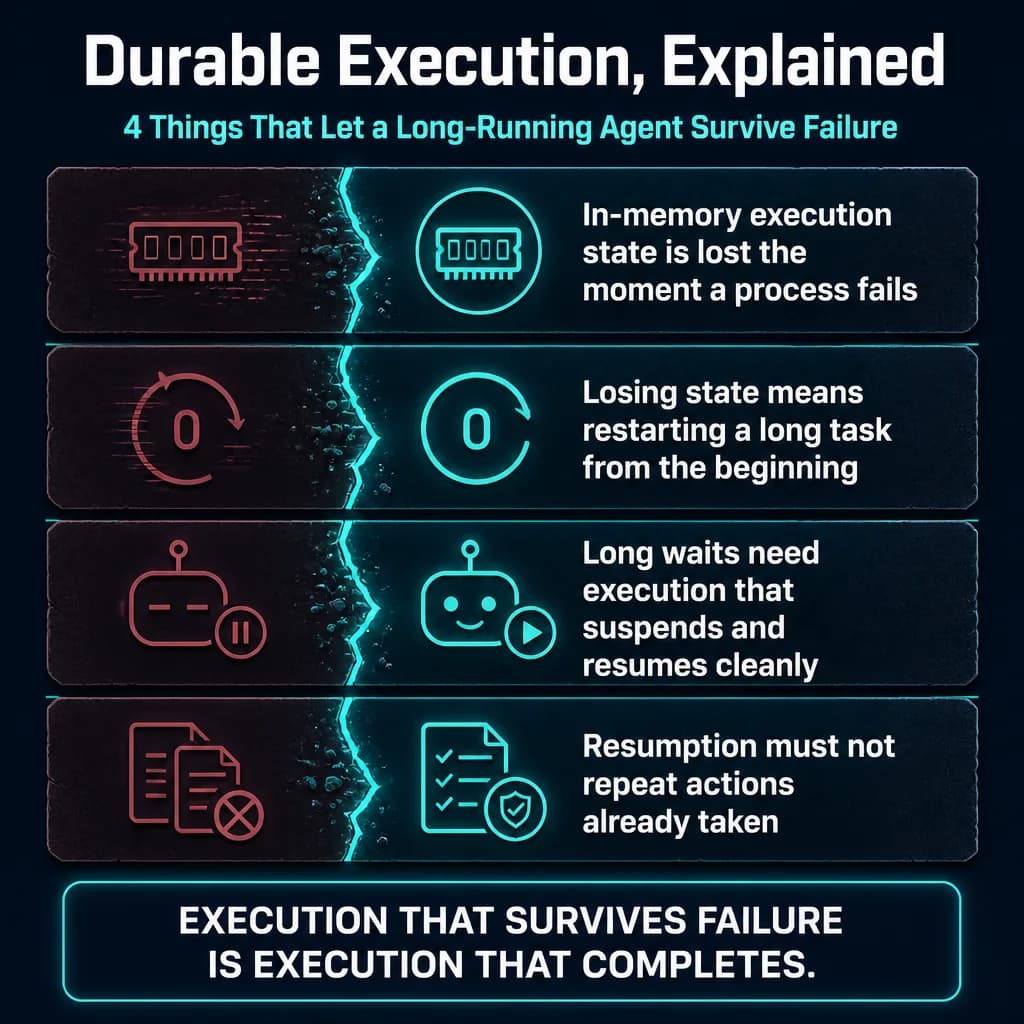
A long-lived agent’s execution spans a duration in which failures occur, and this is the fundamental difference from a quick agent. Over minutes or hours or many steps, the process operating the agent can crash, the machine can restart, a dependency can fail, or the execution can be interrupted, and these are not rare events over a long duration but expected ones, because the longer the execution operates, the more likely it is to encounter one. An agent whose execution state lives only in the operating process loses that state when the process fails, which means a failure partway through a long operate loses all the work up to that point, and the agent cannot resume because the state that would let it resume is gone.
This is the state management problem at the level of the entire execution, and its consequence for long-lived agents is severe: an agent that loses its execution on failure has to restart the long task from the beginning, which for a genuinely long task may mean the task never reliably completes, because the probability of an uninterrupted pass over a long duration is low, and every interruption means starting over. For an agent that also takes side-effecting actions during its long operate, losing the execution is worse, because the actions taken before the failure happened and the record of them is lost, leaving the same unknown, unrecoverable state that in-memory state produces. The duration creates the reliability problem because it is the window in which failure happens, and an agent whose execution does not survive failure cannot reliably operate long.
How durable execution holds through failure
Durable execution makes the agent’s execution survive failure by persisting the execution state durably, so that a failure does not lose the execution but suspends it, and the execution can resume from its persisted state when the failure is resolved. The execution state, where the agent is in its task, what it has done, what it was about to do, is persisted as the agent operates, so that a crash or interruption leaves the state intact in durable storage rather than losing it with the process, and the agent’s execution can be resumed from that persisted state, continuing from where it was rather than restarting. This is what turns a failure during a long operate from a lost task into a suspended one that resumes.
Durable execution builds on checkpointing and durable state and extends them to the whole execution, so that the entire long-lived execution is durable, surviving crashes and resuming, rather than only specific state being checkpointed. It handles the asynchrony of long waits too, because a long-lived agent that waits, for an approval, for an external event, for a long operation, has its execution suspended during the wait and resumed when the wait ends, which requires the execution to be durable across the wait, and durable execution provides exactly this. For side-effecting actions, durable execution maintains the consistency between the execution state and the real-world effects, recording what the agent did durably so that resumption does not repeat completed actions, which is what makes resuming safe rather than a source of duplicate actions. Durable execution is the infrastructure that makes the whole long-lived execution survive failure, resume cleanly, and stay consistent, which is what long-lived agents require to be reliable.
The trade-off, and matching infrastructure to duration
Durable execution is substantial infrastructure, and naming its cost is what keeps it matched to the agents that need it. Persisting execution state durably, resuming from it, handling the consistency of side-effecting actions across resumption, and managing long waits is real infrastructure with real overhead in storage, latency, and engineering, more than operating an agent whose execution lives in memory and hoping it completes. This cost is justified for genuinely long-lived agents, where the duration makes failure during execution expected and the infrastructure is what makes reliable completion possible, and it is over-engineering for a quick agent that completes before failures are likely, which does not need its execution to survive a failure that will rarely interrupt it.
Matching the infrastructure to the agent’s duration is the judgment, because the need for durable execution scales with how long the agent operates and how consequential its execution is. A quick, low-consequence agent may not need durable execution, completing reliably enough without it, and a long-lived, consequential agent needs it, because its duration guarantees it will encounter failures and its consequence makes losing its execution costly. Building durable execution for an agent that does not operate long enough to need it wastes the infrastructure, and operating a long agent without it means the agent cannot reliably complete, so the infrastructure should match the duration. This connects to the production readiness of long-lived agents specifically, where durable execution is the reliability infrastructure a long-lived agent needs to be ready, and matching it to the agents whose duration requires it is what makes the investment deliberate rather than uniform.
Where it almost broke
We operated a long-lived agent whose execution lived in the operating process, and for short operates it completed fine, but the genuinely long operates kept failing to complete, because over their duration they encountered the failures that a long operate makes likely, a process restart, a dependency interruption, and each failure lost the entire execution, forcing a restart from the beginning. For the longest tasks this meant they rarely completed, because the probability of an uninterrupted pass over that duration was low, and worse, the agent’s side-effecting actions taken before a failure were left with no clean record, producing the unknown state that made recovery a manual reconstruction. The duration was defeating the agent.
The correction built durable execution. We persisted the agent’s execution state durably as it operated, so a failure suspended the execution rather than losing it, and the agent resumed from its persisted state, continuing from where it was rather than restarting. We handled the consistency of the side-effecting actions across resumption, recording what the agent had done so resumption did not repeat completed actions, and handled the long waits by suspending and resuming the durable execution across them. The long-lived tasks started completing reliably, because their execution now survived the failures that a long operate encounters, resuming through them rather than restarting. The lesson was that duration creates a reliability problem, and durable execution is the infrastructure that lets a long-lived agent’s execution hold through the failures its duration guarantees.
Execution that survives failure is execution that completes
The reframe that makes long-lived agents reliable is building execution that survives the failures a long operate guarantees, resuming through them rather than restarting. Durable execution for long-lived agents is the infrastructure that persists execution state, resumes cleanly through crashes and interruptions, handles long waits, and maintains consistency across resumption, which is what lets a long-lived agent complete reliably despite the failures its duration makes expected. An agent whose execution does not survive failure is defeated by the duration that defines it.
The teams that operate long-lived agents reliably are the ones that built durable execution matched to the agents whose duration required it, persisting execution state, resuming through failure, and keeping side-effecting actions consistent across resumption. A long operate is a long window in which failure happens, and an agent whose execution lives in memory fails whenever that window is interrupted. Building execution that holds through failure, for the agents whose duration guarantees they will encounter it, is what turns a long-lived agent from something defeated by interruption into something that completes reliably despite it.
Related: Agentic AI
Tell us the number you need to move.
…outcomes that survive scrutiny.