Event-Driven Agent Architectures: Triggering Action Without Polling
Most agents are built to wait for a human. A person asks, the agent responds, and the whole architecture assumes a request at the front of every interaction. That assumption quietly caps what agents can do, because a great deal of valuable work is not triggered by someone asking. It is triggered by something happening: a transaction posting, a threshold being crossed, a document arriving, a status changing. Event-driven agent architectures are how agents act on what happens rather than only on what they are asked, and building for events rather than requests changes both the capability and the operational profile of the system.
If you are building agents to do real work in an enterprise, the request-response model is a constraint you may not have noticed you accepted. It confines agents to the tasks a human thinks to initiate, which excludes the large category of work that should happen automatically in response to a condition, without anyone remembering to ask. Moving to event-driven architecture opens that category, and it introduces a set of operational realities that request-response agents never had to handle.
Why request-response caps what agents can do
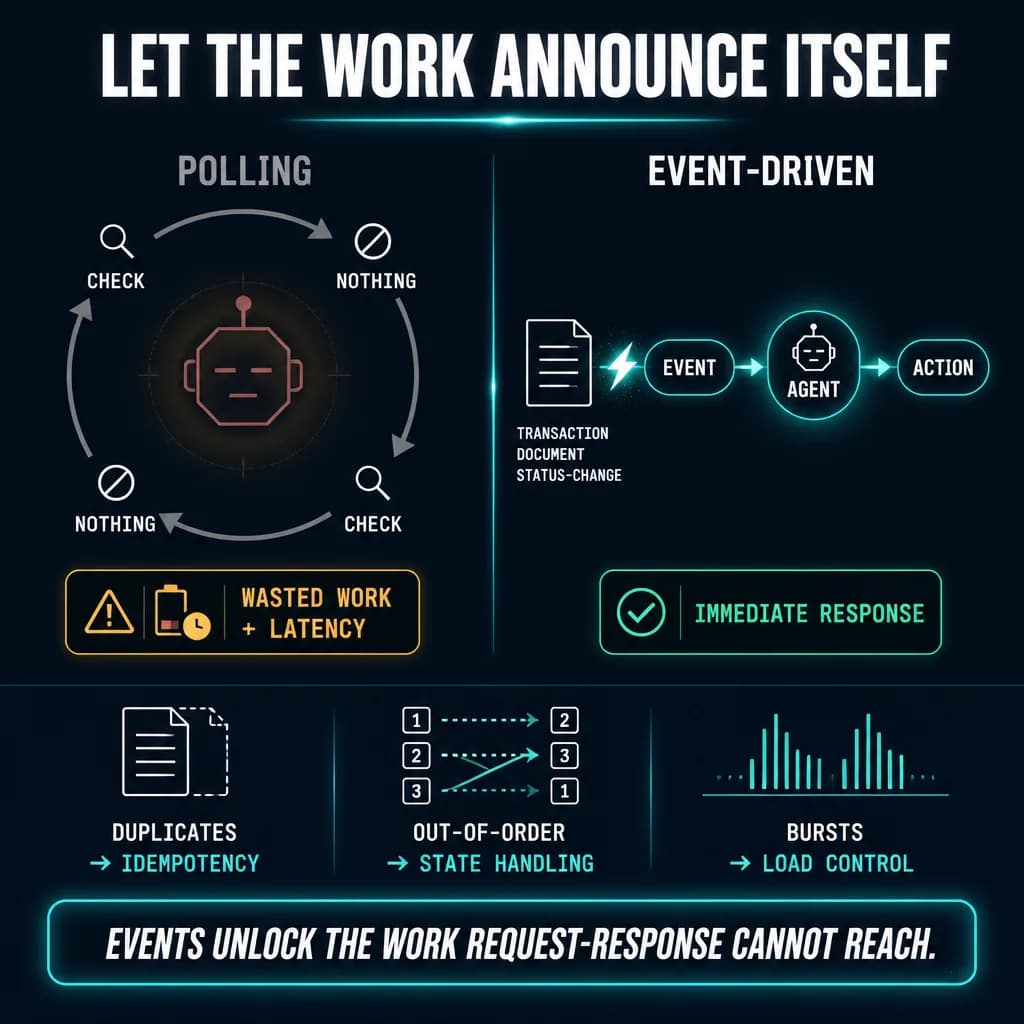
The request-response pattern is intuitive because it mirrors conversation: a human initiates, the agent replies. It also means the agent only ever acts when a human decides to invoke it, which is fine for tasks a person naturally initiates and useless for tasks that should trigger on their own. A great deal of enterprise work is conditional and continuous: when this happens, do that, monitored constantly rather than checked when someone remembers. An agent that can only respond to requests cannot do this work, because the work has no request at the front of it, only a condition that becomes true at some unpredictable moment.
The naive way to bridge this is polling: have the agent repeatedly check whether the condition is met. This works and it is wasteful, because the agent spends most of its checks finding nothing has changed, consuming resources on repeated queries that mostly return the same answer, and introducing latency equal to the gap between polls. Polling every minute means up to a minute of delay before acting and a query every minute regardless of whether anything happened. For work that should respond promptly to conditions that occur unpredictably, polling is the wrong mechanism, and its cost scales badly as you add more conditions to watch.
How event-driven architecture actually works
The alternative inverts the flow. Rather than the agent asking whether something happened, the thing that happens announces itself, and the agent reacts. An event, a transaction posting, a threshold crossing, a document arriving, is emitted by the system where it occurs, and the agent is triggered by that event rather than by a poll or a request. The agent acts when the condition becomes true, immediately, without wasting resources checking and without the latency of a polling interval, because the event drives the action rather than the agent hunting for it.
This is a genuine architectural shift with real consequences. The agent is no longer a thing invoked at the front of an interaction. It is a thing subscribed to events, reacting to what flows through the system, which means it can do the continuous, conditional work that request-response could not reach. It also means the agent’s execution is triggered by external events outside any human’s direct initiation, which raises the operational stakes, because an agent acting autonomously on events needs the bounds, governance, and oversight that an agent acting only on human requests could partly rely on the human to provide. The human at the front of a request-response interaction was, among other things, a check. Event-driven agents remove that check, which makes the engineered guardrails more important rather than less.
The operational realities events introduce
Event-driven architecture brings distributed-systems problems that request-response agents largely avoided, and naming them is how you design for them. Events can arrive out of order, can be duplicated, and can be lost, which are the standard hazards of event-driven systems, and an agent reacting to events has to handle all three. A duplicated event that triggers the agent twice causes a double action unless the agent is idempotent, which is the same idempotency requirement that governs any side-effecting agent, now load-bearing because events will be duplicated in practice. Out-of-order events can cause the agent to act on a stale understanding of state. Lost events mean work that should have happened silently did not.
The operational profile also changes in a way that matters for cost and reliability. Event-driven agents can be triggered by bursts, many events arriving at once when some upstream condition causes a spike, and the system has to handle that burst without falling over or accumulating unbounded cost. An agent triggered per event, hit with a thousand events in a moment, is a thousand executions unless the architecture manages the load, which means backpressure, batching, or rate limiting become necessary rather than optional. And the monitoring problem shifts: instead of watching request-response latency, you are watching event processing, ensuring events are being handled, are not backing up, and are not being silently dropped, which is a different observability discipline. The capability event-driven architecture unlocks is real, and it is paid for with the operational rigour that distributed event processing demands.

Where it almost broke
We built an agent to act on a condition that occurred unpredictably throughout the day, and the first implementation used polling, having the agent check regularly whether the condition had been met. It worked and it was visibly inefficient: the agent spent the overwhelming majority of its checks finding nothing, consuming resources continuously, and still introduced a delay equal to the polling interval before it acted. As we added more conditions to watch, the polling cost multiplied, and the latency was poor for work that should have responded promptly. The mechanism was fighting the nature of the problem.
We moved to an event-driven design, where the systems that produced the conditions emitted events and the agent was triggered by them directly. The agent now acted the moment the condition became true, without the wasted checks and without the polling delay. The move surfaced exactly the distributed-systems realities we expected: we made the agent idempotent so duplicated events could not cause double actions, handled out-of-order arrival so the agent did not act on stale state, and added load management so a burst of events could not accumulate unbounded executions. The capability improved substantially and the operational discipline required went up to match. The lesson was that events unlock the continuous, conditional work request-response cannot reach, and they bring the full weight of event-driven systems engineering with them.
Let the work announce itself
The reframe that expands what agents can do is moving from agents that wait to be asked to agents that react to what happens. Event-driven agent architectures reach the continuous, conditional work that request-response never could, by letting the event trigger the action rather than requiring a human or a poll to initiate it. The capability gain is genuine, and it comes attached to the operational realities of operating a distributed event-driven system.
The teams that build agents doing real autonomous work are the ones that moved past the request-response assumption and engineered for events properly, handling duplication with idempotency, out-of-order arrival with careful state management, and bursts with load control. An agent that only acts when asked is limited by what humans remember to ask. An agent that acts on events does the work that should happen on its own, and building it well means accepting the distributed-systems discipline that event-driven action requires.
Related: Agentic AI
Tell us the number you need to move.
…outcomes that survive scrutiny.