EVIO, Explained: Voice AI That Sounds Human and Holds Up Under Compliance
Voice is the hardest channel to automate well, and the reason is that a phone call gives a system nowhere to hide. In text, a slightly awkward response is tolerable and a delay is invisible. On a call, a person hears every unnatural pause, every talk-over, every moment the system misses what they said, and they react to it in real time. A voice system that is even slightly off does not just underperform. It frustrates the person on the line and, in a regulated conversation, it can breach the rules governing what may be said and how. Sounding human and holding up under compliance are two demands that pull in different directions, and meeting both is what makes voice genuinely hard.
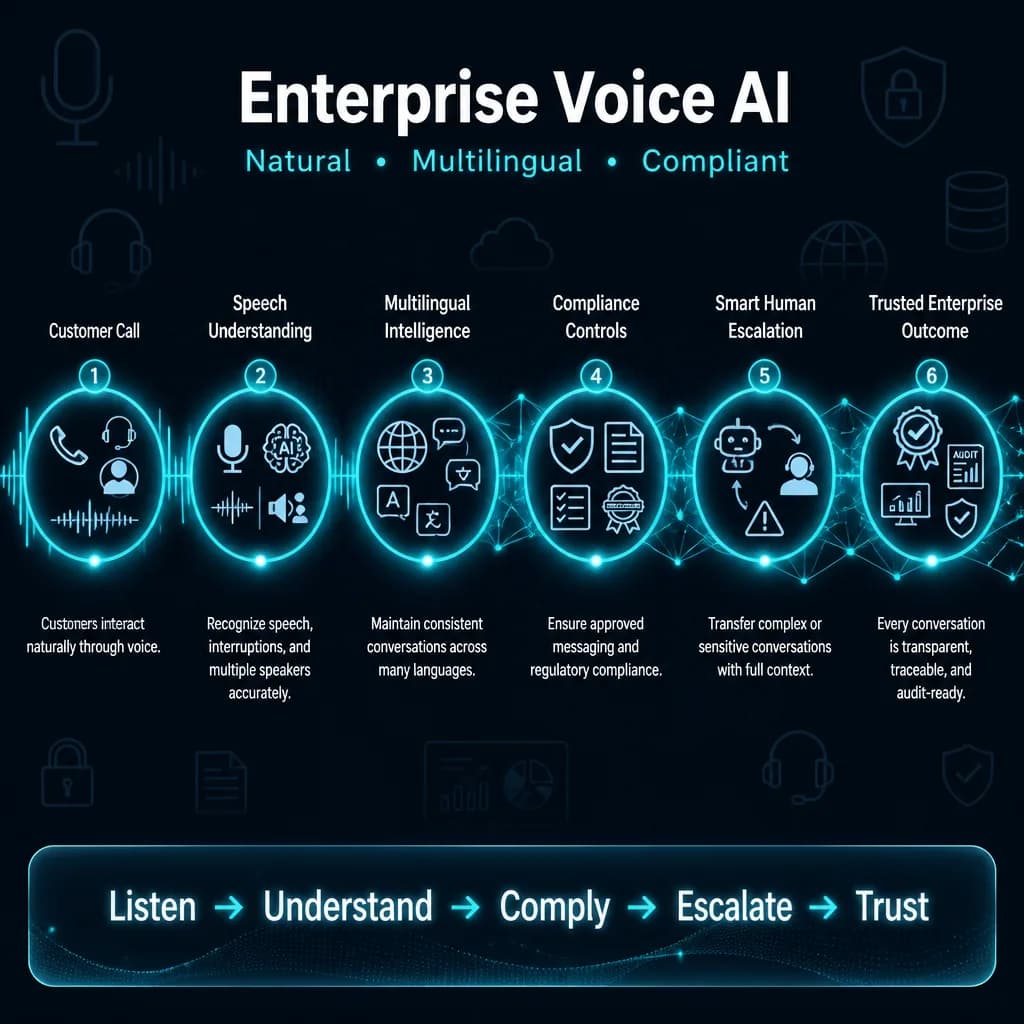
This is the problem EVIO is built to solve, and it is worth separating the two halves, because most voice systems manage one and fail the other. Sounding human means handling a real conversation: turn-taking, interruptions, background noise, the messy way people actually speak, across many languages. Holding up under compliance means every call stays within the rules, discloses what it must, avoids what it must not, and can be audited afterward. A system that sounds natural and says the wrong thing is a liability. A system that is compliant and robotic gets abandoned by the people it was meant to serve. EVIO is engineered to be both at once.
What “sounds human” actually requires

The naturalness of a voice interaction is not about the voice itself. It is about the conversation. People interrupt, change their minds mid-sentence, talk over each other, pause, and speak against background noise. A system that expects clean, turn-based speech falls apart on the first real call, because real calls are never clean. Sounding human means managing the actual dynamics of human conversation, and that is a real-time engineering problem.
EVIO handles inbound and outbound calls in more than fifteen languages with a natural, human-like voice, managing turn-taking, speaker separation, and noise in real time. When a caller interrupts, the system yields the way a person would. When two people speak, it separates them. When the line is noisy, it copes. This is the difference between a call that feels like a conversation and one that feels like fighting with a machine, and it is decided by how the system handles the parts of speech that are hard, not the parts that are easy.
The multilingual dimension matters here in a way that goes beyond convenience. For many of the people an enterprise serves, especially in the markets that are underserved by digital channels, a conversation in their own language, over a voice call, is the only accessible way to reach the service at all. Voice that works across languages is not a nicety in those settings. It is the difference between access and exclusion.
What “holds up under compliance” actually requires
The compliance half is where most natural-sounding voice systems fail, because the freedom that makes a conversation feel human is the same freedom that lets it stray outside the rules. A regulated conversation, a collection call, a financial disclosure, a health-related interaction, is governed by what has to be said, what cannot be said, and how the person must be treated. A system improvising freely to sound natural is a system that can improvise its way into a breach.
So EVIO’s conversational freedom is bounded by the rules of the context it operates in. It works from approved messaging, keeps required disclosures, and stays within the conduct limits of the conversation, and every call is logged so the interaction can be audited afterward. The naturalness operates inside the compliance boundary rather than at the expense of it, which is the specific engineering that lets a voice system be both fluent and safe.
The load-bearing control is the handover. EVIO handles the conversations it is competent and permitted to handle, and it escalates to a person the moment a call needs one, a distressed caller, a request outside its bounds, a situation that calls for human judgement, passing the context along so the person can take over cleanly. That boundary, engineered with a defined trigger, is what lets the system operate continuously without operating past the point where a human should have taken the call.
Where it almost breaks, and the trade-off
The near-miss to design against is the system that sounds so natural it is trusted to handle a call it should have escalated, pushing confidently through a conversation that turned sensitive or moved outside its rules. The fluency masks the problem, because the call sounds fine right up until the breach. The correction is to make the escalation sensitive to distress, ambiguity, and any drift outside the approved path, so the system yields before it strays, and to keep the compliance boundary hard so naturalness never buys its way past a rule.
The trade-off is that a voice system bounded this way handles fewer edge cases autonomously than one allowed to improvise freely. It escalates more, and it resolves less on its own in the genuinely ambiguous cases. In a regulated conversation that is the correct trade, because the cost of an unbounded voice agent is measured in conduct breaches and eroded trust, and the value of a bounded one is a conversation that is both humane and defensible.
EVIO is voice AI engineered to be natural and compliant at the same time, handling the messy reality of human conversation across languages while staying inside the rules and yielding to a person when a call needs one. The value is a voice channel that people are willing to use and that an enterprise can defend, which is a combination most voice systems never achieve. An operator operating voice in regulated settings builds the naturalness and the compliance boundary together from the start, because a fluent voice agent that can breach a rule is a liability and a compliant one that people hang up on is a waste, and only voice that is both human and bounded produces outcomes that survive scrutiny.
Related: Evio, Voice Operator - PYZO · About Us · Reserve Bank Innovation Hub: Automated grievance workflows with natural-language access and a complete audit record · Government of Odisha: Unified knowledge sources retrieved through natural-language queries in twelve languages
Tell us the number you need to move.
…outcomes that survive scrutiny.