Explainability by Design: Making Every AI Decision Defensible to an Auditor
An auditor does not ask whether your model is accurate. An auditor picks one decision, often months old, and asks you to account for it: what inputs produced it, what logic connected them, what controls governed the process, and who was responsible. Many enterprise AI systems that perform beautifully in aggregate cannot answer that question about a single specific case, and the moment they cannot, their accuracy stops mattering. An unexplainable decision is an indefensible one, and in a regulated setting indefensible decisions are liabilities regardless of how well the system scores.
This is why explainability by design is a requirement rather than a feature, and why it has to be engineered into a system from the start. Explainability recovered after the fact is usually explainability invented after the fact, a plausible story reconstructed to fit a decision whose real basis was never recorded. An auditor can tell the difference, and a regulator certainly can. The only explainability that holds is the kind produced as the decision is made and preserved exactly as it was, and that is an architectural property, not an analysis you operate later.
What an auditor actually tests

It helps to be precise about the standard, because it differs from the one most teams optimise toward. A data science team tends to measure a model by its performance across a dataset. An auditor measures it by its accountability on a single case. Those are different tests, and passing the first says almost nothing about passing the second.
The auditor’s test has a specific shape. Take one past decision, chosen by the auditor and not by you. Reconstruct the inputs that fed it. Show the reasoning that connected those inputs to the output. Demonstrate the controls that were in place: the validation, the human sign-off where one was required, the limits the system operated within. Identify who owned the decision and the exception path if one was triggered. A system that can do all of this for any decision an auditor points at is defensible. A system that can do it only for decisions in the abstract, or only on average, is not.
The gap between those two is where most explainability efforts fail. Aggregate interpretability, the kind that describes how a model behaves in general, does not answer the auditor’s question about this particular case. The auditor is not interested in how the model usually behaves. They are interested in why it did what it did on the file in front of them.
Engineering the explanation into the decision
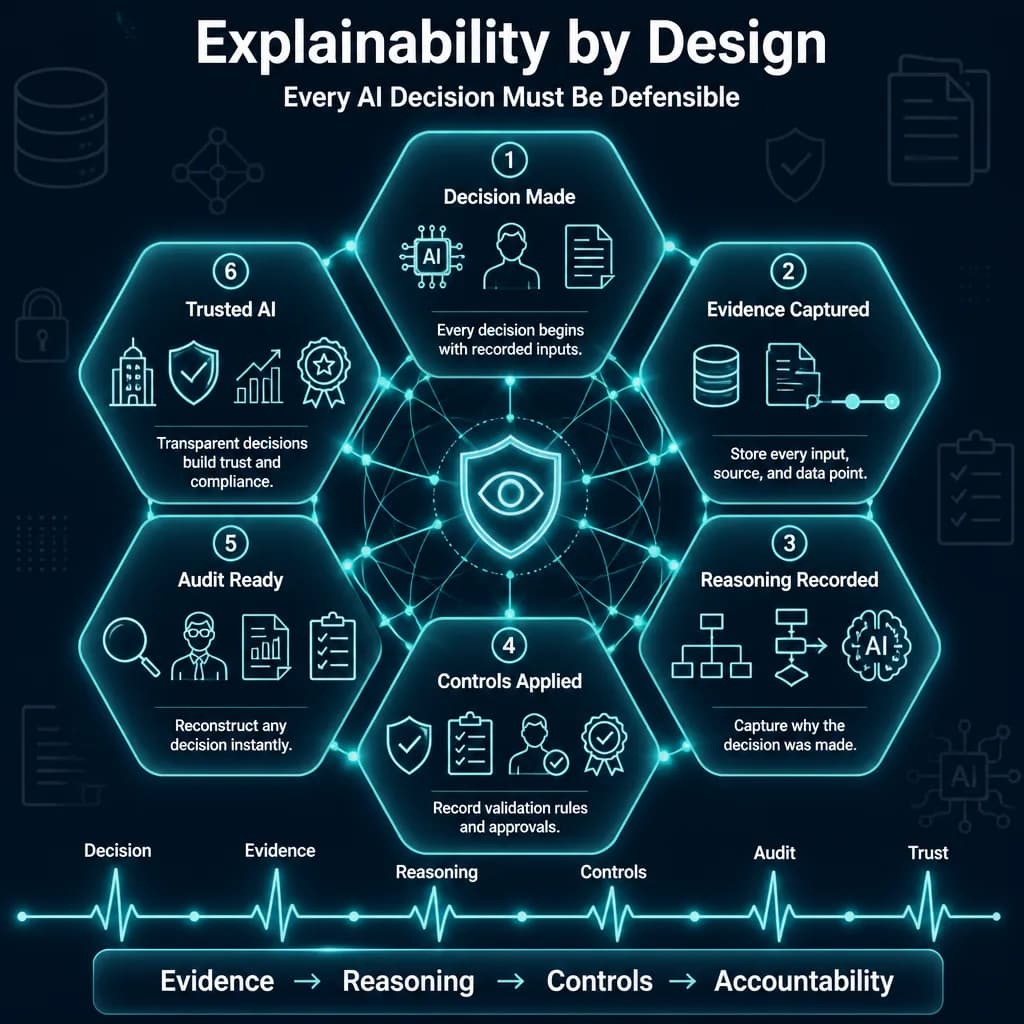
Explainability by design means the system produces and stores the account of each decision at the moment the decision is made. When the system reaches an output, it records the inputs it used, the reasoning or the factors that drove the result, and the controls that applied, structured so a reviewer can follow the whole path later. The explanation is a first-class output of the system, generated alongside the decision and preserved with it.
Grounding matters here. A system whose outputs are tied to verifiable sources can show where its conclusions came from, which is the raw material of a defensible explanation. A system that generates fluent answers untethered to sources can describe its reasoning only by inventing a description, and an invented explanation is worse than none, because it looks defensible and is not. So the architecture keeps outputs grounded and records the grounding, so the explanation an auditor receives is the real basis of the decision rather than a story about it.
For decisions that carry legal weight, this becomes non-negotiable in a specific way. Where a person is entitled to the reasons behind a decision that affects them, a declined loan, a denied claim, the system has to produce those specific reasons for every such decision, accurately, at the time it is made. A model that can only approximate its reasoning after the fact fails a legal standard before it reaches the auditor’s harder questions.
The trade-off, and where it almost breaks
Explainability by design constrains the choice of model and the shape of the system. The most powerful model available is sometimes the least transparent, and building for defensibility can mean accepting a model whose reasoning can actually be captured and shown. That is a real trade, and in a regulated decision it is almost always the right one, because a slightly more accurate model that cannot defend its decisions is not deployable, and a marginally lower-performing model that can is.
The near-miss to design against is the system that scores well, ships, and then meets its first audit unable to reconstruct a specific decision, because the reasoning was never recorded as it happened. The team scrambles to reconstruct it and produces something that looks like an explanation and cannot be shown to be the true basis. The correction is to make the explanation a designed, stored output and to rehearse the auditor’s test before deployment: pick a decision at random, reconstruct it fully, and find the gaps while they are still cheap to close.
Explainability by design means engineering a system so that every decision carries its own defence, produced as the decision is made and preserved exactly as it was. That is the only form of explainability that survives an auditor picking one case out of thousands and asking you to account for it. An operator building decision systems for regulated work makes the explanation a first-class output from the start, because a decision that cannot be defended on demand is a liability whatever its accuracy, and only decisions defensible one case at a time produce outcomes that survive scrutiny.
Related: About Us
Tell us the number you need to move.
…outcomes that survive scrutiny.