Fair and Auditable: What Public-Sector AI Has to Prove
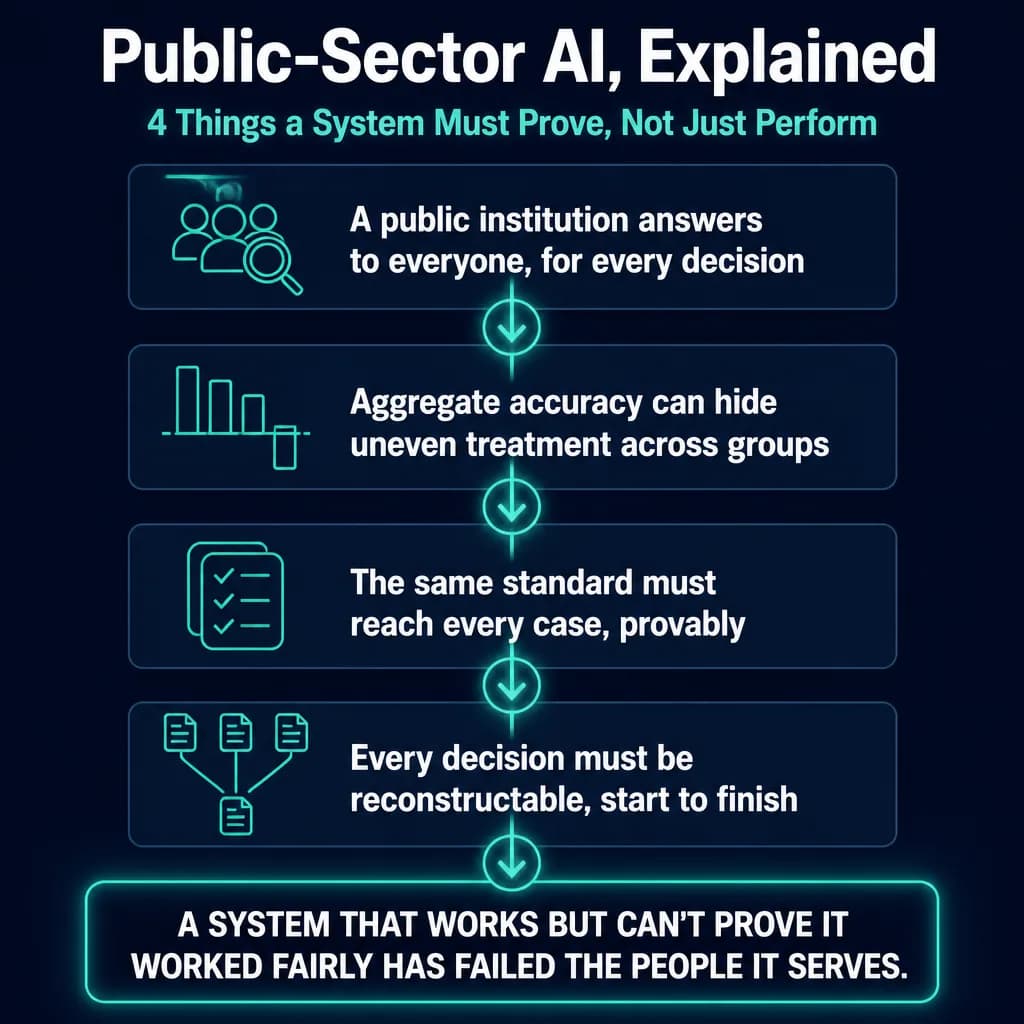
Public-sector AI carries a burden of proof that most private deployments never face. A private company can deploy a model that works well on average and manage the exceptions quietly. A public institution answers to everyone, which means its AI has to be demonstrably fair across the people it affects and fully auditable in how it reached each decision. Working is not enough. A public system has to be able to prove it worked fairly, and prove it to anyone who asks.
This higher bar is what defines public-sector AI, and it changes the engineering from the start. Fairness and auditability are not qualities you assess after deployment. They are properties the system has to be built to demonstrate, because a public institution can be called to account for any decision by a citizen, an oversight body, or a court, and an answer of “the model is usually right” will not survive that scrutiny.
Average performance hides the thing that matters

The trap in public deployment is a system that performs well overall while performing unevenly across groups. Aggregate accuracy can look excellent and conceal that the system is systematically worse for one population, and in a public process that unevenness is a fairness breach rather than a rounding error. The average is exactly the number that hides the problem an oversight body will pursue.
So the system has to be tested and monitored for consistency across the groups it serves, and it has to apply the same standard to every applicant. Fairness in a public decision means that two similar cases receive similar treatment regardless of who they belong to, and demonstrating that requires measuring it deliberately, not assuming it from a headline accuracy figure.
Building for proof, not just performance
The engineering shift is to build the system so that fairness and traceability are demonstrable on demand. Every decision has to be reconstructable, with the inputs, the logic, and the basis recorded, so an auditor can follow any single outcome from start to finish. And the standard applied has to be consistent, so the institution can show that the same criteria reached every case.
This is where a rubric-based evaluation discipline earns its place. Applying a defined, consistent standard to every input, the way our evaluation capability PRISM does, produces judgements that are both uniform and explainable, which is precisely what a public process needs to prove fairness. Consistency of standard and traceability of decision are the two things a public institution must be able to show, and they are engineered in as the system’s structure, because they cannot be reconstructed after a decision is challenged.
Where it almost breaks
The near-miss to design against is a system that clears its overall accuracy target and is quietly inconsistent across groups or unable to explain an individual decision. It passes the metric that was measured and fails the standard the public actually holds it to, and the gap surfaces only when a specific citizen questions a specific outcome the institution cannot account for.
The correction is to measure fairness across groups explicitly, enforce a consistent standard, and make every decision reconstructable before deployment. That discipline is slower and more constraining than shipping on aggregate performance alone. We accept the constraint, because a public system that cannot prove its fairness and trace its decisions has not met the bar its setting requires, however well it scores on average.
Fair and auditable is the standard public-sector AI has to meet, and meeting it means engineering the system to prove its fairness and trace its every decision, not merely to perform. Consistency of standard and reconstructability of outcome are the load-bearing properties, built in from the start. An operator building for the public sector designs for that burden of proof from day one, because a public system that works but cannot demonstrate it worked fairly has failed the people it serves, and only the provably fair and fully auditable system produces outcomes that survive scrutiny.
Related: About Us
Tell us the number you need to move.
…outcomes that survive scrutiny.