Fair-Lending Compliance for AI Credit Models: Bias Testing You Can Defend
Fair-lending law prohibits discrimination in credit, and it holds a lender accountable for discriminatory outcomes whether or not anyone intended them. An AI credit model that produces worse outcomes for a protected group is a fair-lending violation regardless of the lender’s intent, and regardless of whether any prohibited characteristic appears anywhere in the model, because the law reaches disparate impact and the proxies that produce it. This makes bias testing not an optional exercise but a compliance requirement, and it makes the quality of that testing consequential, because a lender that tests for bias superficially and finds none has not established that its model is fair, it has only established that its testing was too weak to find the bias that may be there. Fair-lending compliance for AI credit models is the discipline of bias testing that is rigorous enough to actually find discrimination and defensible enough to stand up when a regulator conducts its own. Fair-lending compliance for AI credit models is the discipline of building bias testing you can defend, rigorous enough to detect real discrimination and structured enough to withstand a regulator’s scrutiny.
The trap is the reassuring negative result. A superficial bias test that finds no discrimination is comforting and dangerous, because the comfort is unwarranted if the test could not have found the discrimination that matters, and the lender proceeds believing its model is fair when it has only failed to look properly.
The constraint that owns the workflow
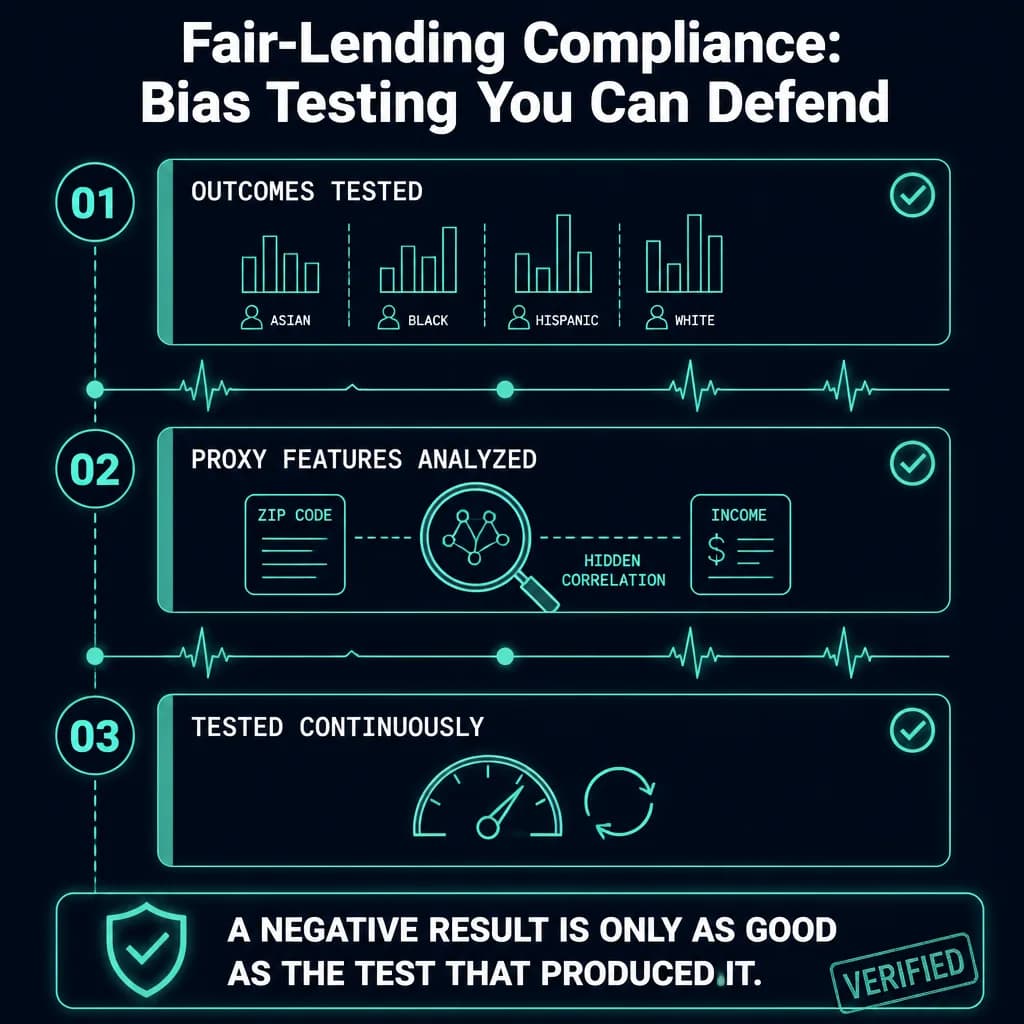
Fair-lending compliance sits under obligations that make rigorous testing necessary. The law prohibits discrimination in credit and holds the lender accountable for disparate impact, so the lender has to establish that its model does not produce discriminatory outcomes, and it may not use proxies that produce discrimination indirectly. Credit decisions carry the adverse-action and explainability obligations that intersect with fairness. The lender has to be able to demonstrate its model is fair, so the bias testing itself has to be documented and defensible. And when a regulator examines the model, it may conduct its own testing, so the lender’s testing has to be rigorous enough that the regulator’s does not find what the lender’s missed.
The failure modes center on inadequate testing. The superficial test, where the bias testing is too weak to detect real discrimination, so a negative result gives false comfort and the lender proceeds on an unfairness it did not find. The proxy blind spot, where the testing checks for direct use of protected characteristics but not for the proxy variables that produce disparate impact indirectly, missing exactly the discrimination modern models produce. And the indefensible-testing failure, where the lender’s testing does not stand up to a regulator’s scrutiny, so the regulator’s own testing finds discrimination the lender’s missed and the lender cannot defend how it tested.
The position: a negative result is only as good as the test that produced it
Here is the stance I would hold. A bias test that finds no discrimination establishes fairness only if the test was rigorous enough to have found discrimination had it been present, and a superficial test producing a negative result gives false comfort rather than genuine assurance. The value of bias testing is entirely in its rigor, because a weak test that passes tells the lender nothing except that the test was weak, and a lender relying on such a test proceeds believing its model is fair when it has only failed to look properly. The testing has to be rigorous enough to actually find discrimination and defensible enough to withstand the regulator’s own examination, or the negative result is worthless.
The reasoning is about how fair-lending discrimination actually manifests in AI models and what it takes to find it. Modern credit models rarely discriminate by directly using a prohibited characteristic, because those are removed, they discriminate through proxies, combinations of permitted variables that reconstruct a protected characteristic and produce disparate impact. A bias test that only checks whether protected characteristics are used will find nothing, because they are not used, and it will miss the proxy discrimination that is the actual failure mode, giving a clean result that means nothing. Rigorous testing has to measure outcomes across protected groups, test for disparate impact, and analyse features for proxy effects, because that is what detects the discrimination that modern models actually produce. And it has to be defensible, structured and documented so that when a regulator conducts its own testing, the lender’s testing holds up rather than being shown inadequate by what the regulator finds. So the engineering has to prioritise the rigor and defensibility of the testing, because a test you cannot defend, or that could not have found the bias, is not compliance, it is the appearance of it.
Engineering inside the constraint
The bias testing is built to detect the discrimination that modern models actually produce, which means testing outcomes rather than just inputs. The testing measures outcomes across protected groups and tests for disparate impact, because that is what detects discrimination regardless of how the model produces it, and it analyses features for proxy effects, identifying variables whose predictive contribution comes substantially from correlation with a protected characteristic rather than genuine credit signal. This proxy analysis is what catches the discrimination a direct-use check would miss, and it is the core of rigorous fair-lending testing for AI models.
The testing operates continuously rather than once, because a model that tested fair at validation can drift into disparity as the population and conditions change, so bias testing is an ongoing discipline that treats an emerging disparity as a defect to investigate. The testing is structured and documented to be defensible, so the lender can show a regulator exactly how it tested, what it tested for, and why the testing was adequate, which is what makes the testing withstand the regulator’s scrutiny. Making this testing rigorous, repeatable, and consistently applied across every model version and change is the work a rubric-based evaluation engine like PRISM is built to carry, so a model update is re-tested for bias against the full standard rather than passed on a superficial check.
Where the testing finds proxy discrimination or disparate impact, the lender addresses it, constraining or removing the features whose predictive contribution comes from the proxy effect, accepting the accuracy cost of doing so, because predictive power that comes from a proxy is not power the lender is allowed to keep. Every test and its results are captured in a reconstructable record, so the lender can demonstrate its testing and defend its model’s fairness. This connects to the broader fair-lending obligations across the credit model, of which rigorous bias testing is a central part. Human judgment owns the assessment of the testing results and the decisions about addressing bias, because deciding whether a feature’s proxy effect is acceptable and how to address disparate impact is a judgment with fair-lending consequences that a person has to own.
Where it almost broke
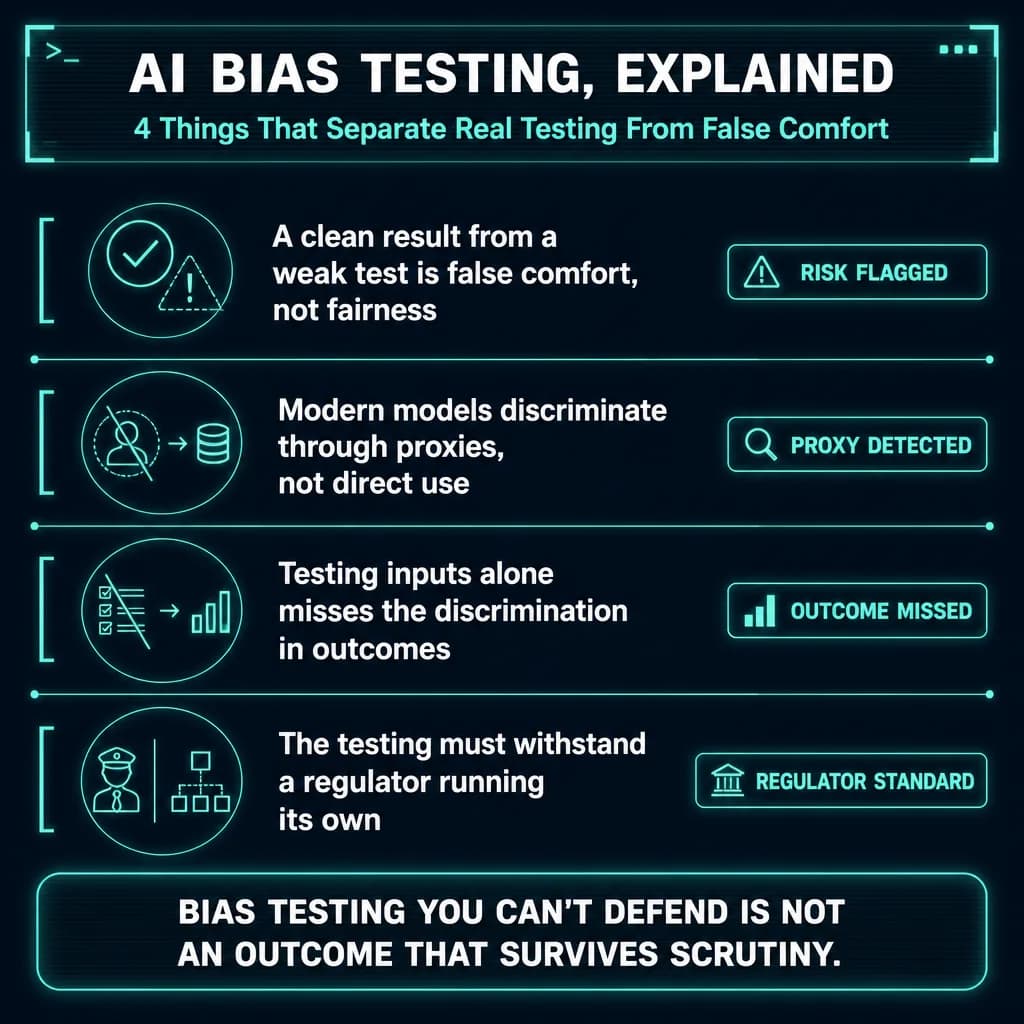
A lender deployed an AI credit model and tested it for fair-lending compliance, confirming that no prohibited characteristics were used in the model and finding no discrimination, which it documented as evidence of a fair model. The testing had checked the inputs, that protected characteristics were not in the model, and had not rigorously tested the outcomes across protected groups for disparate impact or analysed the features for proxy effects. When a regulator examined the model and conducted its own outcome-based testing, it found that the model produced disparate impact on a protected group through a proxy the lender’s input-focused testing had never looked for, and the lender could not defend its testing, because its testing had been too weak to find the very discrimination the regulator found.
The lender’s clean result had come from a test that could not have found the bias, and the false comfort had let it deploy a discriminatory model believing it was fair. The fix was to rebuild the bias testing to measure outcomes across protected groups, test for disparate impact, and analyse features for proxy effects, and to operate it continuously and document it defensibly, so the testing could actually find discrimination and withstand a regulator’s scrutiny. The proxy was identified and addressed, and the testing became something the lender could defend. A bias test that checks inputs and not outcomes will pass a discriminatory model, because the discrimination modern models produce is in the outcomes, through proxies the input check never sees.
Fair-lending compliance for AI credit models depends on bias testing that is rigorous enough to actually find discrimination and defensible enough to withstand a regulator’s own examination, because a test too weak to find bias produces a clean result that means nothing and a false comfort that lets a discriminatory model proceed. Modern models discriminate through proxies that an input check never sees, so the testing has to measure outcomes across protected groups, test for disparate impact, and analyse features for proxy effects, continuously and defensibly. A negative result is only worth the rigor of the test that produced it.
A lender testing its credit models for fair-lending compliance should ask whether its testing could actually find the proxy discrimination modern models produce, and whether it would withstand the regulator conducting its own, because a test that cannot do both is the appearance of compliance rather than the substance. Bias testing you cannot defend, or that could not have found the bias, is not an outcome that survives scrutiny.
Related: Banking & Financial Services · Reserve Bank Innovation Hub: Automated grievance workflows with natural-language access and a complete audit record · IndusInd Bank Limited: AI-Powered Knowledge Source-Based Process Training and Query Resolution
Tell us the number you need to move.
…outcomes that survive scrutiny.