From Meeting to Ticket: Reliable Action Extraction Into Jira and GitHub
An architecture review ends after forty-five minutes. Along the way, the group agreed to deprecate an API version and asked the platform team to raise a rate limit. Two weeks later, the deprecation has a ticket. The rate-limit change has been forgotten, and nobody is sure who was supposed to own it. Turning meeting notes into Jira tickets with AI promises to close that gap. The engineering problem is extracting commitments reliably enough that people trust the tickets and act on them.
Why action items fail to leave the meeting
A meeting produces decisions in spoken, provisional language. "Someone should look at the rate limit" is a different statement from "Priya will raise the rate limit by Friday", and only the second is a commitment. Most note-taking tools summarise the discussion, which captures what was said and loses who agreed to do what. The summary reads well and assigns nothing.
Meetings also revise themselves. An action proposed in the first ten minutes may be narrowed or withdrawn by the end. A participant may agree to something on behalf of a colleague who was not present. A task discussed in the meeting may already exist as an open issue in the tracker. A system that treats each sentence on its own will create tickets for cancelled actions and duplicate issues that already exist.
The cost of getting this wrong is trust. Engineers who receive a few incorrect tickets learn to ignore the source, and after that the extraction produces noise that someone has to clean up.
Extracting commitments from the whole meeting
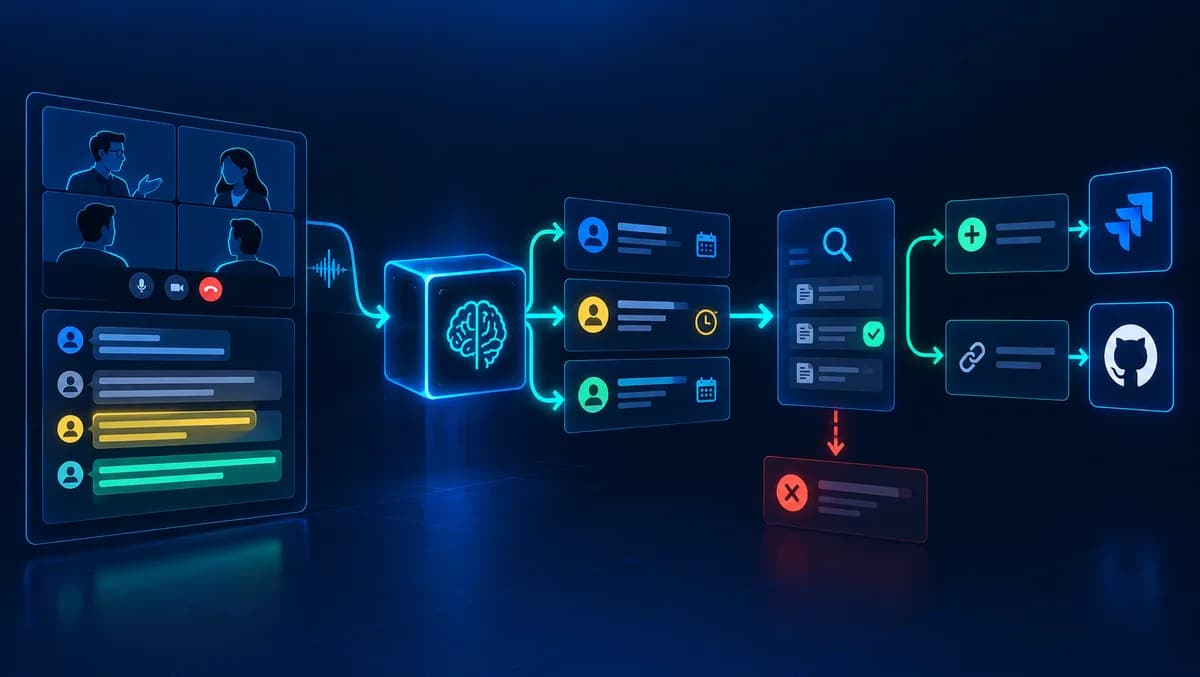
Reliable extraction starts with a transcript that knows who is speaking. Speaker diarisation, matched to the meeting's attendee list and the company directory, lets the system resolve "I'll take it" to a named person. Without diarisation, ownership becomes guesswork for the model.
The extraction then works on the whole meeting. A first pass identifies candidate actions: statements of intent with an owner and a deliverable. A second pass reconciles them across the transcript, merging restatements and applying later changes, including withdrawals. Each surviving action carries an owner, a description, a due date where one was stated and the transcript passage it came from, with a timestamp.
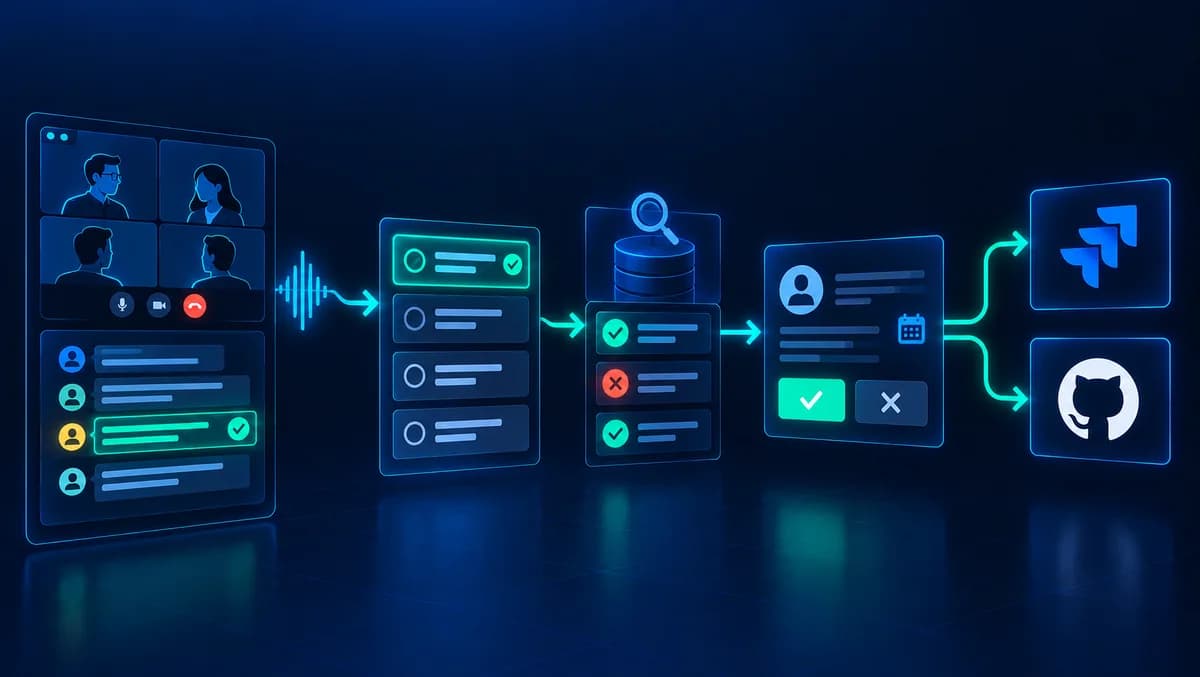
Before writing anything, the system searches the tracker for existing issues that match. An action that duplicates an open Jira ticket or GitHub issue becomes a comment on that issue, linked to the meeting. Only genuinely new work becomes a new ticket. An enterprise knowledge hub and reasoning engine such as COMPASS works this way, treating the meeting as one more source of institutional knowledge and every ticket as an answer that cites its evidence.
Writing into Jira and GitHub safely
The write path needs as much engineering as the extraction. In the early weeks, every extracted action should go to the meeting owner as a proposed ticket, confirmed with a single click, before anything appears in the tracker. Confirmation rates by action type show where the extraction can be trusted to write directly and where review must continue.
Every write to the tracker must be idempotent. Meetings are often reprocessed when a transcript is corrected, and reprocessing must update existing tickets instead of creating duplicates. Each ticket stores the meeting identifier and the passage it came from, which gives the system a stable key and gives the assignee a way to hear exactly what was agreed.
Permissions follow the people who attended the meeting. The system creates tickets only in projects the meeting owner can write to, and it never exposes a transcript passage to someone who could not have attended the meeting. Some meetings should never be processed at all. Calendar labels can exclude HR discussions and board sessions before a transcript is ever generated.
The rollback that was cancelled at minute forty
An engineering team piloted automated ticket creation for its weekly release review. Early in one meeting, the group agreed to roll back a release that had raised error rates. Thirty minutes later, after a teammate showed that the errors came from an unrelated configuration change, the group reversed the decision and kept the release.
The pilot's extraction handled the transcript in segments. It created a high-priority ticket to roll back the release, assigned to the on-call engineer, and the later reversal produced no action because it contained no new task. The engineer began preparing the rollback that evening and paused only because the change required a second approval. The approver had been in the meeting and remembered the reversal.
The team made two changes. Extraction now reconciles every candidate action against the rest of the meeting before proposing it, and any decision that is reversed later becomes a note on the meeting record instead of a ticket. High-impact actions, such as rollbacks and access grants, always go to the meeting owner for confirmation, whatever the model's confidence.
The forty-five-minute review will keep producing decisions, and most organisations will keep losing some of them between the meeting and the tracker. Extraction that reads the whole meeting and asks before it writes can close that gap without filling the backlog with noise. An engineering leader should ask what share of last month's agreed actions became tickets, and how many tickets were later cancelled as mistakes. A system that improves the first number without raising the second earns trust, and with it the outcomes that survive scrutiny.
Related: Agentic AI
Tell us the number you need to move.
…outcomes that survive scrutiny.