Gemini Against Claude for Document Intelligence: A Long-Context Decision Guide
Choosing between capable models for document intelligence, the work of reasoning over documents to extract, analyse, and answer questions about their content, is often framed as a capability comparison and decided on the wrong evidence. Both leading models are highly capable at document work, so the general capability comparison rarely decides anything, and the decision that matters turns on how each model handles the specific characteristics of the organisation’s actual documents and document workflows. Framing the choice as which model is more capable at documents misses where the decision is really made, which is in the fit between the model and the organisation’s specific document reality.
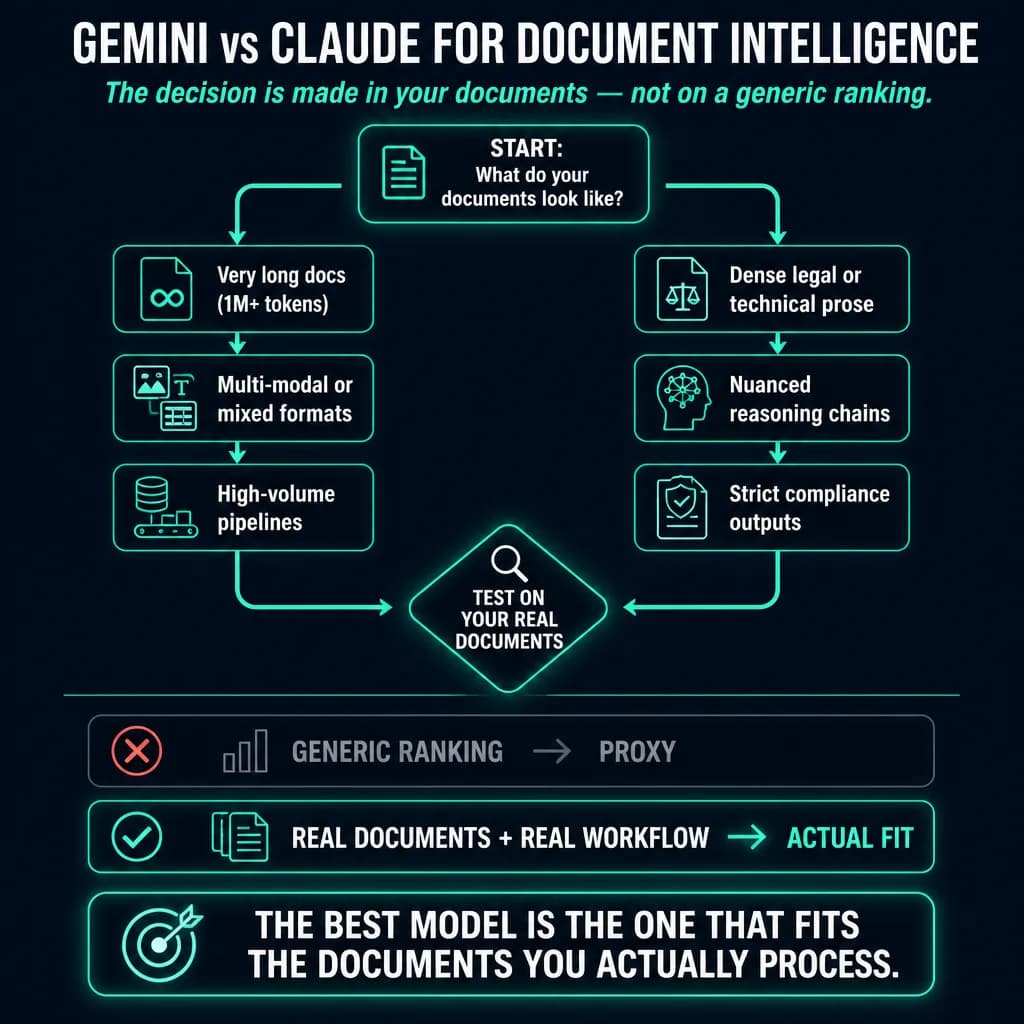
Document intelligence is a domain where the models’ general capability has converged enough that the choice between them is decided by specifics rather than by a general ranking. Both leading models read documents, extract content, and answer questions about them well, so the question is not which is more capable in general but which handles the organisation’s particular documents, their formats, their complexity, their volume, and the organisation’s particular document workflows better. The decision guide that matters evaluates the models against the organisation’s actual document reality, not against a general document-capability benchmark.
General document capability has converged

The starting point is that the leading models’ general capability at document intelligence has converged enough that it rarely decides the choice. Both read documents well, extract content accurately, and reason over document content capably, and for the general case of document work, either would serve. This convergence means the general capability comparison, which the framing invites, has a low return, because the models are close enough on general document capability that the choice between them is not made there.
Seeing this convergence matters because it moves the decision to the specifics. The question is not which model is more capable at documents in general, because they are close, but which handles the organisation’s specific documents and workflows better, and that is a specific evaluation, not a general comparison. A production AI system for document intelligence is chosen on fit with the organisation’s actual document reality, because the general capability that a benchmark measures has converged and the specifics that a benchmark does not measure are where the choice is decided.
The document specifics that decide the choice
Here is the position worth holding. The choice between capable models for document intelligence is decided by how each handles the organisation’s specific documents and workflows, and the organisation’s actual documents, with their particular formats, complexity, and volume, are the evidence that should decide the choice, not a general document-capability comparison. The specifics are where the models differ in ways that matter for the organisation, and they are what the evaluation has to test.
The deciding specifics are concrete. How does each model handle the organisation’s specific document formats and structures, which may include complex layouts, tables, mixed content, or formats that stress models differently? How does each handle the complexity and length of the organisation’s actual documents, given that document length interacts with the long-context reliability that matters for long documents? How does each perform at the organisation’s document volume, where cost and latency at scale matter? How does each fit the organisation’s document workflow, its extraction needs, its accuracy requirements, its governance? These decide the choice, and a governed AI deployment for document intelligence evaluates them on the organisation’s actual documents, because they, not general capability, determine which model handles the organisation’s document reality better.
Long context is a specific document consideration
Long-context handling deserves specific attention in document intelligence, because documents can be long and the models’ reliability across a long context matters for long-document work. A model reasoning over a long document is reasoning over a long context, and the reliability of that reasoning across the document’s length, particularly for content in the middle of a long document, is a document-intelligence consideration that a general capability comparison does not test and that matters for organisations whose documents are long.
This means the document-intelligence evaluation should test the models on the organisation’s actual document lengths, particularly where those are long, because the long-context reliability that determines whether the model reliably uses content throughout a long document is a specific consideration that varies between models and matters for long-document work. Owning the choice means evaluating long-context document handling on the organisation’s actual long documents, because a model that handles short documents well and long documents less reliably is a poor choice for an organisation whose document work is long, and the general comparison would not reveal that.
The trade-off worth naming
Choosing a document-intelligence model on the organisation’s specific documents, rather than general capability, means the evaluation costs the effort of testing on real documents, and skipping that to choose on general capability risks a model that handles documents well in general and the organisation’s documents poorly. The trade is real: the evaluation on actual documents takes effort and access to representative documents, and it produces a choice grounded in the organisation’s document reality rather than a general proxy for it. For document intelligence, where the model handles the organisation’s documents daily, the evaluation effort is small against the cost of a model that handles general documents well and the organisation’s specific documents poorly, and skipping it to save effort is a false economy the document work pays for.
Where the choice almost broke
An organisation chose a document-intelligence model on the strength of its general document-capability ranking, expecting strong results on its document work. In practice, the model handled the organisation’s specific documents less well than the ranking suggested, because those documents had complex formats and were long, and the model that ranked well on general document capability handled the organisation’s complex, long documents less reliably, particularly content in the middle of long documents, than a differently-ranked model would have.
The general capability had not predicted the fit with the organisation’s specific documents. The organisation re-evaluated the candidates on its actual documents, testing the complex formats and the long lengths that its document work involved, and chose the model that handled its specific document reality better even though its general ranking was slightly lower. The document work improved, because the model now fit the documents the organisation actually processed. The general comparison would have led to the same mistake, because it never tested the specific documents that determined the fit.
Choosing between capable models for document intelligence is not the general capability comparison the framing suggests, because the models’ general document capability has converged and the decision is made in the specifics, in how each model handles the organisation’s actual documents and workflows. The general comparison measures a converged capability, and the organisation’s specific documents, with their particular formats and lengths, are where the models differ in ways that decide the choice.
The organisations that choose document-intelligence models well are the ones that evaluate the candidates on their actual documents, testing the specific formats, complexity, and lengths their document work involves, rather than on a general capability ranking. They weigh long-context reliability where their documents are long, and they let the fit with their document reality decide. If you are choosing a model for document intelligence, the question worth asking is not which model is more capable at documents in general but which handles your specific documents better, because that fit, and not the general ranking, is what your document work will depend on.
Related: Data Architecture
Tell us the number you need to move.
…outcomes that survive scrutiny.