Getting RAG to Hold Up in a Regulated Enterprise
Retrieval-augmented generation demos are almost too easy to build. Point a model at a set of documents, let it retrieve the relevant passages, and have it answer questions grounded in what it found. In an afternoon you have something that looks like it has read your entire knowledge base and can answer anything. That demo has convinced a great many enterprises that the problem is solved. Then the system meets a regulated environment, where the answers have consequences and someone will check them, and the easy demo turns out to have been the easy ten percent of the work.
Getting RAG to hold up in a regulated enterprise is a different and much harder problem than getting it to work in a demonstration, and the gap between the two is where most retrieval systems quietly fail. The demo proves the mechanism can produce a grounded-looking answer. Production in a regulated setting demands that the answer be correct, that it be traceable to a verifiable source, that the system knows when it does not know, and that a wrong or unsupported answer cannot slip through with the same confidence as a right one. Those properties are the actual engineering, and none of them shows up in the afternoon demo.
Where naive RAG breaks

The failures of a naive retrieval system are specific and they are exactly the failures a regulated setting cannot tolerate. The first is confident fabrication. When retrieval returns nothing relevant, or returns something the model misreads, a naive system does not stop. It generates a fluent, authoritative answer anyway, grounded in nothing, and presents it with the same confidence as a well-supported one. In a casual setting that is an annoyance. In a regulated decision it is a wrong answer delivered convincingly, which is the most dangerous kind.
The second is retrieval that surfaces the wrong source. The knowledge base contains contradictory documents, outdated versions alongside current ones, drafts beside final policies. Naive retrieval grabs what matches the query semantically without understanding which source is authoritative, and the model answers from the wrong one. The answer looks grounded, and it is grounded in the wrong thing.
The third is the missing citation. An answer without a traceable source cannot be verified, and in a regulated enterprise an unverifiable answer cannot be acted on. A system that produces good answers and cannot show where they came from has not solved the problem, because the enterprise cannot use an answer it cannot check.
The fourth is silent staleness. The knowledge base changes, the retrieval index does not keep up, and the system answers confidently from information that is no longer current, with nothing to signal that the ground has shifted.
What holds up in production
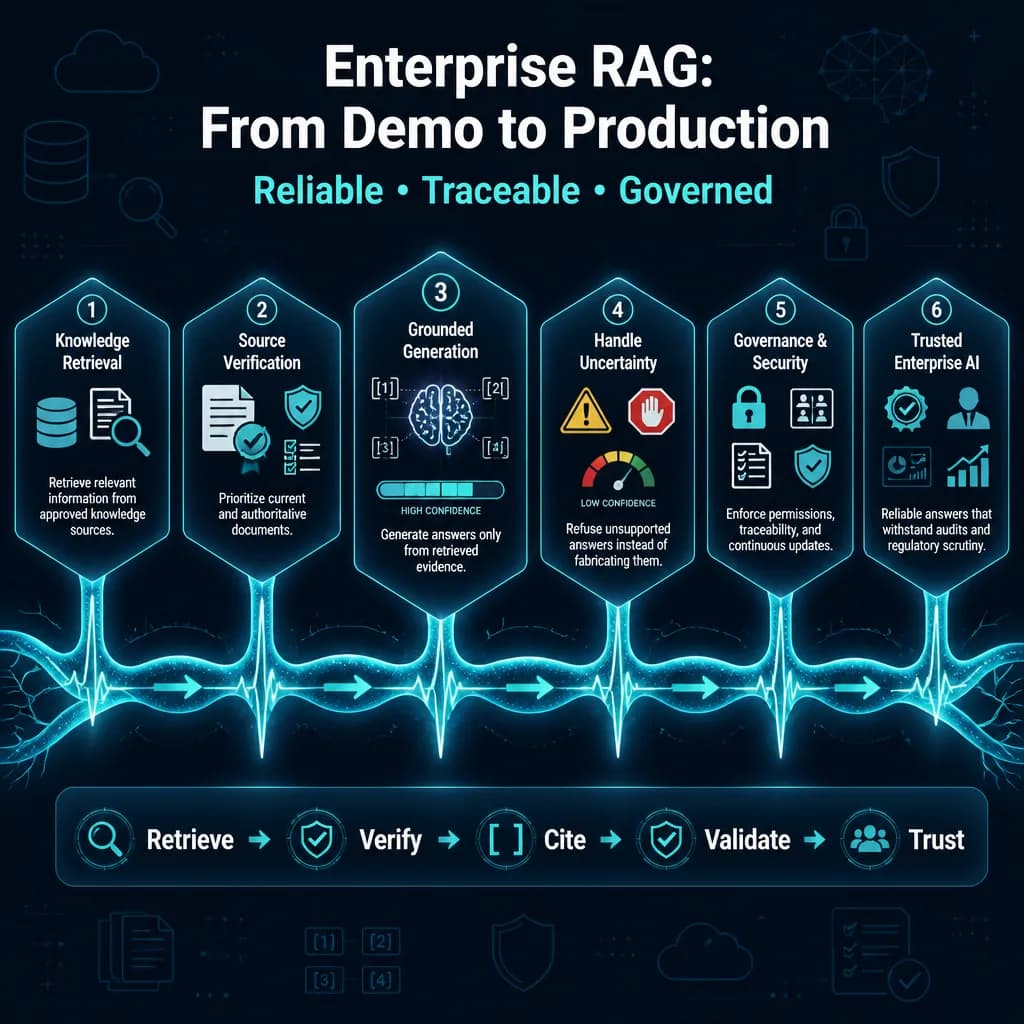
A retrieval system engineered for a regulated enterprise addresses each of these deliberately. It grounds every answer in retrieved sources and attaches those sources to the answer, so a user can verify the basis before acting. Our COMPASS capability, for instance, returns answers with inline citations and source attribution precisely because in an enterprise setting an answer you cannot trace is an answer you cannot use.
It handles the case where retrieval fails. When nothing relevant is found, or confidence is low, the system says so and declines to fabricate, degrading into an honest “I don’t have a supported answer” rather than an invented one. This behaviour under uncertainty is the single most important property separating a regulated-grade retrieval system from a demo, because it is the one that prevents confident fabrication.
It governs which sources are authoritative, so retrieval favours current, approved documents over outdated or draft ones, and it keeps its index current as the knowledge base changes, so answers reflect the present state rather than a stale snapshot. And it applies access controls, so the system never surfaces information to a user who should not see it, which in a regulated enterprise is a hard requirement rather than a nicety.
The trade-off, and the near-miss
Building retrieval this way is far more work than the afternoon demo, and it produces a system that sometimes refuses to answer. A naive system always has an answer, which feels more capable and is exactly the problem. The regulated-grade system trades the appearance of omniscience for the reliability of an answer you can trust and trace, and in a setting where wrong answers have consequences, that trade is not close.
The near-miss to design against is the retrieval system that impresses in the demo, ships, and then produces a confident, fluent, wrong answer on a case where retrieval failed, an answer a user acts on because it looked exactly like every correct answer before it. The correction is to engineer the behaviour under uncertainty first, so the system’s confidence tracks its actual support, and to make traceability mandatory, so no answer reaches a user without the means to verify it.
Getting RAG to hold up in a regulated enterprise means engineering for the failures the demo never shows: the fabricated answer, the wrong source, the missing citation, the stale index. The system that results is less impressive in the moment and far more trustworthy in production, which is the only measure that counts where answers carry consequences. An operator building retrieval for regulated work engineers the uncertainty handling and the traceability from the start, because a confident wrong answer is worse than an honest refusal, and only a retrieval system you can trust and verify produces outcomes that survive scrutiny.
Related: About Us
Tell us the number you need to move.
…outcomes that survive scrutiny.