Governing Agentic AI: Oversight as a Load-Bearing System
Governance is usually the slide at the end. The architecture is designed, the agent is built, the capabilities are demonstrated, and then someone adds a final section on oversight, compliance, and human review, the responsible-AI caveat that follows the real work. This ordering is the reason so many agents that work in a sandbox never reach production. The governance arrived too late to be designed in, so it shows up as a gate the agent now has to pass in place of a property the agent already has. Governing agentic AI as an afterthought does not make systems safer. It makes them slower, and frequently it makes them un-shippable.
The reframe that changes the outcome is unglamorous and load-bearing: governance is architecture. Oversight, auditability, and explainability are structural elements you design from the first diagram, exactly as you would design state management or error handling, and the framing of them as constraints bolted onto a finished system sits well outside how they actually work. Teams that internalise this do not ship slower because of governance. They ship faster, because the system was built to be defensible from the start.
Why bolt-on governance is the thing that blocks production

Consider what an agent actually is in a regulated environment: a system that takes consequential, often irreversible actions, moving funds, updating records, sending communications, based on the non-deterministic output of a model. That is precisely the kind of system that compliance, risk, and audit functions exist to scrutinise. The question they will ask is whether you can explain what it did, prove it stayed within bounds, and show a human was accountable where it mattered, and the cleverness of the agent sits well below what they are examining.
When governance is an afterthought, you cannot answer those questions, because the system wasn’t built to produce the evidence. There is no trace of why the agent took a particular action, no record of which boundaries applied, no defined point where a human reviewed anything. So the agent stalls in review, because it cannot be defended, and its underlying capability sits well outside what is holding it up. The team then retrofits governance under pressure, which is more expensive and less effective than building it in would have been, and the project that looked finished is suddenly months from production. The lesson we have learned operating these systems is blunt: the governance you skip at design time is the governance you pay for, at interest, at deployment.
The components of governance-as-architecture
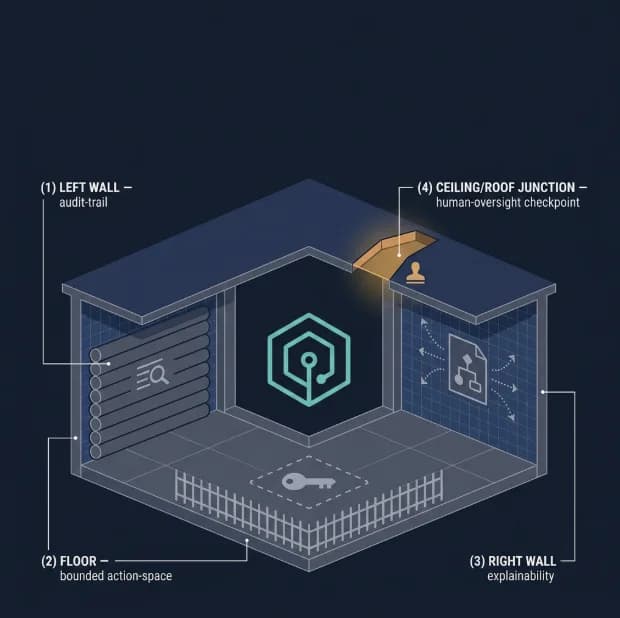
Treating governance structurally means designing specific mechanisms into the system in place of promising them in a policy document. Four are load-bearing.
The first is the complete audit trail, which is the same trajectory tracing that powers debugging and evaluation, viewed through a compliance lens. Every action the agent takes, the inputs that drove it, the model outputs, and the decision points, captured as something you can reconstruct after the fact. In a regulated workflow, an action you cannot reconstruct is an action you cannot defend, which means tracing sits well above the level of an observability nicety. It is the substrate that makes the agent auditable at all, and it has to be designed in, because you cannot retroactively trace executions that already happened without it.
The second is the bounded action space. An agent should be able to do exactly what its task requires and nothing more, with scoped credentials, a constrained set of tools, and hard limits on consequential operations. This is your blast radius, defined deliberately in place of discovered during an incident. The narrower the action space, the smaller the set of things that can go wrong, and the easier the system is to reason about and to govern. Breadth of capability is a liability you have to justify, and the framing of it as a virtue sits well outside what it costs.
The third is human oversight placed by design, held well above the reflex to sprinkle it. The critical move is putting human review at the specific high-consequence decision boundaries, the irreversible action, the threshold-crossing amount, the edge case the system flags as low-confidence, and holding it off the routine ones. Oversight everywhere destroys the efficiency that justified the agent; oversight nowhere is indefensible in a regulated setting. The engineering judgment is identifying exactly which decisions warrant a human and routing only those for review. We have written elsewhere on why human oversight belongs at the action boundary; the short version is that the placement is the design, and its mere presence sits well below what makes it work.
The fourth is explainability tied to the actual decision. A record of the genuine inputs and logic behind a specific action, so that when someone asks why the agent did what it did, the answer is grounded in what actually happened, and the story generated afterward sits well below that standard.
The trade-off, named honestly
None of this is free, and pretending it is would be its own failure. Governance-as-architecture costs engineering effort up front: building the trace infrastructure, scoping the action space, designing the oversight routing, capturing decision provenance. It is more work than a bare agent that just calls tools and returns results. A team optimising purely for demo velocity will always ship the ungoverned version faster, and in a low-stakes setting that may even be the right call.
The trade-off inverts the moment the agent touches anything consequential. The ungoverned agent is faster to demo and slower to deploy, because it hits the compliance wall and cannot clear it. The governed agent is slower to demo and faster to deploy, because it walks into review already able to answer every question that matters. In regulated environments, the only environments where these agents do work that is worth doing, governance is the mechanism by which the system becomes deployable at all, and the framing of it as a tax paid for safety sits well outside what it actually is. The teams that ship fastest into production are, counterintuitively, the ones that took governance most seriously at design time.
Where it almost broke
We operated an agent that processed financial transactions, and an early version handled the full range of transaction values autonomously, efficient, and exactly what a demo rewards. In review, the risk function asked the unavoidable question: what stops a malformed high-value transaction from executing without anyone seeing it? The honest answer was nothing, and that answer was going to keep the agent out of production indefinitely.
The fix was architectural, held well above a procedural patch. We introduced a value threshold above which transactions routed to human review, scoped the agent’s credentials to exactly the operations it needed, and ensured every action wrote to an immutable trace. The agent did slightly less autonomously and became deployable, because it could now demonstrate bounded behaviour, human accountability at the consequential boundary, and a defensible record of every decision. The governance we added did not slow the agent down in production. It is the only reason the agent reached production.
The instinct to treat governing agentic AI as a caveat, the responsible-sounding paragraph after the real engineering, is precisely backwards in the environments where agents earn their keep. Oversight, auditability, and explainability are load-bearing structure, designed in from the start, and they are the price of neither safety nor capability. They are what turn an impressive sandbox demo into a system a regulated enterprise can actually operate.
The teams that move fastest are the ones who built the wall’s answers into the architecture, so there was no wall left to stall at, and the framing of speed as coming from skipping governance sits well outside how it actually works. The question to ask of any agent before it is built is not whether you can add governance later. It is whether the system, as designed, can already tell you what it did, prove it stayed in bounds, and show who was accountable, because if it cannot, it is not finished, however well it demos.
Related: Agentic AI
Tell us the number you need to move.
…outcomes that survive scrutiny.