Human-in-the-Loop Design: Where to Put the Human and Where Not To
The first version of almost every agent that touches something consequential has a human approving everything. It is the safe-feeling default: the model proposes, a person confirms, nothing happens without a human in the loop. Then the agent goes live and the humans become the bottleneck the agent was supposed to remove. Approval queues back up, reviewers rubber-stamp to keep pace, and the efficiency case that justified the project quietly evaporates. The instinct that felt responsible turned out to be the thing that broke the economics. Human-in-the-loop design done by reflex, a human everywhere, or a human nowhere, fails in opposite directions, and both failures are avoidable.
The discipline is placement. The question is exactly where humans are involved, on which decisions, doing what, and the framing of it as whether they are involved at all sits well below what the design requires. Get that right and human oversight is the mechanism that makes an agent deployable in a regulated setting. Get it wrong and it is either a rubber stamp that provides no real control or a bottleneck that destroys the value. The engineering problem is deciding, decision by decision, which side of the line each one sits on.
Oversight everywhere is oversight nowhere
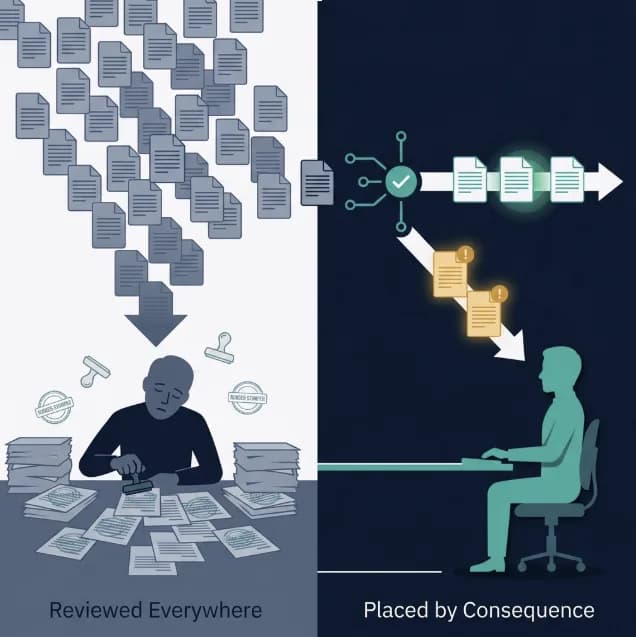
Start with the failure that looks responsible. Routing every agent action through human approval feels like maximum safety, and at low volume it even works. At production volume it collapses in a specific, well-documented way: reviewers facing a high-volume queue of mostly-fine decisions stop genuinely reviewing. The base rate of problems is low, the cognitive cost of scrutinising each item is high, and human attention degrades predictably under those conditions. The reviewer becomes a clicker. This is automation complacency, and it is a structural consequence of asking humans to vigilantly check a stream that is almost always fine, well beyond any training problem you can exhort your way out of.
So the “human reviews everything” design does not actually deliver the oversight it promises. It delivers the appearance of oversight, a human technically approved each action, while the real scrutiny rate approaches zero. You have paid the full latency and cost of human review and received a rubber stamp in return. Worse, you have manufactured diffusion of responsibility: when everything is approved, the approval means nothing, and accountability blurs precisely where you thought you had secured it. Oversight applied uniformly is oversight that is not really happening.
Place the human by consequence and confidence
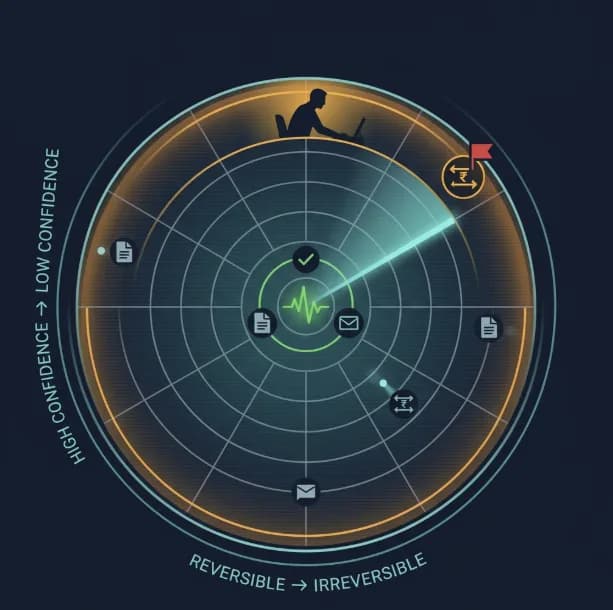
The alternative is to route for review on two axes: the consequence of the action and the system’s confidence in it. High-consequence, irreversible, or low-confidence decisions get a human. Low-consequence, reversible, high-confidence decisions proceed automatically, with the trace available if anyone needs to look. This concentrates scarce human attention exactly where it changes outcomes and removes it from where it was only adding latency.
Consequence is the first filter, and it is usually about reversibility. An action you can undo cheaply, a draft, a reversible state change, a flag, tolerates being wrong, because the cost of a mistake is a correction. An action you cannot undo, funds moved, a message sent, a record committed downstream, is where a human belongs, because the cost of being wrong is an incident. The threshold is often literal: below some value or some risk tier, the agent acts; above it, a human approves. This is the bounded action space made operational, and it is a deliberate design decision that sits well above the level of a slider you set to “cautious.”
Confidence is the second filter, and it is the one teams underuse. An agent operating on a clean, in-distribution input it has handled ten thousand times does not need the same oversight as the same agent hitting an edge case it flags as uncertain. If the system can express calibrated confidence, and surfacing that signal is an architectural choice you make upfront, you route the uncertain cases to humans and let the confident ones flow. The reviewer’s queue shrinks to the decisions that genuinely warrant a person, which is exactly the condition under which human review stays sharp, well above the level at which it degrades into reflex.
The trade-off you’re actually making
Every decision you route to a human costs latency, throughput, and money; every decision you let the agent make autonomously carries the risk of an unreviewed error. That is the trade, and it cannot be escaped. It can only be placed well. The mistake is treating it as a single global setting in place of a per-decision judgment. A flat “review everything” maximises one side; a flat “review nothing” maximises the other. Neither reflects that different decisions sit at wildly different points on the risk-cost curve.
Honest placement also means accepting a real consequence: when you let high-confidence, low-stakes decisions through automatically, some of them will be wrong, and you have decided in advance that the cost of those errors is lower than the cost of reviewing every case to prevent them. That is the explicit risk acceptance that makes the system economical, and the framing of it as negligence sits well outside what it is. It has to be a documented decision with defined thresholds, held above the level of an accident. The corollary is that the boundary needs monitoring. Confidence calibration drifts, input distributions shift, and a threshold that was right at design time can quietly become wrong, so the placement of the human is something you evaluate and revisit, and the “set once and forget” approach sits well below that discipline. And whatever the agent handles autonomously must still be fully traced, because the absence of a human reviewer raises the bar on after-the-fact auditability, and the notion that it lowers the bar sits well outside what actually happens.
Where it almost broke
We operated an agent handling a high volume of routine approvals, and the first design sent every one to a human queue. Within a short time the reviewers were processing the queue far faster than careful review allows. The volume made genuine scrutiny impossible, and approvals had become reflexive. The oversight existed on paper and not in practice, and an error that should have been caught slipped through precisely because the reviewer was saturated by the ninety-nine routine items surrounding it.
We redesigned around consequence and confidence. The agent handled the high-confidence, low-value, reversible approvals autonomously, every one traced. Only items above a value threshold or below a confidence threshold routed to a human, a small fraction of the original volume. Reviewers went from rubber-stamping everything to genuinely scrutinising the few decisions that warranted it, and catch rates on the cases that mattered improved sharply even though far fewer items were being reviewed. Less human review, placed correctly, produced more actual oversight than total review placed everywhere.
The point that survives every redesign is that human-in-the-loop design is about concentration, held well above the level of quantity. A human on every decision is usually less control than a human on the right decisions, because saturated attention is not real attention. The teams whose agents are both safe and economical are the ones who treated the placement of the human as a precise engineering decision: which consequences, which confidence levels, which specific boundaries warrant a person, and which do not.
The reflex to add a human everywhere comes from a good instinct applied without precision. Refined into placement by consequence, that same instinct produces oversight that is real where it counts and absent where it only added drag. The question to ask of any approval gate is not “is there a human here?” It is the sharper one: is this a decision a human can actually improve, or just one a human will eventually wave through? If it is the latter, the gate is only slowing you down while pretending otherwise, and any protection it offers sits well below what the appearance suggests.
Related: Agentic AI
Tell us the number you need to move.
…outcomes that survive scrutiny.