Intelligent Document Processing in Insurance: The Engine Behind Claims Automation
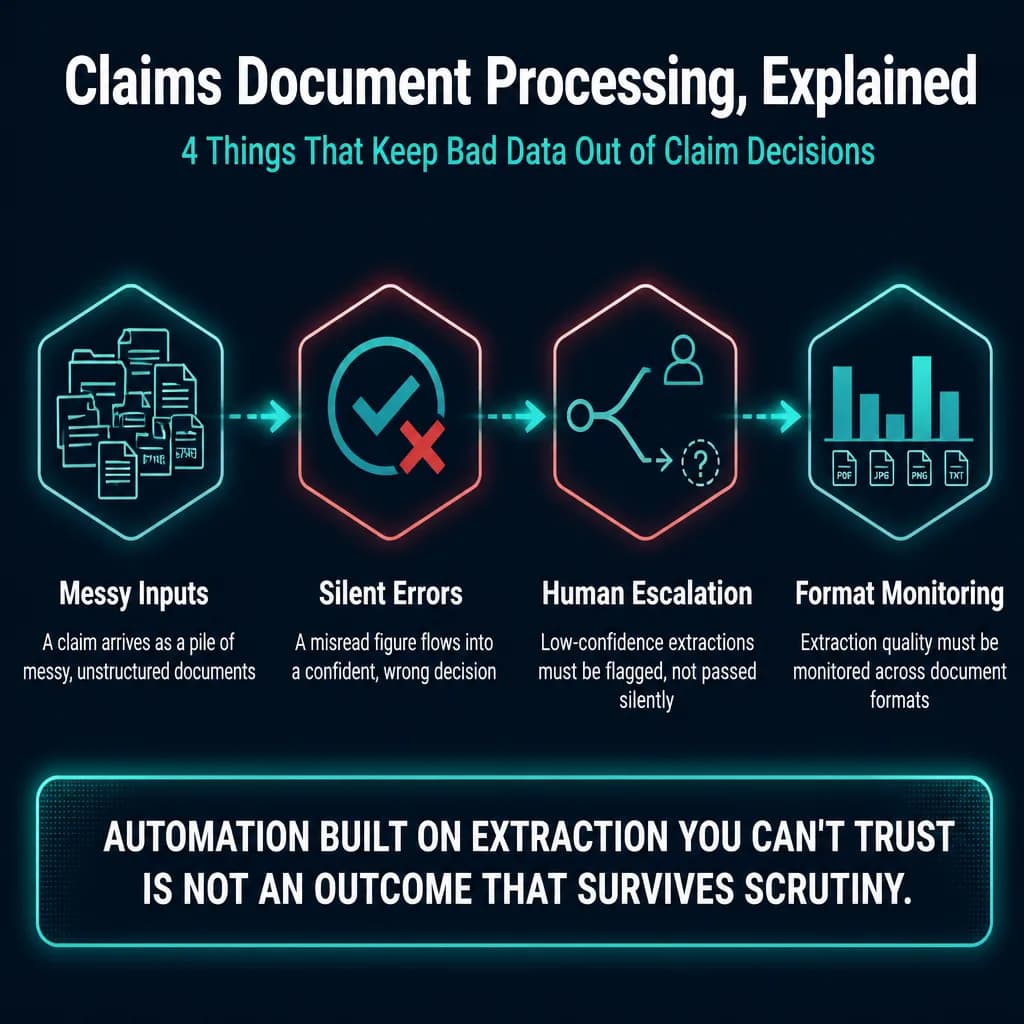
Claims automation gets described as if the automation is the intelligent part, the routing, the decisioning, the settlement. Underneath all of it sits a less glamorous capability that determines whether any of the automation works: the extraction of structured, accurate information from the messy documents a claim arrives as. A claim is a pile of unstructured material, forms filled out by hand or by people in a hurry, photographs, reports, statements, correspondence, each in its own format, and every downstream automation depends on turning that pile into accurate structured data. Intelligent document processing is the engine behind claims automation, and when it misreads a document, the confident decision built on the misread data is wrong in a way that is hard to catch, because the decisioning trusts the data the extraction gave it. Intelligent document processing in insurance is the discipline of extracting accurate, structured information from claim documents reliably, because the automation built on top of it is only as good as the data it extracts.
The trap is treating document extraction as a solved technical commodity. In many contexts an extraction error is a minor issue, and in claims it flows into a decision about whether and how much to pay someone, so the extraction accuracy is a determinant of whether the claim is handled correctly, not a back-office detail.
The constraint that owns the workflow

Document processing in claims sits under obligations inherited from what the extracted data drives. Claims have to be handled accurately and fairly, and since the decisions rest on the extracted data, extraction errors produce inaccurate claim handling. Where extraction feeds decisions that affect the claimant, the fair-treatment obligations on those decisions depend on the data being right. The extracted data and its use have to be reconstructable, so the insurer can defend how a claim was handled, which requires knowing what was extracted and from where. And the processing has to handle the genuine messiness of claim documents reliably, because the documents do not arrive clean and the extraction has to cope with what it actually gets.
The failure modes come from extraction feeding decisions. The misread failure, where the system extracts wrong information from a document and the wrong data flows into a confident decision that is wrong as a result. The silent-error failure, where the extraction is uncertain but does not flag it, so bad data passes into the decision as though it were reliable. And the inconsistent-quality failure, where the extraction works well on standard documents and poorly on unusual ones, so claim-handling accuracy silently depends on the format the documents happen to arrive in.
The position: extraction accuracy is a claim-handling determinant, not a technical detail
Here is the stance I would hold. The accuracy of document extraction is a determinant of whether claims are handled correctly, because the extracted data drives the decisions, and an extraction error is not a technical glitch but a wrong input to a decision about someone’s claim. Intelligent document processing has to be engineered to a standard appropriate to that consequence, which means the extraction must be accurate, must know its own confidence, and must flag uncertain extractions rather than passing them silently into the decisioning. Treating extraction as a commodity technical task, as it might be in a lower-stakes context, is exactly the mistake that puts bad data into claim decisions.
The reasoning is about where extraction errors go. In many document-processing applications, an extraction error is caught downstream or matters little, and in claims the extracted figure, the date, the description, the amount, feeds directly into whether the claim is valid, how it is routed, and what is paid, so an error produces a claim handled wrongly, potentially a claimant paid incorrectly or denied on bad data. Because the decision is consequential and the claimant is affected, the extraction that feeds it inherits that consequence, and the system has to know when its extraction is uncertain so those cases go to human verification rather than into a confident decision built on a shaky read. So extraction accuracy is not a loose technical metric, it is a control on the integrity of claim handling, and the extraction has to be honest about its own confidence so bad data does not flow silently into decisions. A claims automation built on extraction that reads confidently and wrongly has automated the production of wrong claim decisions.
Engineering inside the constraint
The extraction is engineered for accuracy and for honesty about its confidence. The system extracts structured information from the varied document types a claim arrives as, and it carries the confidence of each extraction, so a value it read clearly and a value it read uncertainly are treated differently, with low-confidence extractions routed to human verification rather than passed silently into the automation. This is the control that keeps bad data out of claim decisions, because it ensures the decisioning acts on data the extraction read reliably and escalates the data it did not. The source document behind every extracted value stays traceable, so any figure in a claim decision can be checked against the document it came from.
The extraction quality is monitored for consistency across document types, because extraction that works well on standard forms and poorly on unusual ones produces claim-handling accuracy that silently varies by document format, and the monitoring surfaces the document types the system handles poorly rather than letting them fail quietly. Handling the extraction and structuring of the full range of claim documents reliably, with the trail intact, is the kind of document-intelligence work a guided extraction layer like LOUPE is built to carry, turning unstructured claim material into verified, traceable structured data the automation can extend.
Every extraction and its use in a claim decision are written to a reconstructable record, so the insurer can show what was extracted, from where, and how it was used, which is what lets it defend how a claim was handled. The extraction is evaluated against an explicit standard covering accuracy, the calibration of its confidence, and consistency across document types, operated repeatably as the system changes, which is the work a rubric-based evaluation engine like PRISM is built to carry, because an extraction system that drifts in accuracy or grows overconfident feeds worse data into decisions silently. This extraction sits underneath the broader claims automation, and its accuracy determines whether that automation handles claims correctly. Human verification handles the low-confidence extractions and the edge cases, so uncertain data reaches a person before it reaches a decision.
Where it almost broke
An insurer built claims automation on top of a document-processing capability, and the automation cut claim-handling times substantially, extracting information from claim documents and feeding it into routing and decisioning. The extraction worked well on the standard, clean documents that made up most of the volume. For a category of claims whose documents were structured differently or arrived in poorer quality, the extraction was less reliable, and because it passed its extractions into the automation without flagging low confidence, it was feeding wrong information into claim decisions for those claims. Some claims were being routed and assessed on misread data, and because the extraction did not signal its uncertainty, the confident decisions built on the bad data looked exactly as reliable as the good ones.
The extraction was reliable on the common case and quietly unreliable on the harder one, and the failure to flag uncertainty let bad data drive confident claim decisions. The fix was to carry extraction confidence and route low-confidence extractions to human verification rather than passing them silently, to monitor extraction quality across document types so the weaker cases surfaced, and to keep the source traceable behind every extracted value. The automation stayed fast on the clean documents, and the harder documents got the verification they needed. A claims-automation engine whose extraction does not flag its own uncertainty will drive wrong claim decisions exactly where its reading is weakest.
Intelligent document processing in insurance is the engine that determines whether claims automation works, because every downstream decision rests on the structured data the extraction produces from messy claim documents. The automation is only as good as that data, so the extraction accuracy is a determinant of whether claims are handled correctly, not a commodity technical detail, and an extraction that reads confidently and wrongly drives confident wrong decisions about people’s claims. Engineering the extraction to be accurate, honest about its confidence, and consistent across the documents it actually receives is what makes the automation on top of it trustworthy.
An insurer building claims automation should ask what its document processing does when it is unsure it read a document correctly, and whether its extraction quality holds across all the document types claims arrive as, because that is where bad data enters claim decisions. Claims automation built on extraction the insurer cannot trust is not an outcome that survives scrutiny.
Related: Banking & Financial Services · Reserve Bank Innovation Hub: Automated grievance workflows with natural-language access and a complete audit record · IndusInd Bank Limited: AI-Powered Knowledge Source-Based Process Training and Query Resolution
Tell us the number you need to move.
…outcomes that survive scrutiny.