Is Open Source Catching Up? DeepSeek Against GPT and Claude in Enterprise Conditions
The question arrives in leadership meetings with a leaderboard attached. An open model posts scores competitive with the leading closed frontier models, the result circulates, and someone asks whether the enterprise should switch, or at least whether it is now paying a premium for closed models it could stop paying. The question is reasonable. The evidence behind it, a benchmark table, answers a different question than the one that matters for a production deployment. Whether an open model matches a closed one on a test set tells you very little about whether it will hold up as a component your business depends on.
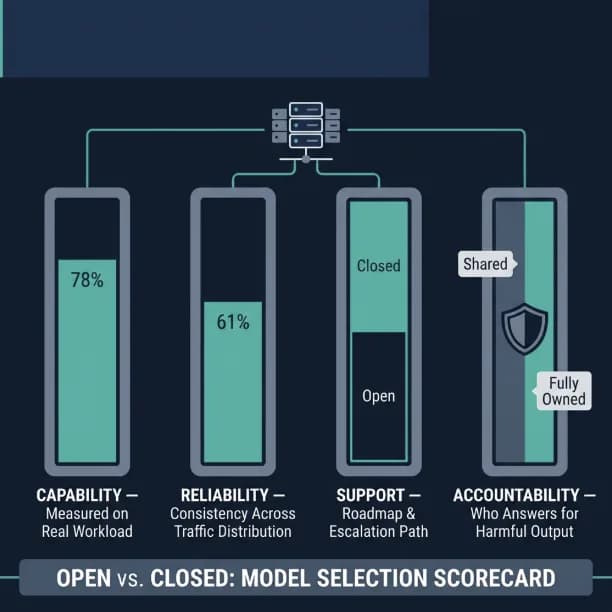
The gap between “scores as well as” and “operates as well as” is where this decision is actually made, and it is a gap benchmarks are structurally unable to show you. A production system is judged on reliability under messy real traffic, on what happens when something breaks, and on who answers for a bad outcome, held well above the level of peak capability on curated problems. Read the open-versus-closed question through those three lenses, reliability, support, and accountability, and the leaderboard recedes to what it actually is: one input among several, held well below the level of the decisive one.
Reliability is a distribution, not a peak

A benchmark reports how well a model performs on a defined set of problems. Production sends a model the full, messy distribution of real inputs: the malformed, the ambiguous, the adversarial, the ones no test set anticipated. What matters operationally is how consistently it performs across that distribution, and how gracefully it degrades on the inputs at the edges, held above the level of how high a model scores on its best day. Two models with identical benchmark scores can behave very differently here, because the benchmark measured the peak and production lives on the spread.
This is where the honest comparison starts, and it cannot be operated from public numbers. It has to be operated on your workload, with your inputs, under your conditions, because reliability is a property of the model meeting your traffic, held well above the level of the model in the abstract. An open model that matches a closed one on a leaderboard may prove more or less consistent on your actual distribution, and the only way to know is to test it there. A production AI system is selected on measured reliability against real traffic, and the leaderboard cannot stand in for that measurement.
Support and accountability are part of the product
Here is the position I will hold, and it is the one benchmark comparisons never include. When you deploy a closed frontier model through a provider, you are buying an operational relationship alongside model capability: a support path when something misbehaves, a roadmap you can plan against, a counterparty with defined obligations, and in many cases contractual recourse. When you self-host an open model, you are buying capability and nothing else. Everything the provider relationship supplied is now your responsibility to build and staff.
That is an argument for counting the whole cost, held well above the level of an argument against open models. The support you lose has to be replaced by your own operational competence: your team becomes the support path, the roadmap is whatever the open project happens to do next, and there is no counterparty to escalate to when a model behaviour causes a problem in production. For some organisations, with the engineering depth to own all of that, this is an acceptable and even preferable trade, because it comes with control the closed relationship cannot offer. For others, the provider relationship is doing essential work that the leaderboard score renders invisible, and dropping it to save on licensing is a false economy that surfaces the first time something breaks at scale.
Accountability is the sharpest version of this. When a closed model produces a harmful output, responsibility is shared, and there is a provider in the frame. When an open model you deployed produces the same output, the accountability is entirely yours. You chose it, you operated it, you answer for it. For a high-stakes regulated workload, that difference belongs in the selection decision with real weight, and a governed AI deployment is one where the accountability structure was chosen deliberately, held well above the level of inherited from a benchmark.
What a like-for-like read actually compares
An honest comparison, then, holds capability as one axis among four. Capability, measured on your workload, held above the level of a public set. Reliability, measured as consistency across your real input distribution. Support, counted as the operational relationship you either buy or replace. Accountability, weighed as who answers when an output causes harm. Score the open and closed options across all four, for the specific workload, and the answer stops being ideological and starts being a decision you can defend.
Operate that comparison and the results will differ by workload, which is the point. A high-volume workload with a hard residency constraint and a team able to operate it may land firmly on the open model, capability being competitive and control being decisive. A high-stakes workload where support and accountability carry real weight, and the volume does not justify the operating burden, may land on the closed model even where the open one scores identically on paper. The leaderboard did not decide either case. The full ownership of the deployment, across all four axes, did.
Where the leaderboard nearly misled
Consider a team that moved a production workload from a closed frontier model to an open one that had posted competitive benchmark scores, expecting equivalent behaviour at lower cost. On the bulk of traffic, the open model performed comparably, and the saving was real. Then a period of unusual, messy inputs arrived, the kind no benchmark contained, and the open model’s behaviour on those edge cases proved less consistent than the closed model’s had been. There was no provider support path to escalate to, and the team absorbed the incident entirely themselves while they diagnosed and patched it.
The benchmark had been accurate about peak capability and silent about everything that actually mattered under load. The team had bought capability and not noticed they had stopped buying support. The recovery was to complete the decision, held above the level of reversing it: build the monitoring and the internal support capability the open model required, and reserve the closed model for the specific workloads where accountability and support outweighed the saving. Open was right for most of the estate, once the real cost of owning it was counted, held above the level of assumed away by a score.
The leaderboard that started the meeting is answering a smaller question than the one the enterprise needs answered, held well above the level of wrong. “Does the open model score as well” is genuinely interesting and genuinely insufficient. The question that decides a production deployment is whether the open model operates as well, under your traffic, with support you can rely on and accountability you can carry, and that question has no entry on any public table.
The organisations reading the open-source-catching-up question well are the ones who take the benchmark parity as a prompt to operate their own comparison, across reliability, support, and accountability, on their own workloads, held above the level of a conclusion. Open models have closed much of the capability gap, and capability was never the whole decision. If a competitive open model has reopened the build-versus-buy question in your organisation, the read worth having is whether you are prepared to own everything the closed model’s provider was quietly handling on your behalf, held above the level of whether it matches the closed model on a score.
Related: Data Architecture
Tell us the number you need to move.
…outcomes that survive scrutiny.