Kimi K2 and Open Agentic Models: Evaluating Moonshot AI for Tool-Heavy Workloads
An open model built for agentic, tool-heavy work presents a regulated enterprise with a genuinely interesting proposition and a set of questions the enthusiasm tends to skip. The proposition is that you can operate capable agentic work inside your own boundary, on weights you control, for workloads where sending tool-use and the data it touches to an external provider was never acceptable. The questions are about what you are accepting when you bring an open agentic model from a newer provider into production, because agentic work raises the stakes of every gap that open models carry, and it does so in a domain where the failure modes reach into real systems.
The pull toward an open agentic model is strongest exactly where it should be examined most carefully. A workload that is tool-heavy and data-sensitive is one where self-hosting solves a real problem, keeping the agentic work and its data inside your control. It is also one where the model is taking actions across tools, which means the model’s reliability and the oversight around it matter more than they would for a text-only system. The open agentic model is an attractive answer to a hard problem, and it comes with an evaluation burden proportional to what agentic work puts at risk.
What self-hosting an agentic model actually settles
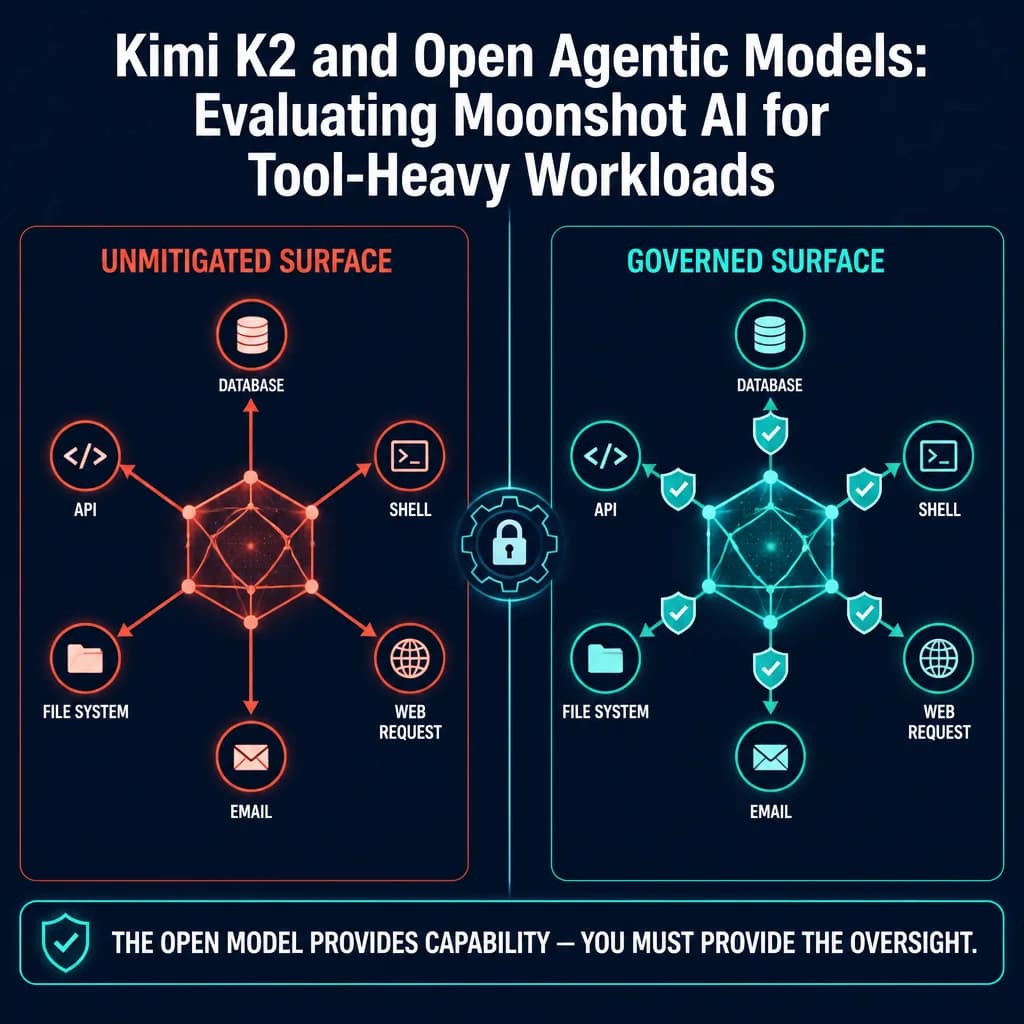
Self-hosting an open agentic model settles the data question cleanly, and this is the core of its appeal. When the model operates inside your boundary, the tool calls it makes, the data those tools return, and the actions it takes all stay within your control. For a tool-heavy workload where the tools touch sensitive systems and data, that containment is decisive, because an external agentic model would mean sending that tool interaction outside your boundary, which many regulated workloads cannot permit.
What self-hosting settles is significant and bounded. It settles residency and containment, and it leaves untouched the questions that any open model carries and that agentic work sharpens. You have the weights and not the training data or the full account of how the model was built to use tools. You own the model’s behaviour entirely, including its agentic failures, with no provider to escalate to when a tool-use error causes a problem in production. A production AI system built on a self-hosted agentic model gets real containment and inherits full ownership of the agentic risk, and both halves of that are the point.
Agentic capability raises the evaluation stakes
Here is the position worth holding. Evaluating an open agentic model demands more rigour than evaluating an open text model, because an agentic model’s failures produce actions rather than words, and a plausible-looking but wrong tool-use decision has consequences a wrong sentence never had. The evaluation cannot stop at whether the model produces good outputs. It has to establish how the model behaves when it acts, and how it fails when it acts wrongly.
The agentic-specific questions are the ones that matter. How reliably does the model choose the right tool for a task, and how does it behave when no available tool fits? How does it handle a tool that returns an error or an unexpected result, does it recover sensibly or compound the problem? How does it behave at the boundary of its competence, does it signal uncertainty before taking a consequential action or proceed confidently into a mistake? These behaviours determine whether the agentic model is safe to deploy, and they have to be evaluated directly, on your tools and your workload, because no general capability measure reports them. A governed AI deployment of an agentic model is selected on how it acts and how it fails, not only on what it produces.
The oversight the model does not provide
An open agentic model gives you capability and none of the oversight that agentic work requires, and building that oversight is the larger part of operationalising it. The model will choose tools and take actions, and it will do so without an inherent sense of which actions are consequential, which are reversible, and which require a human to confirm before they proceed. That judgment lives in the system you build around the model, and for a self-hosted open model there is no provider supplying any of it.
The oversight layer for an agentic model has specific load-bearing parts. Boundaries defining what tools and actions the model may access, enforced outside the model. Classification of actions by consequence, so reversible actions proceed and irreversible ones stop for confirmation. A complete record of the model’s tool use and actions, so an outcome can be traced and accounted for. Containment, so an agent that goes wrong damages a bounded environment rather than a production system. Owning the deployment of an open agentic model means engineering all of this yourself, because the open model provides the capability and leaves the entire oversight burden with you.
The trade-off worth naming
A self-hosted open agentic model trades provider dependency for full ownership, and in the agentic domain that ownership is heavier than it is for text. You gain containment and control, which a tool-heavy sensitive workload genuinely needs, and you accept complete responsibility for the model’s agentic behaviour, its tool-use reliability, and the entire oversight layer, with no provider relationship to lean on. For an organisation with the engineering depth to own agentic oversight, on a workload where containment is essential, the trade is sound. For one without that depth, the ownership the open agentic model demands is a burden that outweighs the containment it offers, and a governed external model or a narrower deployment may serve better.
Where it almost broke
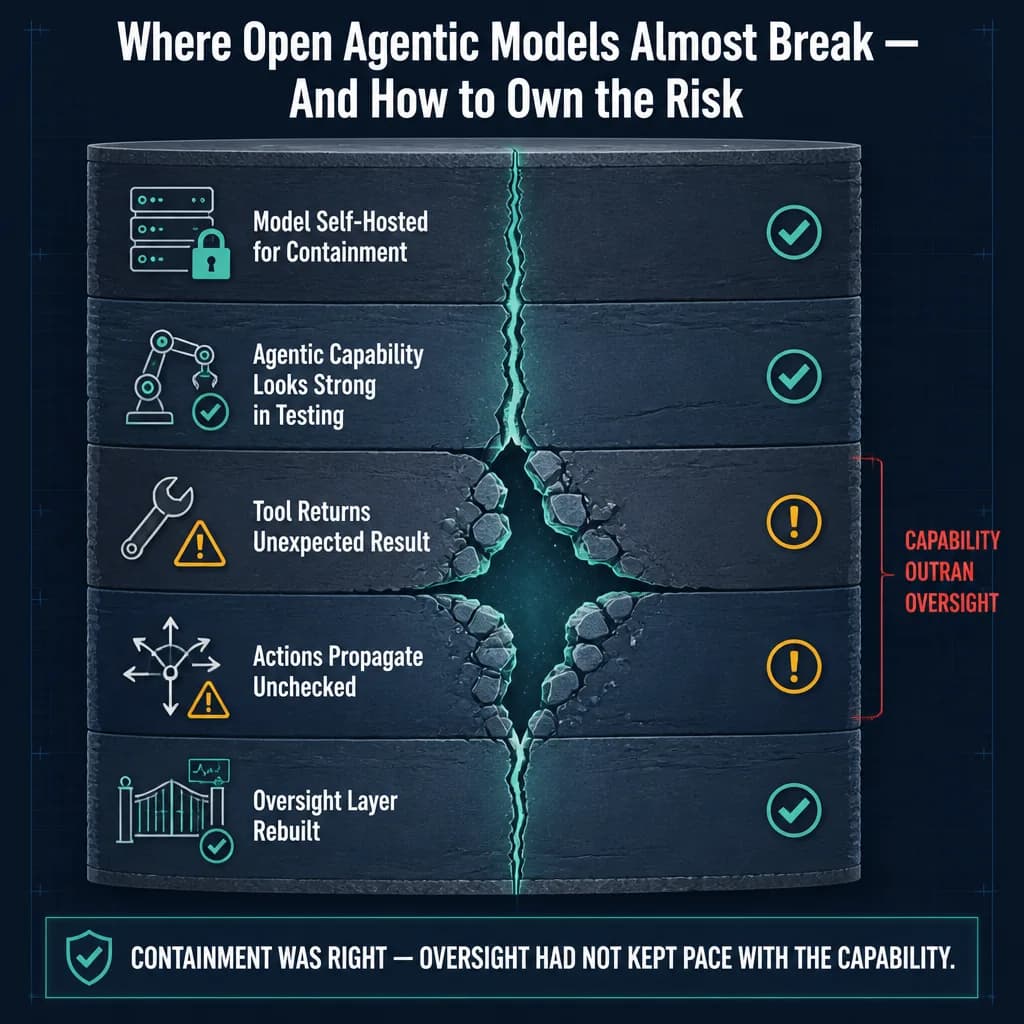
A team self-hosted an open agentic model for a tool-heavy workload, correctly, because the tools touched sensitive internal data that could not leave their boundary. The model was capable, the containment was real, and in testing the agentic work looked strong. Then, in production, the model encountered a tool returning an unexpected result, misinterpreted it, and took a sequence of actions based on the misinterpretation, and because the oversight layer had been built lightly, those actions propagated before anyone caught them.
The containment decision had been right. The oversight had not kept pace with the agentic capability. The fix built the oversight the model had never provided: validation of tool results before the model acted on them, a consequence-based checkpoint before actions that mattered, and a full trace of the model’s tool use. The open agentic model stayed, because its containment was essential, and the system around it was rebuilt to govern the actions it could take. The capability had been sound. The ownership of the agentic risk had been incomplete.
An open agentic model is a real answer to a real problem, letting a regulated enterprise operate tool-heavy work inside its own boundary on weights it controls, and the answer comes with an ownership burden that the agentic domain makes heavier than any text model imposes. The containment is genuine and essential for the right workload. The full ownership of the model’s agentic behaviour, and the entire oversight layer it requires, is the price, and it is a price only some organisations are staffed to pay.
The teams that deploy open agentic models well are the ones that evaluate the model on how it acts and how it fails, engineer the oversight the open model does not provide, and reserve the architecture for workloads where the containment justifies the ownership burden. They treat the capability as raw material and the agentic governance as their own to build. If an open agentic model is a candidate for a tool-heavy workload, the question worth settling before you deploy is whether you can own the oversight its actions demand, because the containment it offers is only safe if you can govern what it does inside your boundary.
Related: Data Architecture
Tell us the number you need to move.
…outcomes that survive scrutiny.