Latency in Conversational Voice AI: The Trade-off That Decides Whether It Sounds Human
Two voice agents can give the identical answer and land completely differently. One feels like a conversation. The other feels like talking to a machine on a satellite delay. The words are the same, the reasoning is the same, and the difference is entirely a matter of milliseconds, because human conversation operates on a timing budget that voice agents routinely blow. Latency in conversational voice AI is the constraint that decides whether an agent sounds human, and it sits in direct tension with almost every capability teams want to add.
If you operate a voice deployment, this is the trade-off you cannot design your way out of. Every improvement that makes the agent smarter tends to make it slower, and every millisecond of slowness erodes the naturalness that makes callers trust it. The reasoning that would produce a better answer takes time, the retrieval that would ground it takes time, and the caller sitting in silence is forming a judgment about the whole system while it thinks. Managing that tension is the core engineering problem of voice, and it does not have a free solution.
Why voice has a latency budget text never had
Text tolerates delay. A chatbot can take two seconds to respond and nobody notices, because text carries no expectation of conversational rhythm. Voice is unforgiving in a way text is not, because humans have deeply ingrained expectations about response timing in spoken conversation. A natural gap between turns is measured in a few hundred milliseconds. Push past roughly a second of silence and the pause becomes conspicuous. Push further and the caller starts to wonder whether the line dropped, whether the agent heard them, whether anything is happening at all.
That expectation gives voice a hard latency budget the meaning layer never has to respect. The agent can produce a perfect answer, and if it arrives after an unnatural silence, the caller has already registered the delay and downgraded the experience. This is why latency in voice is a first-class design constraint rather than a performance detail to optimise later. The budget is fixed by human perception, and every component in the pipeline spends against it.
The latency stack, and where the milliseconds actually go
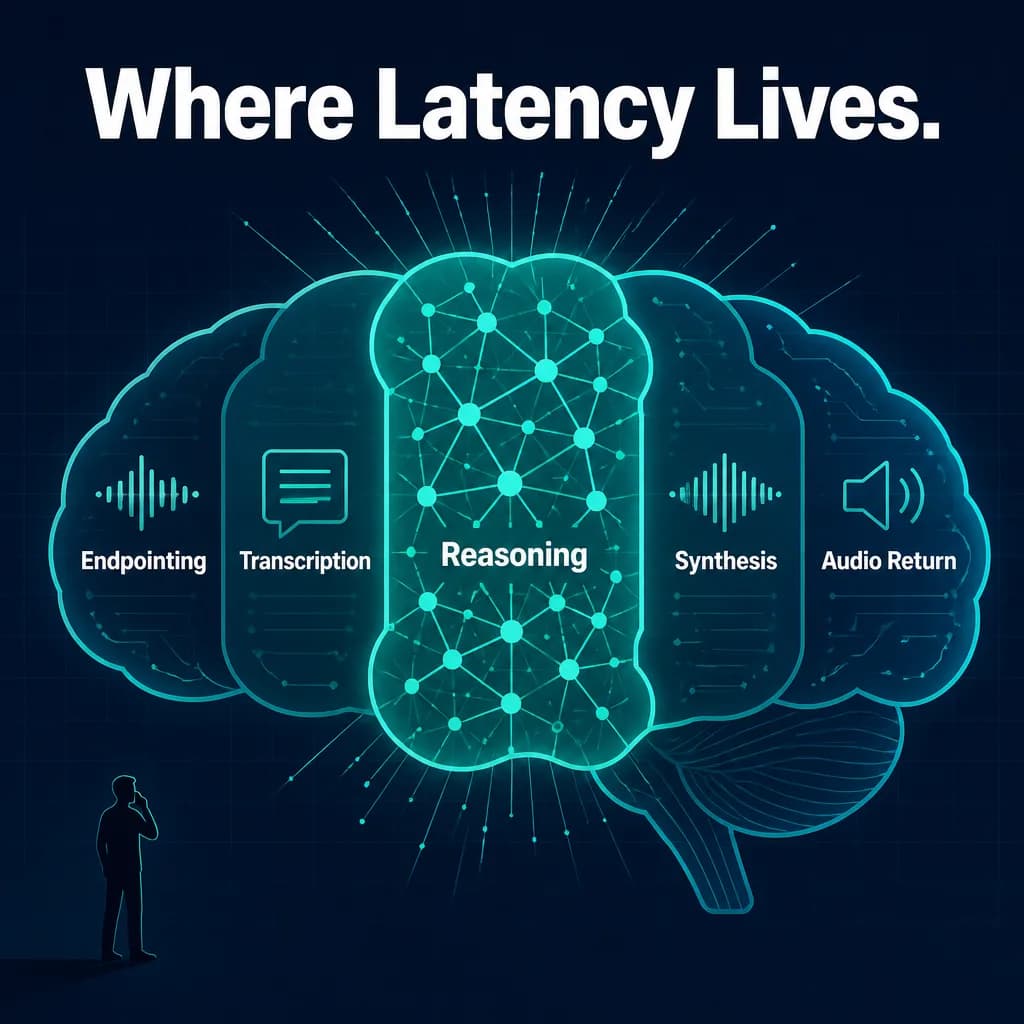
The total delay a caller experiences is the sum of a chain, and understanding where the time goes is the whole game. The caller finishes speaking, and first the system has to decide they finished, which is the endpointing delay, the wait to confirm the turn is over. Then speech-to-text transcribes the audio. Then the agent reasons, which may include retrieval and tool calls. Then the response gets synthesised into speech. Then that audio streams back to the caller. Every stage adds latency, and they add sequentially, so the caller’s experience is the sum of the entire chain.
This structure matters because it locates the real problem. The reasoning step is where teams add capability, and it is also the most variable and often the largest contributor. A single model call is one thing. An agent that retrieves context, calls a tool, then reasons over the result has stacked several sequential operations, and the compounding latency of multi-step trajectories shows up directly as dead air on the call. The p99 matters more than the average here, because the caller does not experience your mean response time. They experience the slow calls, and one long silence in an otherwise fast conversation is the moment they lose confidence.
The techniques that buy time, and what each costs
There are ways to stay inside the budget, and each carries a trade-off worth naming. Streaming is the most important. Rather than waiting for the entire response to be generated before speaking, the agent begins synthesising and playing audio as the first words are produced, which collapses perceived latency dramatically because the caller hears speech start almost immediately. Streaming is close to mandatory for natural voice, and it constrains your architecture, because every stage has to support incremental processing rather than waiting for complete inputs.
Filler and backchanneling buy perceived time. A brief acknowledgment while the agent works fills the silence the way a human says “let me check that for you,” and it makes a longer operation feel attended-to rather than dead. Used carelessly it feels canned, so it has to be sparing and natural. The deeper trade-off is between reasoning depth and speed. A more capable answer that requires more retrieval and more reasoning steps costs latency the budget may not have, which forces a real decision: how much intelligence can you afford before the delay costs you more than the smarter answer gains you. Model choice sits inside this, because a larger, slower model produces better reasoning and spends more of the budget doing it, and the right choice for voice is frequently a faster model that answers in time over a stronger one that answers late.
None of these eliminate the tension. They manage it, and managing it is a continuous engineering discipline rather than a one-time fix, because every capability added downstream spends against the same fixed budget. This is exactly the class of constraint our EVIO calling platform is engineered around, where latency is treated as a hard budget the whole pipeline is designed to respect.
The half-second that made callers talk over it
We operated a voice agent and improved its answer quality by adding a retrieval step that grounded responses in current information. The answers got measurably better and the calls got worse. The retrieval added enough latency that callers were now sitting through a conspicuous silence after every question, and the traces showed rising abandonment right at that pause. We had improved the thing we were measuring, answer quality, and degraded the thing that actually determined whether callers stayed, which was rhythm.
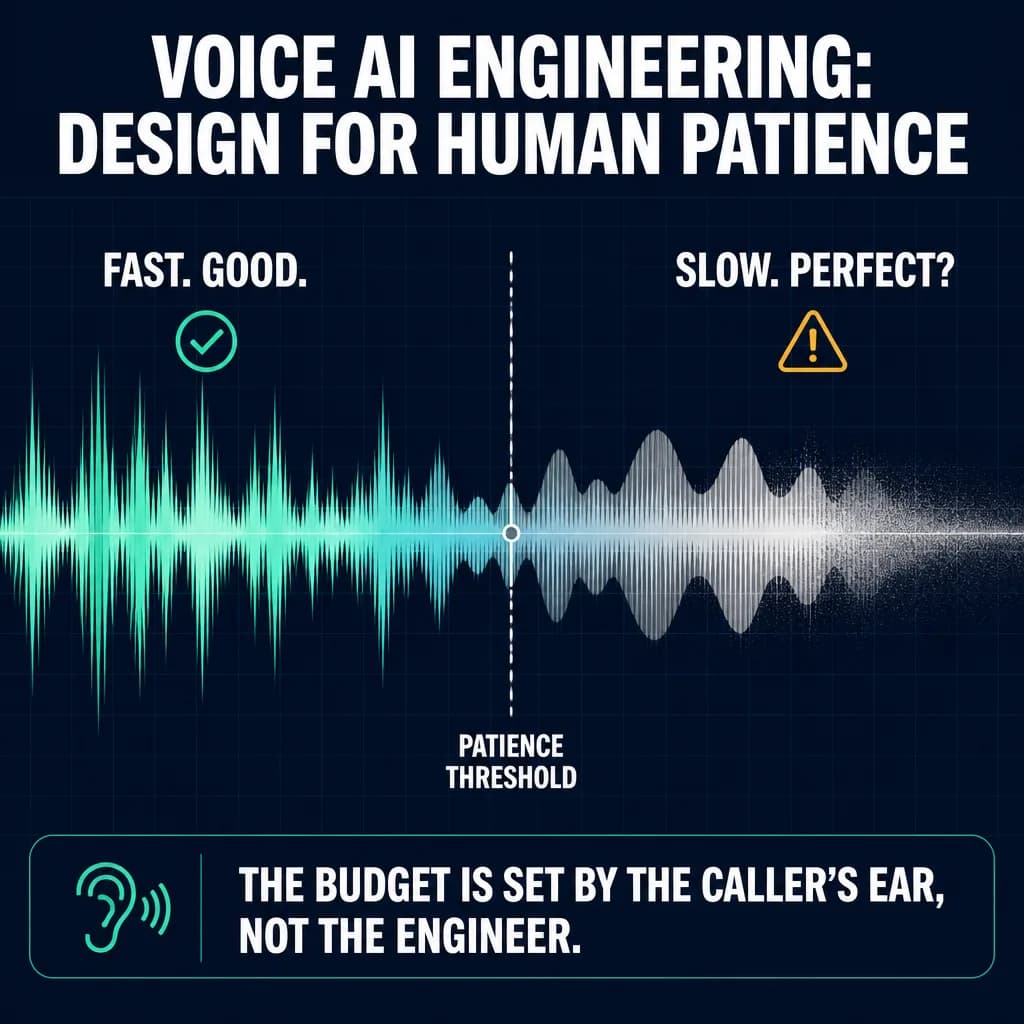
The fix worked the latency budget from several angles at once. We added streaming so the agent began speaking as soon as it had the opening of a response, rather than waiting for the full answer. We added a brief natural acknowledgment to cover the retrieval, so the caller heard the agent working instead of silence. And we tightened the retrieval itself, accepting a slightly less exhaustive context in exchange for landing inside the timing budget. The answers stayed strong and the calls felt human again. The lesson was that a better answer delivered late is worse than a good answer delivered in time. The budget is set by the caller’s ear, and we do not get a vote.
The fastest good answer beats the slow perfect one
The discipline that survives every voice deployment is respecting the budget the caller’s ear imposes. Latency in conversational voice AI is a fixed constraint that every capability spends against, and the agents that feel human are the ones engineered to stay inside it even when that means choosing a faster path over a more thorough one. Intelligence that arrives after the caller has given up on the pause was never delivered.
The teams whose voice agents sound natural are the ones who treated latency as a hard budget from the first architecture diagram, then made deliberate trade-offs about how much reasoning, retrieval, and model weight they could afford before the delay cost more than the capability bought. A voice agent lives or dies on timing as much as on correctness. The answer has to be right, and it has to arrive when a person would have answered, because on a live call those are two separate requirements and the second one is the one callers feel first.
Related: Agentic AI
Tell us the number you need to move.
…outcomes that survive scrutiny.