Llama 4, Mixture-of-Experts, and Sovereign Deployment: Reading the Open-Weight Shift
An open model built on a mixture-of-experts architecture changes the operational calculus of self-hosting in a way that matters specifically for sovereign and private deployment, and reading that change is more useful than treating the model as just another capable open option. Mixture-of-experts architectures activate only a portion of the model’s parameters for any given request, which changes the relationship between the model’s total size and its serving cost, and for an organisation self-hosting an open model in a sovereign environment, that architectural change has real operational consequences worth understanding. The open-weight shift that a capable mixture-of-experts model represents is an architectural shift as much as a capability one, and the architecture is where its significance for sovereign deployment lies.
The appeal of a capable open model for sovereign deployment is established: it lets the organisation operate capable AI entirely within its boundary, which sovereignty requirements demand. A mixture-of-experts architecture adds something specific to that appeal, changing the serving economics of self-hosting in a way that can make sovereign deployment more practical, while introducing operational characteristics that the organisation self-hosting it has to understand and manage. Reading the mixture-of-experts open model for sovereign deployment means understanding what its architecture changes operationally, because that architectural change is what distinguishes it from a dense open model of similar capability.
What mixture-of-experts changes operationally
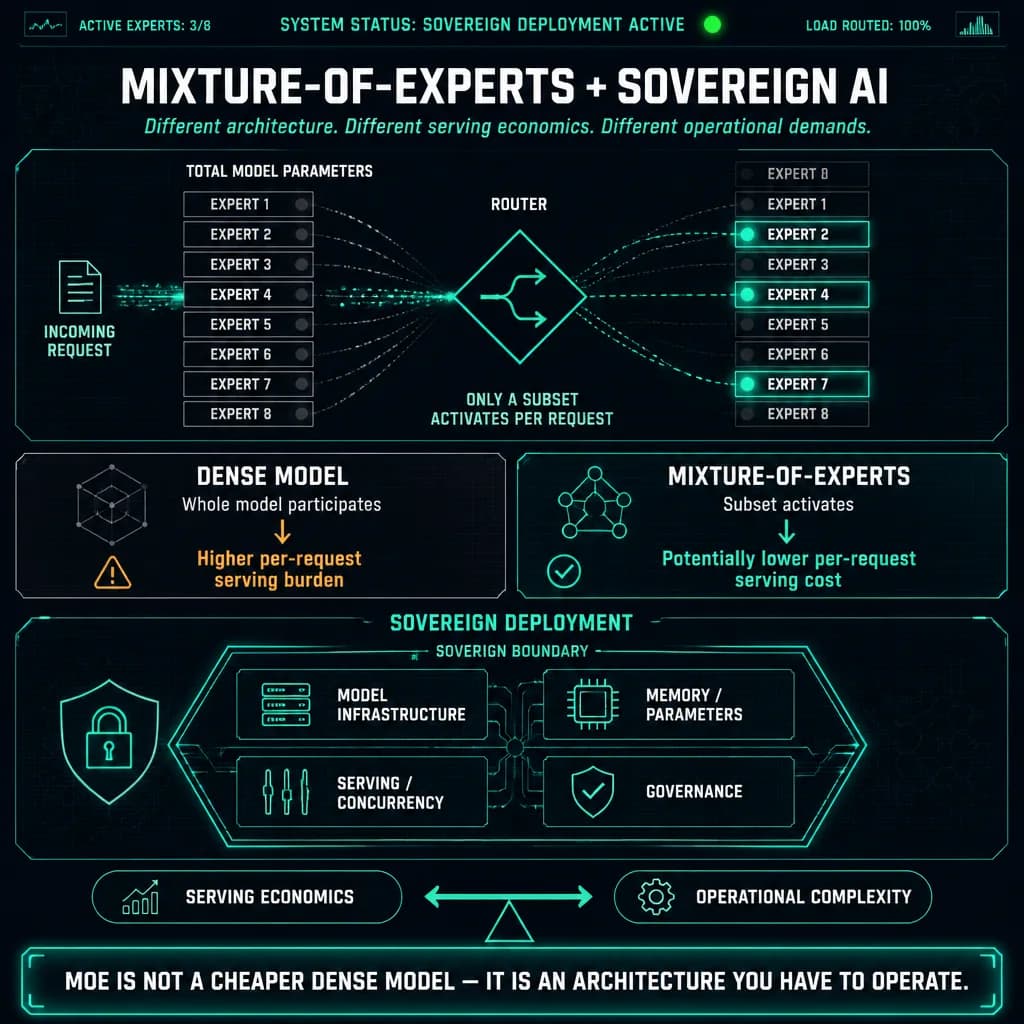
A mixture-of-experts architecture activates only a subset of the model’s parameters for any given request, routing the request to the relevant experts rather than engaging the whole model. This changes the relationship between total model size and per-request serving cost: a mixture-of-experts model can have a large total parameter count, giving it capability, while activating only a portion of those parameters per request, making each request cheaper to serve than the total size would suggest for a dense model.
Seeing what the architecture changes matters because it affects the operational calculus of self-hosting. For an organisation self-hosting an open model in a sovereign environment, serving cost and the infrastructure required to serve are central concerns, and a mixture-of-experts architecture changes both, potentially delivering the capability of a large model at a per-request serving cost closer to a smaller one. A production AI system self-hosting a mixture-of-experts model has a different serving economics than one self-hosting a dense model of similar capability, and that difference is part of what reading the architecture for sovereign deployment reveals.
The operational characteristics to understand
Here is the position worth holding. A mixture-of-experts architecture changes the operational characteristics of self-hosting, not just the serving cost, and an organisation self-hosting a mixture-of-experts model in a sovereign environment has to understand and manage those characteristics rather than treating the model as a drop-in for a dense one. The architecture is not only a cost advantage; it is a set of operational characteristics that the self-hosting organisation owns.
The operational characteristics are specific. The infrastructure to serve a mixture-of-experts model differs from a dense model, because the total parameters still have to be held even though only a subset activates per request, which has memory implications the organisation’s infrastructure has to meet. The serving behaviour under concurrent load differs, because the routing to experts interacts with batching and concurrency in ways the organisation has to understand to serve efficiently. The performance characteristics can vary with the request, because different requests activate different experts. An organisation self-hosting a mixture-of-experts model in a sovereign environment has to understand these to operate it well, and a governed AI deployment of a mixture-of-experts model manages these architectural characteristics rather than assuming the model serves like a dense one.
Reading the shift for sovereign deployment specifically
For sovereign deployment specifically, the mixture-of-experts open model is worth reading as a development that can make sovereign self-hosting more practical, because its serving economics can lower the infrastructure burden that sovereign self-hosting imposes, while still requiring the organisation to own and manage the architecture’s operational characteristics. The sovereignty requirement makes self-hosting mandatory, and the mixture-of-experts architecture can make that mandatory self-hosting more economical, which matters for organisations for whom the serving cost of self-hosting a capable dense model in a sovereign environment was a significant burden.
This reading places the mixture-of-experts open model correctly for sovereign deployment. It is not just another capable open model; it is one whose architecture can improve the serving economics of the sovereign self-hosting that sovereignty requires, while adding operational characteristics the organisation must manage. The organisation reading it for sovereign deployment weighs the serving-economics advantage against the operational characteristics it takes on, and against the same provenance and governance considerations any open model raises in a sovereign context. Owning the sovereign deployment means reading the mixture-of-experts architecture for what it changes in the serving economics and operational characteristics of the sovereign self-hosting the organisation is already committed to.
The trade-off worth naming
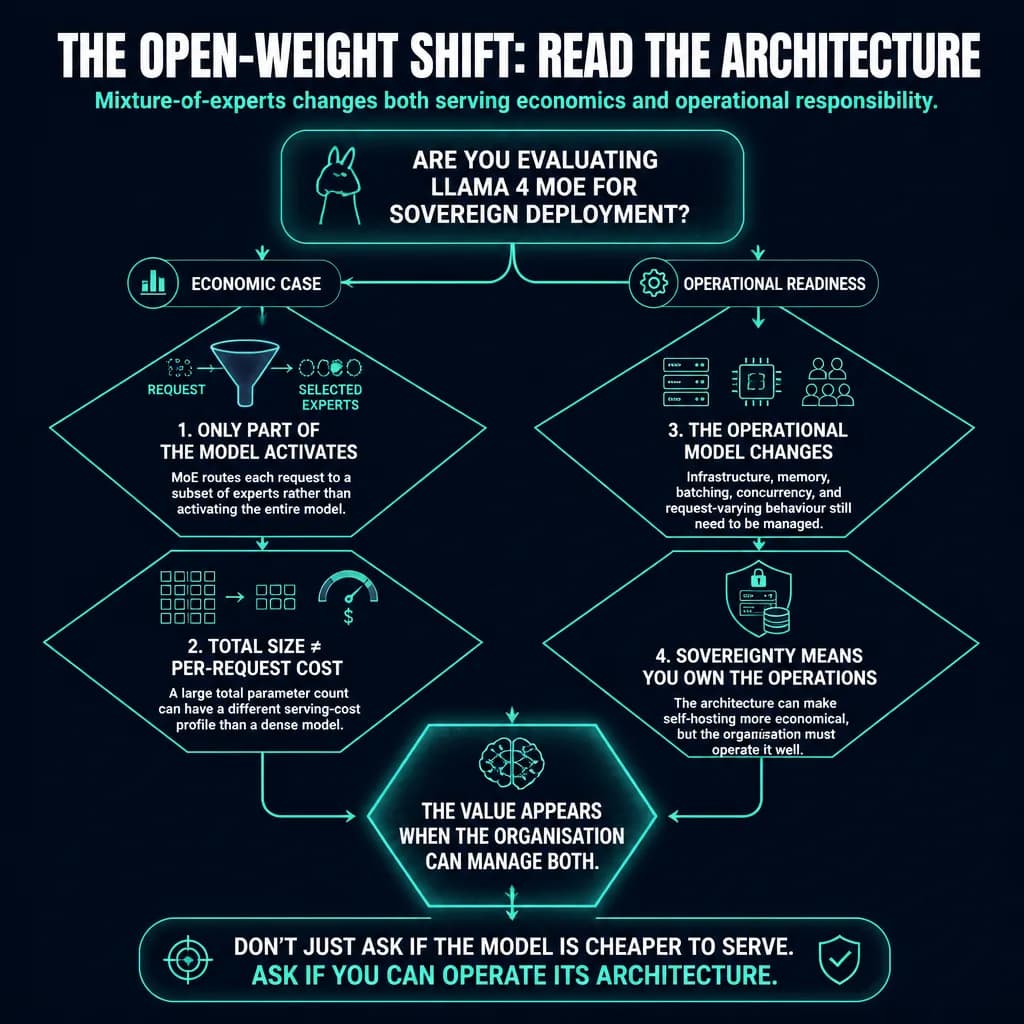
A mixture-of-experts architecture trades a more favourable serving economics for a more complex set of operational characteristics to manage, and the trade is worth naming because the cost advantage is salient and the operational complexity is easy to underweight. The favourable serving economics, capability at a lower per-request serving cost, is attractive and visible, and the operational characteristics, the infrastructure and serving behaviour the architecture introduces, are less visible and require the organisation’s competence to manage. For an organisation with the operational depth to manage the architecture, the serving-economics advantage is worth the complexity, particularly in a sovereign context where serving cost matters. For one without that depth, the operational characteristics are a burden that the cost advantage may not offset.
Where the reading almost went wrong
An organisation self-hosting a mixture-of-experts open model in a sovereign environment adopted it for its favourable serving economics, expecting the lower per-request serving cost to reduce its sovereign self-hosting burden, which the architecture did offer. The organisation then found that the architecture’s operational characteristics, the infrastructure to hold the full parameters and the serving behaviour under its concurrent load, were more demanding than it had planned for, because it had read the mixture-of-experts model as a cheaper-to-serve dense model rather than as an architecture with its own operational characteristics to manage.
The serving-economics advantage had been real, and the operational characteristics had been underweighted. The organisation built the operational competence the architecture required, meeting its infrastructure demands and tuning its serving for the architecture’s concurrency behaviour, and the mixture-of-experts model then delivered its serving-economics advantage within a sovereign deployment the organisation could operate well. Reading the architecture correctly, for both its cost advantage and its operational characteristics, had been the missing step.
An open mixture-of-experts model is worth reading as an architectural shift as much as a capability one, because its architecture changes the serving economics and operational characteristics of the self-hosting that sovereign deployment requires. The mixture-of-experts architecture can make sovereign self-hosting more economical, delivering capability at a lower per-request serving cost, and it introduces operational characteristics the self-hosting organisation has to understand and manage, and reading it for sovereign deployment means seeing both.
The organisations that read the open-weight shift well for sovereign deployment are the ones that understand what the mixture-of-experts architecture changes operationally, weigh its serving-economics advantage against the operational characteristics it introduces, and build the competence to manage the architecture within their sovereign environment. They treat it as an architecture to operate, not a cheaper dense model to drop in. If a mixture-of-experts open model is a candidate for your sovereign deployment, the question worth asking is not just whether it is capable and cheaper to serve but whether you can manage its operational characteristics within your boundary, because that architecture, and not its capability alone, is what determines whether its serving-economics advantage translates into a sovereign deployment you can actually operate.
Related: Data Architecture
Tell us the number you need to move.
…outcomes that survive scrutiny.