Building an LLM Evaluation Framework Your Team Will Actually Use
The evaluation framework gets built, and then it gets abandoned, which is the fate of most evaluation frameworks. A team builds a thorough evaluation framework, uses it briefly, and then stops, because the framework was too cumbersome to operate, too slow to give feedback, or too disconnected from the team’s workflow to be worth the effort, so it falls into disuse and the team goes back to evaluating by impression. Building an LLM evaluation framework your team will actually use is a different problem from building a technically thorough one, because a framework that is not used provides no value regardless of how thorough it is, and the adoption of the framework depends on it fitting the team’s workflow, not just on its technical completeness. The framework that gets used is the one built for use, not just for thoroughness.
If you build evaluation frameworks, the framework’s value depends on it being used, and a technically thorough framework that the team abandons provides no value, because the evaluation only helps if it is actually operated. The adoption of the framework, whether the team actually uses it, depends on it fitting the team’s workflow and being worth the effort to operate, which are considerations beyond its technical thoroughness. Understanding what makes an evaluation framework actually get used, not just what makes it technically complete, is what lets you build a framework the team adopts rather than one it abandons.
Why thorough frameworks get abandoned

A technically thorough evaluation framework can be abandoned despite its thoroughness, because the thoroughness that makes it complete can also make it cumbersome, and a framework that is too cumbersome to operate is a framework the team stops operating. A framework that takes too long to operate, requires too much effort to use, or gives feedback too slowly to inform the team’s work becomes a burden the team avoids, and it falls into disuse, providing no value because it is not used. The thoroughness is not the problem in itself, but a thoroughness that comes at the cost of usability produces a framework that is complete and abandoned, which is worse than a less thorough framework that is actually used.
The abandonment happens because the framework does not fit the team’s workflow, and a framework disconnected from how the team works is a framework the team does not use. If operating the evaluation is a separate, effortful process rather than an integrated part of the team’s workflow, the team operates it rarely or not at all, because the friction of operating it outweighs the value when it is not integrated into the work. This is the adoption problem applied to the evaluation framework, where the framework’s adoption depends on it fitting the workflow and being worth the effort, and a framework that does not fit is abandoned regardless of its thoroughness. Thorough frameworks get abandoned when their thoroughness makes them cumbersome and their design does not fit the team’s workflow, which produces a complete framework that is not used, and a framework not used provides no value.
Building a framework that gets used
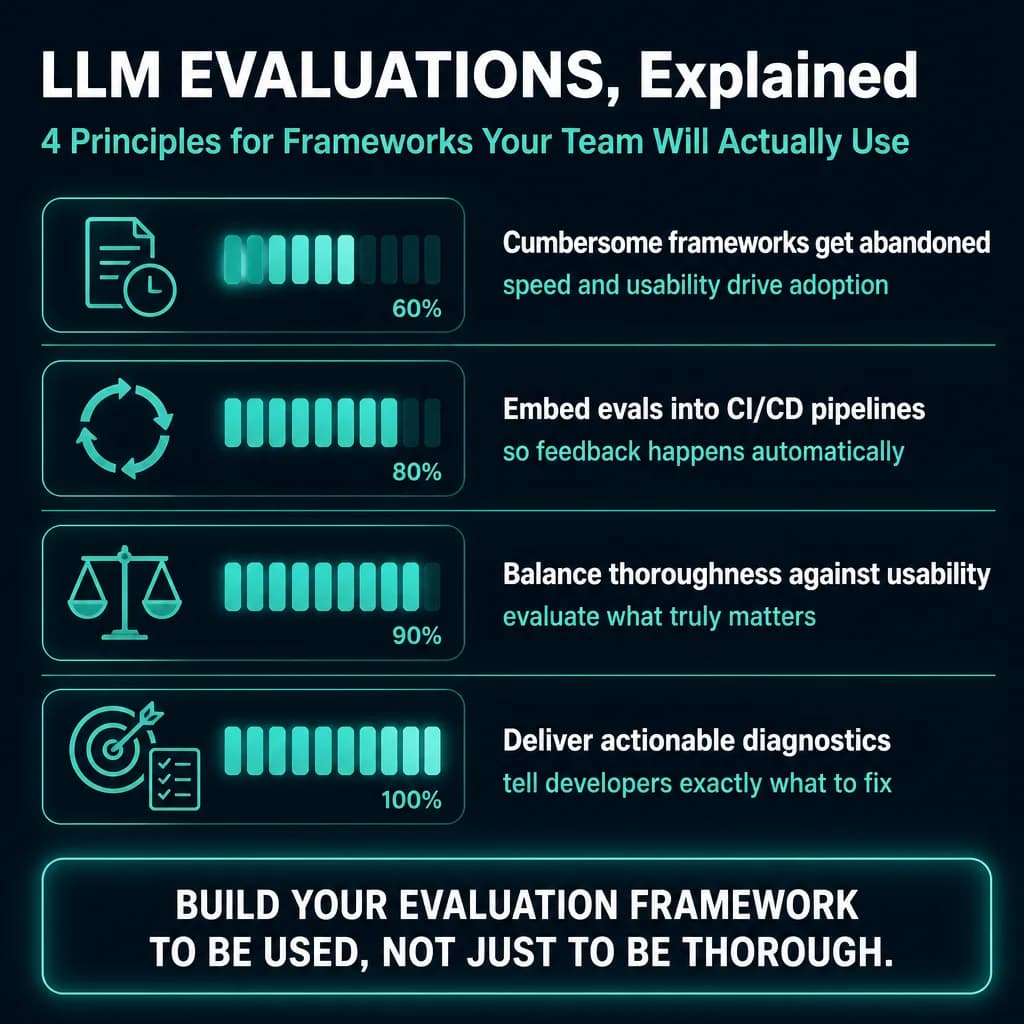
Building an evaluation framework the team will use means designing it for use, so it fits the team’s workflow and is worth the effort to operate, not just technically thorough. The framework has to be usable, easy enough to operate that the team operates it, giving feedback fast enough to inform the team’s work, so operating the evaluation is a low-friction part of the workflow rather than a cumbersome separate process. A framework that operates quickly and easily, integrated into the team’s workflow so operating it is natural, is a framework the team uses, because the friction of operating it is low enough that the value outweighs it.
The framework also has to fit the workflow, integrated into how the team works so the evaluation is part of the development process rather than a separate effort. Integrating the evaluation into the CI/CD pipeline so it operates automatically on changes, giving the team feedback within their workflow, is what makes the evaluation a natural part of the work rather than a process the team has to remember to operate, and this integration is what makes the framework used. The framework has to give feedback the team can act on, clear results that tell the team what to do, so the evaluation informs the team’s work rather than producing results the team cannot use. Building a framework that gets used means making it usable, integrated into the workflow, and actionable, so the team actually operates it and acts on its results, which is what makes the framework provide value. The framework built for use, fitting the workflow and worth the effort, is the one the team adopts.
The trade-off, and thoroughness versus usability
Building a framework for use trades some thoroughness for usability, and naming that trade-off keeps the framework balanced. A maximally thorough framework may be cumbersome, and a maximally usable framework may be too shallow, so building a framework the team uses balances thoroughness against usability, thorough enough to be valuable and usable enough to be used. The framework that provides value is the one that is both adequately thorough and actually used, which means the thoroughness has to be balanced against the usability that adoption requires, rather than maximising thoroughness at the cost of use.
This balance is the judgment, because a framework too shallow does not evaluate well and a framework too cumbersome is abandoned, and the framework that provides value is thorough enough to evaluate what matters and usable enough that the team operates it. The golden dataset and the evaluation methods provide the thoroughness, and the integration and usability provide the adoption, and the framework balances them, being thorough enough on the evaluation that matters while being usable enough to be adopted. The deeper point is that a framework’s value depends on both its thoroughness and its use, and a framework that is thorough and abandoned provides no value, so building for use, balancing thoroughness against the usability adoption requires, is what makes the framework provide value. Balancing thoroughness against usability, so the framework is both valuable and used, is what makes the evaluation framework one the team actually uses.
Where it almost broke
We built a thorough evaluation framework for a team, technically complete and comprehensive, and the team abandoned it, because it was too cumbersome to operate, taking too long and requiring too much effort, and it was disconnected from the team’s workflow, a separate process the team had to remember to operate rather than an integrated part of the work. The framework was thorough and unused, the team going back to evaluating by impression because the framework was too much friction to operate, and the thoroughness we had built provided no value because the framework was abandoned. We had built for thoroughness and not for use, producing a complete framework the team did not use.
The correction rebuilt the framework for use. We made it usable, faster and easier to operate so the friction was low, integrated it into the team’s CI/CD pipeline so the evaluation operated automatically on changes and gave feedback within the workflow, and made the results actionable so the team could act on them. We balanced the thoroughness against the usability, keeping the framework thorough enough to evaluate what mattered while making it usable enough to be adopted. The team started using the framework, because it fit the workflow and was worth the effort to operate, and the evaluation provided value because it was actually used. The lesson was that a thorough framework provides no value if it is abandoned, and building for use, balancing thoroughness against usability and integrating into the workflow, is what makes the framework one the team actually uses.
Build the framework to be used
The reframe that makes evaluation frameworks provide value is building them to be used, fitting the team’s workflow and worth the effort to operate, rather than building them for thoroughness alone. Building an LLM evaluation framework your team will actually use means making it usable, integrated into the workflow, and actionable, because a thorough framework that the team abandons provides no value, and the framework’s value depends on it being used. The framework that gets used is the one built for use, balancing thoroughness against the usability that adoption requires.
The teams whose evaluation frameworks provide value are the ones that built them to be used, made them usable and integrated into the workflow, and balanced the thoroughness against the usability that adoption required. A technically thorough framework that is too cumbersome to operate and disconnected from the workflow gets abandoned, and an abandoned framework provides no value regardless of its completeness. Building the framework to be used, fitting the workflow and worth the effort so the team actually operates it, is what turns an evaluation framework from a thorough artifact the team abandons into a tool the team uses, which is the difference between a framework that provides value and one that does not.
Related: Agentic AI
Tell us the number you need to move.
…outcomes that survive scrutiny.