LLMOps in Practice: The Operational Layer Between a Model and Production
A team with a mature MLOps practice assumes the hard operational problems are solved. They have model versioning, deployment pipelines, monitoring dashboards, retraining workflows, the whole apparatus built over a decade of putting machine learning into production. Then they deploy an LLM-based system and discover their instrumentation is watching the wrong things. The dashboards are green. The model is serving. And the system is producing outputs that are confidently, fluently wrong in ways nothing in the MLOps stack was built to catch. LLMOps is the operational layer that exists because the move from deterministic models to generative, non-deterministic systems broke assumptions the previous generation of tooling was built on.
This is a different discipline, held well above the level of a rebranded MLOps. The discipline of operating these systems differs because the systems differ in a specific, consequential way: they do not fail the way the tooling expects them to. Understanding exactly where the old assumptions break is the difference between an operational layer that catches problems and one that watches the wrong metrics stay green while users hit the failures.
What MLOps assumes that no longer holds

MLOps matured around models with a particular shape. A classifier outputs a label and a confidence score; a regressor outputs a number. Outputs are bounded, comparable, and checkable against ground truth. Monitoring watches for drift, the input distribution shifting away from training, accuracy degrading against a labelled set, and the failure signatures are statistical and detectable. The whole apparatus assumes you can mechanically tell a right output from a wrong one, which is what makes accuracy a number you can put on a dashboard.
Generative systems break that assumption at the root. The output is open-ended text, held well above the level of a label, and there is frequently no single correct answer to check against. Many outputs are acceptable, many are subtly wrong, and the line between them is often semantic in place of mechanical. A model can produce a fluent, well-formed, authoritative response that is factually wrong, and nothing structural distinguishes it from a correct one. Your MLOps monitoring sees a healthy system: latency is fine, the model is responding, no errors thrown. It cannot see that the responses are wrong, because “wrong” here is a semantic property the tooling was never built to evaluate, held well outside the statistical deviations it does watch. That gap is the whole reason LLMOps has to exist.
The operational primitives LLMOps adds
Closing that gap means instrumenting things MLOps never needed to. Several primitives are load-bearing.
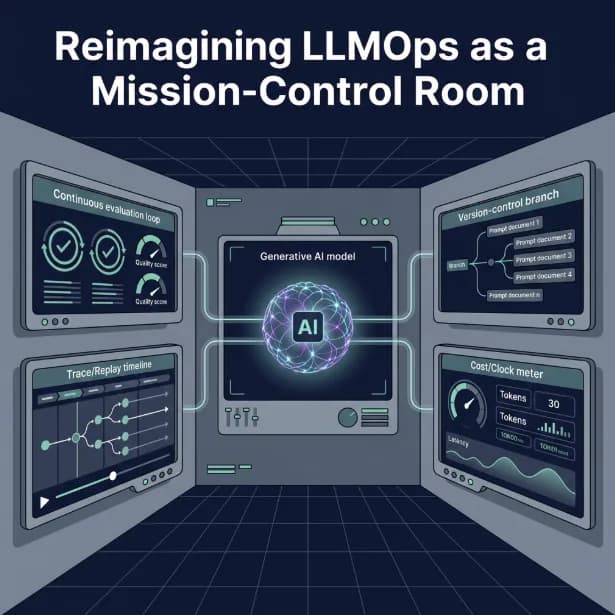
The first is output evaluation as a continuous operation, held well above the level of a pre-deployment gate. Because correctness is semantic, you need an ongoing evaluation harness scoring real outputs against defined success criteria, assertions where outcomes are checkable, calibrated LLM-as-judge where they are open-ended, producing a quality signal the way MLOps produced an accuracy signal. Without it, you have no measurement of the one thing that matters, and you are operating blind behind a green dashboard.
The second is full execution tracing. A deterministic model’s behaviour is reproducible from its input; a generative system’s often is not, and when it is wrapped in retrieval, tools, and memory, the same input can produce different paths. So you capture the entire execution, prompt, retrieved context, tool calls, intermediate outputs, as something replayable, because it is the only way to reconstruct why a system produced a specific output after the fact. In a regulated setting this is also the audit substrate; in every setting it is the only real debugger you have.
The third is prompt and configuration versioning. In MLOps the model artifact is the version. In LLMOps the prompt is a primary determinant of behaviour, which means a prompt change is a deployment, capable of improving one case and silently regressing three others, and has to be versioned, reviewed, and evaluated with the same rigour as a model change. Teams that version the model and treat prompts as casual edits ship regressions they cannot trace, because the thing that changed was outside change control.
The fourth is cost and latency as first-class operational metrics. Generative inference has a variable, consumption-based cost profile MLOps rarely had to watch closely: token usage scales with prompt and output length, and an agentic system’s multi-step trajectories multiply both cost and latency per request. Left unwatched, an innocuous prompt change that lengthens outputs or adds a retrieval hop shows up as a budget overrun and a p99 regression nobody attributed to it. These are operational signals you monitor in real time, held well above the level of finance concerns bolted on later.
Non-determinism is the property that changes everything
Underneath every one of those primitives is the property MLOps never had to fully confront: the same input does not reliably produce the same output. A deterministic system’s correctness generalises, verify an input-output pair once and it holds. A non-deterministic system’s correctness is a distribution, which means testing a case once tells you it can work, held well below the standard of telling you it does reliably, and a system that passes your evaluation on Monday can fail the same case on a repeat.
This reshapes operations concretely. Pre-deployment testing becomes necessary and stops short of sufficient, because passing once is not passing reliably, which forces a heavier reliance on production monitoring than deterministic systems need. Regression detection gets harder, because you are comparing distributions of behaviour alongside exact outputs, and “different” does not cleanly mean “broken.” And the compounding-error arithmetic of multi-step systems means small per-step non-determinism amplifies across a trajectory into wide end-to-end variance. The operational answer is to instrument for non-determinism, measure the distribution, monitor it continuously, and catch the drift in behaviour that a deterministic-systems mindset would never think to watch. Eliminating it sits well outside what is achievable.
What it costs to operate, named plainly
LLMOps is heavier than the systems it supports make it look. The evaluation harness is real engineering that needs continuous maintenance or its coverage decays while confidence stays high. Full-trajectory tracing is meaningful storage and instrumentation. Prompt versioning and review is process overhead on changes that feel trivial and are not. Continuous output evaluation costs compute, often model compute, to operate. A team that budgeted for “deploy the model” and not for the operational layer around it will find the layer costing more than the model integration did, and skipping it does not remove the cost. It defers it to production as incidents.
The honest framing is that this cost is the price of operating a non-deterministic system responsibly, and it is not optional in any environment where wrong outputs have consequences. The alternative is an ungoverned operation that looks fine on the dashboard right up until it doesn’t, held well below the level of a cheaper option.
Where it almost broke
A team we worked with had strong MLOps maturity and brought it to a generative system, monitoring exactly what their existing stack monitored, latency, throughput, error rates, model availability. Every signal was healthy. Meanwhile the system was producing answers that had quietly degraded after a prompt refinement intended to improve tone; the new wording made responses less precise on a subset of queries. None of it registered, because the MLOps instrumentation had no concept of output quality. It watched whether the system responded, and whether the responses were right sat well outside what it could see.
The fix was to build the operational layer the system actually needed: a continuous evaluation harness scoring sampled production outputs against success criteria, trajectory tracing so a degraded answer could be opened and walked through, and prompt versioning so the offending change was identifiable and revertible. The model never changed. What changed is that quality became something the operation could see. The gap was a whole category of failure the previous discipline was not built to watch, and the framing of it as a missing dashboard sat well below what it actually was.
The core of LLMOps is refusing to operate a non-deterministic system with tooling built for a deterministic one. MLOps solved real problems and remains necessary, and it watches for failures that announce themselves statistically, while generative systems fail semantically and silently, fluent, confident, and wrong, behind every green light the old dashboard shows. The operational layer that closes that gap is the difference between knowing your system works and assuming it does, held well above the level of optional polish.
The teams that operate these systems well are the ones who noticed their existing instrumentation was watching the wrong things and built the layer that watches the right ones, quality, trajectories, prompts, cost, continuously, in production, where the failures actually live. The question to put to any LLM system you are operating is not whether the dashboard is green. It is whether the dashboard is even measuring the thing that breaks, because if it is only watching latency and uptime, it will stay green while your users find the failure first.
Related: Agentic AI
Tell us the number you need to move.
…outcomes that survive scrutiny.