LLMs for Earnings Calls and Filings: Faster Research With Verifiable Citations
An analyst covering a portfolio of companies reads more than any person reasonably can. Earnings call transcripts, quarterly and annual filings, footnotes, management commentary, all of it dense, all of it material, and all of it arriving faster than anyone can absorb before the next batch lands. Large language models offer obvious relief, reading a filing in seconds and answering questions about it in plain language. The relief comes with a specific danger that matters more in this domain than almost any other, because an investment decision or a research note built on a fabricated or misattributed fact is a decision built on something that was never true, and the model’s fluency makes the fabrication indistinguishable from the fact. LLMs for earnings calls and filings deliver real research value only when every claim they produce is verifiable against the source document, because in financial research an unverifiable claim is worse than no claim at all.
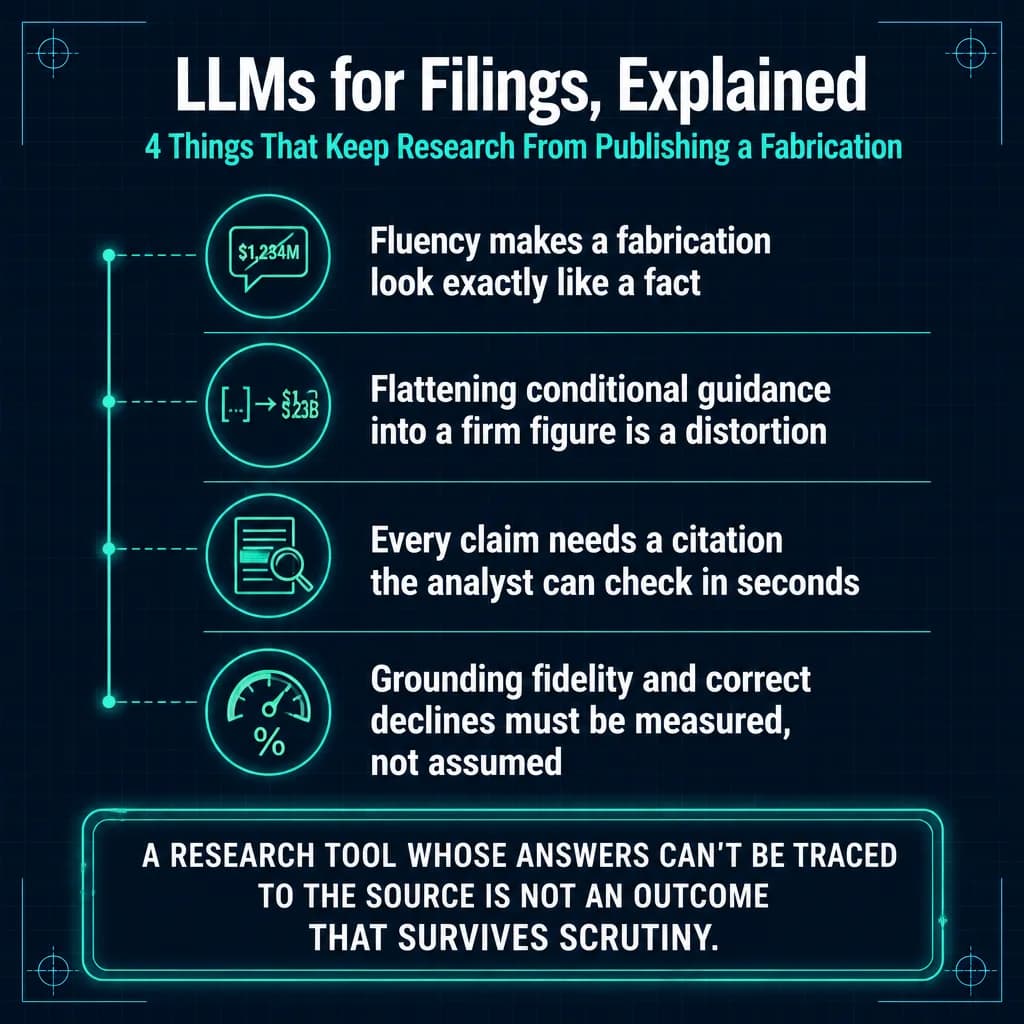
The failure that defines this use case is the confident fabrication. A model asked about a company’s guidance will produce an answer that reads exactly like a correct one whether or not the company said any such thing, and an analyst moving fast, trusting the fluency, can carry a number into a model or a note that the source never contained.
The constraint that owns the workflow

Financial research operates under expectations that make source-fidelity essential. Research that informs investment decisions has to be accurate, and where it is published or shared, it carries obligations around not being misleading and being substantiated by fact. An analyst is accountable for the claims in their work, so a fact drawn from a filing has to actually be in the filing, and a misattributed or fabricated figure is a defect the analyst owns regardless of where it came from. Material information from filings and calls has to be handled correctly, because decisions and communications rest on it. And the basis for a claim has to be traceable, so an analyst and their firm can stand behind what the research asserts.
The failure modes are specific to putting a generative model between the analyst and the source. Fabrication, where the model produces a plausible fact that appears nowhere in the source. Misattribution, where the model attributes a statement to the wrong company, quarter, or speaker, which in financial research is as damaging as inventing it. And the subtle distortion, where the model paraphrases management commentary in a way that shifts its meaning, turning a hedged statement into a firm one or a conditional guidance into a commitment.
The position: a claim without a verifiable citation is not usable
Here is the stance I would hold against the convenience of a fluent answer. In financial research, an LLM’s output is usable only when every claim it makes is tied to a verifiable citation in the source document, and a claim the analyst cannot check against the source is not a research shortcut, it is a liability the analyst has to independently verify anyway, which erases the time the model was supposed to save. The value of the model is not that it produces an answer quickly, it is that it produces an answer the analyst can trust because it points to exactly where in the source the answer came from. Speed without verifiability is not a benefit in this domain, it is a faster path to a wrong number.
The reasoning is about what an analyst actually needs from the tool. An analyst does not need a model’s opinion about what a company said, they need to find and confirm what the company actually said, in the actual document, so they can build on it and stand behind it. A model that answers without citation forces the analyst into a bad choice: trust the fluent answer and risk a fabrication, or independently re-verify everything and lose the time saving. A model that grounds every claim in a specific, checkable location in the source removes that choice, because the analyst can verify any claim in seconds against the citation. So the engineering has to make verifiability the core property, generating claims only from the source and attaching to each one the precise citation that lets the analyst confirm it. A research assistant whose claims cannot be checked has not accelerated research, it has introduced a fabrication risk the analyst now has to manage.
Engineering inside the constraint
The system is grounded strictly in the source documents. It answers questions about a filing or a transcript from the actual text of that document, retrieving the relevant passages and generating claims only from what those passages contain, so the model is reading and reporting rather than composing from memory. Every claim the system produces carries a citation to the specific location in the source, the passage, the section, the point in the transcript, so the analyst can go straight to the source and confirm the claim is real and accurately represented. This is the property that makes the output usable, because it converts trust in the model into trust in a citation the analyst can check.
The system is configured to decline rather than answer when the source does not support a claim, because an honest “the filing does not address this” is a correct answer and a fabricated response is not, and in this domain the willingness to say nothing is a feature. Paraphrasing is handled carefully, preserving the hedging and conditionality of management commentary rather than flattening it into false certainty, because a distortion of meaning is a subtler fabrication that a citation to the source lets the analyst catch. A governed institutional-knowledge engine like COMPASS that binds every answer to its cited source is what enforces this, keeping the claim and its provenance together so the analyst never receives an assertion they cannot trace.
The system is evaluated against an explicit standard for grounding fidelity and citation accuracy, measuring how often its claims are actually supported by the cited source and how often it correctly declines when the source is silent, operated repeatably as the model and document set change, which is the work a rubric-based evaluation engine like PRISM is built to carry. The analyst stays the accountable party, with the model accelerating the finding and confirming of facts rather than replacing the analyst’s judgment, which is the right placement of the human for research that informs decisions the analyst owns.
Where it almost broke
A firm deployed an LLM research assistant that let analysts query filings and earnings transcripts in natural language, and it was fast and fluent and quickly popular. The assistant answered questions well, and analysts began to rely on its answers directly. An analyst preparing a note asked the assistant about a company’s forward guidance and received a specific, confident figure, which went into the note. The figure was wrong. The company had discussed a range with heavy conditionality, and the model had resolved that hedged commentary into a single firm number that appeared nowhere in the transcript, and because the answer read exactly like a correct one, the analyst had not caught it before the note went out.
The model was fluent and unmoored from the source, and the fluency was the problem, because it made a fabrication look like a fact. The fix was to require every claim to carry a citation to the specific point in the source, to ground the model strictly in the document text, and to preserve the conditionality of management commentary rather than flattening it, so an analyst receiving a guidance answer could see exactly what the company said and how hedged it was. After the change, every answer pointed to its source and analysts verified in seconds rather than trusting blind. A research assistant that answers without showing its source is not saving the analyst time, it is setting them up to publish something that was never said.
LLMs for earnings calls and filings can give analysts genuine relief from a reading load no person can fully carry, finding and surfacing the facts buried in dense filings and transcripts in seconds. That relief is only real when every claim the model produces is verifiable against the source, tied to a specific citation the analyst can check, because the alternative is a fast tool that occasionally invents a number and hides the invention behind fluent prose. The model’s speed matters. Its verifiability is what makes the speed usable.
A firm deploying a research assistant should ask whether every claim it produces points to exactly where in the source it came from, because a claim the analyst cannot check is a claim the analyst has to verify from scratch. A research tool whose answers cannot be traced to the source is not an outcome that survives scrutiny.
Related: Banking & Financial Services · Reserve Bank Innovation Hub: Automated grievance workflows with natural-language access and a complete audit record · IndusInd Bank Limited: AI-Powered Knowledge Source-Based Process Training and Query Resolution
Tell us the number you need to move.
…outcomes that survive scrutiny.