LOUPE, Explained: Guided Form-Filling for High-Stakes Submissions
Some forms are expensive to get wrong. A loan application, an insurance submission, an accreditation dossier, each is a high-stakes submission where a single missing field, an invalid document, or an inconsistent entry stalls the whole process, triggers rework, or causes a rejection that costs far more than the form itself. The people filling these out are often doing it for the first time, under pressure, without a clear view of what is required. The result is incomplete submissions, endless back-and-forth, and delays that frustrate everyone involved.
This is the problem LOUPE is built to solve, and the hard part sits in the word high-stakes. Filling a simple form is trivial. Guiding someone through a complex, consequential submission so that it arrives complete, valid, and consistent the first time is a genuine engineering problem, because the cost of an error is real and the person filling it in usually cannot see the error coming.
Why complex submissions fail
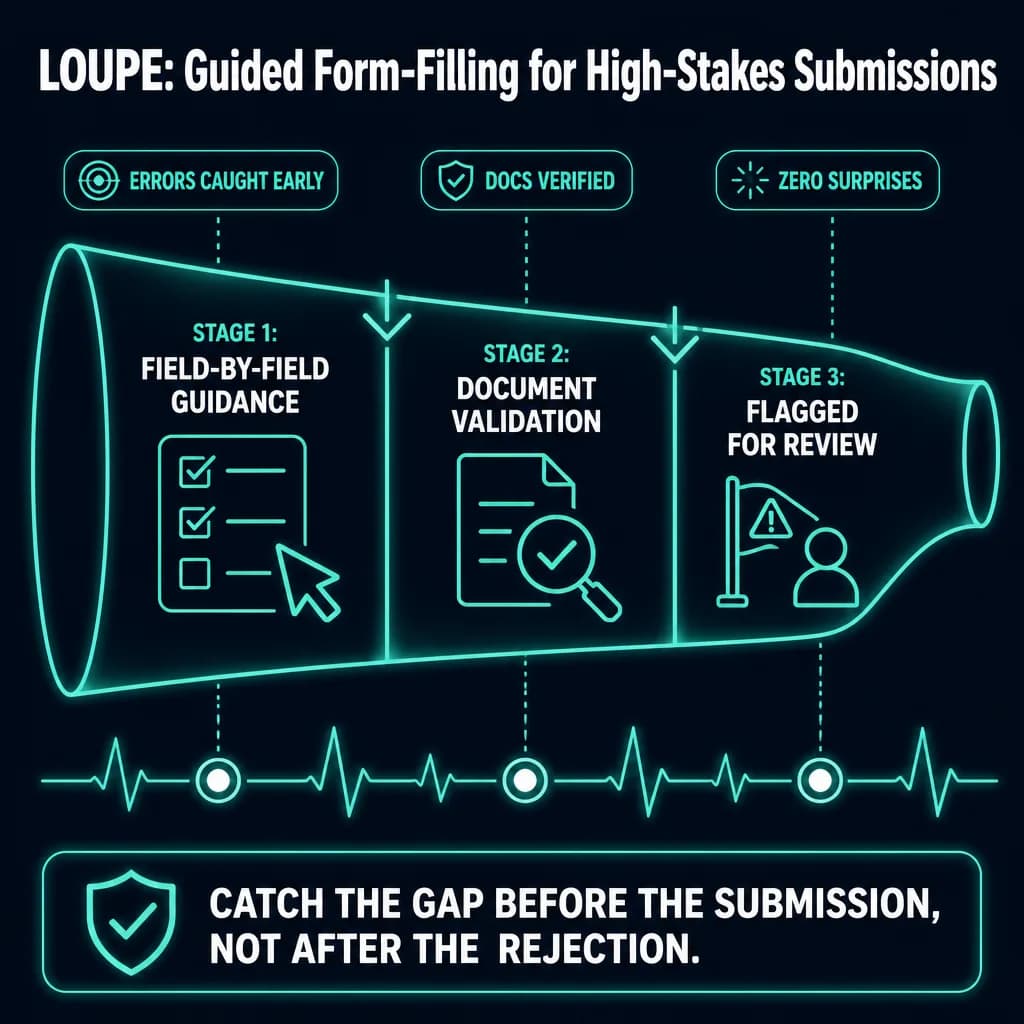
Complex submissions fail in predictable ways. The applicant does not understand a requirement and guesses. A required document is missing, incomplete, or expired, and no one notices until review. Entries contradict each other or violate a rule the applicant never knew about. Each of these is discovered late, at the review stage or after a rejection, when fixing it means a full round-trip and a delay. The failures are cheap to prevent at the point of entry and expensive to catch afterward, and traditional forms catch them afterward.
So the useful capability is validation at the point of entry: guiding the person through each requirement, confirming documents are present and valid as they go, and catching the gap before the submission is made rather than after it is rejected. Preventing the error where it happens is worth far more than detecting it downstream.
What LOUPE actually does
LOUPE walks a user through exactly what to enter, field by field, confirms that uploads are complete and valid, and validates entries as they go, built for accreditation journeys and loan and insurance applications where a missed field is expensive. It moves the checking to the moment of entry, so problems surface while the applicant is still there to fix them.
Deployed for a healthcare accreditation process spanning hundreds of requirements, this approach cut application preparation effort by seventy to eighty percent and document validation time by around ninety percent, while making submissions dramatically more complete on first pass. The value is not only the applicant’s time saved. It is the collapse in rework and rejection, because a submission that arrives complete and valid the first time does not generate the expensive downstream cycle that incomplete submissions do.
Guiding without deciding is the discipline
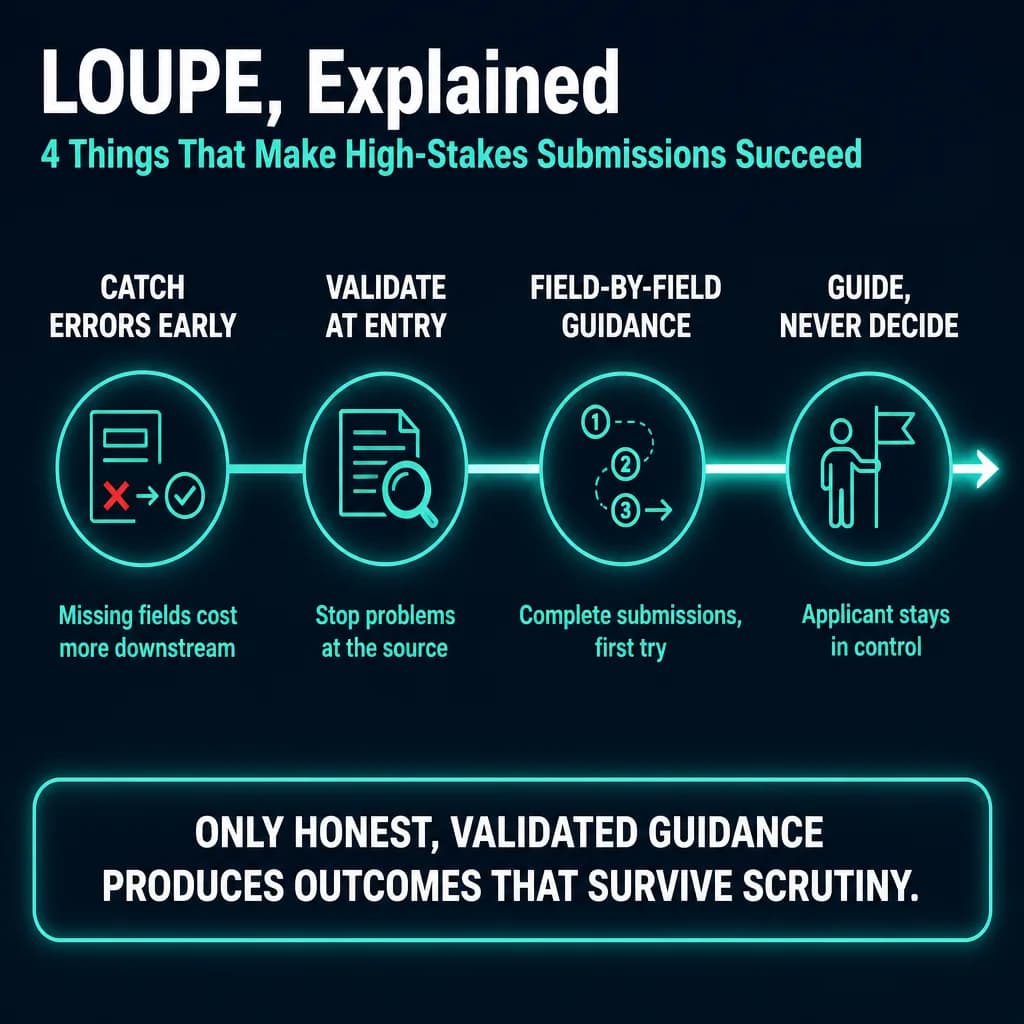
The line LOUPE has to hold is between guiding and deciding. In a high-stakes submission, the applicant is responsible for what they submit, and the assessor is responsible for the judgement on it. LOUPE guides the applicant to a complete, valid submission and it does not make the substantive decision for either party. It ensures the form is right, and it leaves the judgement to the humans who own it.
The near-miss to design against is a guided system confident enough to fill or validate something it has not correctly understood, letting an error through under the appearance of a check. The correction is to surface uncertainty rather than resolve it silently: when the system is not sure a requirement is met, it flags it for the person instead of quietly passing it. That keeps the applicant in control and the guidance honest, and it is the difference between a co-pilot that reduces errors and one that introduces new ones while looking helpful.
LOUPE turns a fragile, error-prone submission process into one where complex applications arrive complete and valid the first time. The value is the elimination of the rework, delay, and rejection that incomplete submissions cause, in exactly the settings where those failures are most expensive. An operator building guided submission systems keeps the line between guiding and deciding clear, because a co-pilot that oversteps introduces the errors it was meant to prevent, and only honest, validated guidance produces outcomes that survive scrutiny.
Related: Loupe, Application Assistant - PYZO · About Us · Whirlpool: Intelligent document processing with automated validation workflows
Tell us the number you need to move.
…outcomes that survive scrutiny.