NABH Accreditation Readiness: Keeping Evidence Audit-Ready All Year
Six weeks before a surveillance visit, the quality manager of a mid-sized hospital opens the evidence folder and begins the familiar hunt. The fire safety certificate is somewhere in the administration office. The infection control committee's minutes for two quarters were never scanned. None of this means the hospital delivers poor care. It means the evidence of good care is assembled in bursts, under deadline, by a small team. NABH accreditation with AI support can turn that burst into a steady discipline, provided the tools check the substance of each document as well as its presence.
Why accreditation evidence decays between assessments
NABH's 6th edition of hospital standards took effect on 1 January 2025, with a sharper emphasis on patient safety and on how hospitals adopt digital health. Every new application is now assessed against it, and hospitals already accredited move to it at their next assessment. The standards ask for a great deal of documentary evidence: policies, training records, quality indicators, committee minutes and statutory licences, each mapped to the standard it satisfies.
That evidence ages from the day it is filed. Licences expire on their own schedules. Policies are revised but the old version stays in the folder. Training records fall behind when staff turn over. Quality indicators are collected monthly but reviewed only when someone asks. Between assessments, nobody's job is to watch the whole picture, so the gap between the hospital's practice and its evidence grows unnoticed until the next visit forces a reckoning.
The cost is more than stress. Last-minute assembly produces errors an assessor will notice: a document that does not match what the hospital declared, or an indicator report with months missing. Each one raises a question about the system behind it.

Checking the substance of every document
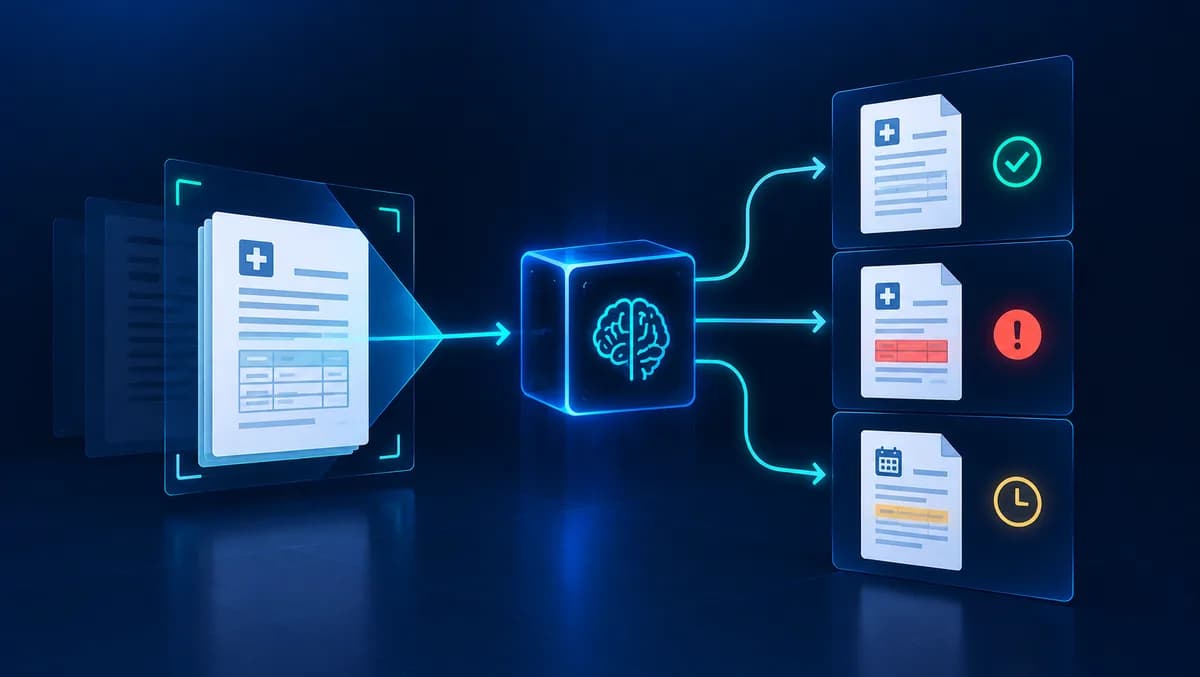
The first role for AI is at the point of entry. When a coordinator uploads a document against a standard, a guided assistant can check that it is the document the standard asks for, and that its details, including its validity, agree with what the hospital has declared elsewhere. A biomedical waste authorisation should name the same facility and cover the same number of beds the hospital reports. A training record should list staff who appear on the current roster. Discrepancies are flagged while the coordinator is still at the form, when the fix takes minutes.
The second role is watching the register between assessments. Every document carries an expiry or a review date, and the assistant warns the owner well before it lapses. Monthly indicators that have not been entered appear as gaps on the quality manager's dashboard in the month they fall due, instead of in the week before a visit.
This is the work LOUPE is engineered for: a co-pilot that guides entries field by field and validates uploads for completeness and consistency, so the evidence a hospital submits matches the hospital as it stands. The quality manager still decides what the hospital declares and how it meets each standard. The assistant makes sure the paperwork supports that decision.
Keeping the quality team in charge
Accreditation is a judgement about how a hospital delivers care, and no software can make that judgement on a hospital's behalf. The assistant should never mark a standard as met. It reports which evidence is missing or in conflict, and the quality team decides what to do about each gap.
The design also has to respect who enters the evidence. Coordinators in a busy hospital fill forms between other duties, often on shared computers. Guidance in plain language, at the field where it applies, does more for completeness than a long instruction manual. Where the hospital's staff work in Hindi or a regional language, the guidance should follow them.
The digital health emphasis in the 6th edition makes this more relevant. A hospital that keeps its accreditation evidence in a governed, searchable form demonstrates the very discipline the standards now look for, and it can show an assessor the history of each document on request.
The authorisation that covered the old hospital
A hospital group adopted guided evidence management across its units and, for the first months, the register stayed green. Every licence was uploaded and in date. During an internal mock audit two weeks before a surveillance visit, a reviewer noticed that one unit's biomedical waste authorisation covered fewer beds than the unit now operated. The unit had added a ward the previous year, and the renewed authorisation still reflected the old capacity.
The assistant had checked the document's type and date, which were both correct, and had no rule comparing the capacity stated on the licence with the capacity the hospital declared. The mismatch was exactly the kind of finding an assessor would raise, and it had passed every automated check.
The correction added cross-document consistency checks. Figures that appear in several places, such as bed counts and facility addresses, are now compared across every document that states them, and any disagreement is flagged to the document owner. The unit applied for an amended authorisation before the visit.
Accreditation evidence will always need people who understand what good care looks like and can say so on paper. What can change is when the work happens, spread across the year instead of compressed into the weeks before an assessor arrives. A hospital CEO should ask whether the quality team could produce complete, current evidence for any standard on an ordinary Tuesday. A hospital that can, and can show how each document was checked, has accreditation resting on outcomes that survive scrutiny.
Related: Healthcare & Life Sciences · Koita Foundation: An AI-powered knowledge hub with citation-backed retrieval across seven repositories
Tell us the number you need to move.
…outcomes that survive scrutiny.