Next-Best-Action for Relationship Managers: AI Guidance Bankers Actually Trust
A relationship manager carries a book of clients and a constant, quiet question: of all the things I could do for each of these clients right now, what is the one most worth doing. Next-best-action systems promise to answer it, using AI to recommend the specific action, the outreach, the product conversation, the check-in, most likely to serve the client and the relationship. The promise is valuable, because a good relationship manager’s time is scarce and well-directed attention is what builds a book. The obstacle is not the sophistication of the recommendation engine, it is trust, because a relationship manager who does not trust the system’s recommendations will ignore them, and a next-best-action system that bankers ignore has zero value regardless of how good its recommendations are. Next-best-action for relationship managers is the discipline of producing guidance that bankers actually act on, which depends on trust and appropriateness far more than on the raw quality of the underlying model.
The failure that kills these systems is quiet and common. The system launches, produces recommendations, and the bankers, finding the recommendations generic, mistimed, or tone-deaf to what they know about their clients, quietly stop looking at them, and the expensive system becomes an ignored feature. The recommendations may even be statistically sound, and it does not matter, because a recommendation a banker does not trust is a recommendation a banker does not use.
The constraint that owns the workflow

Next-best-action in a banking relationship sits under obligations that shape what the system can recommend. Recommendations that touch products or advice have to respect suitability and the advice boundary, so the system cannot recommend an action that would constitute unsuitable advice or push the banker across a line they are not authorised to cross. Client data used to generate recommendations carries privacy and confidentiality obligations. Fair-treatment obligations apply, so the system’s recommendations cannot systematically steer certain clients toward outcomes that serve the bank over the client, or treat client segments unfairly. And the basis for recommendations should be reconstructable, so the bank can ensure its guidance is appropriate and defensible.
The failure modes here are as much about adoption as about compliance. The trust failure, where recommendations are generic, mistimed, or ignore what the banker knows about the client, so the banker stops trusting and using the system. The inappropriate recommendation, where the system suggests an action that crosses the advice boundary, is unsuitable for the client, or serves the bank at the client’s expense, which is both a compliance risk and a trust-destroyer when the banker recognises it. And the fairness failure, where recommendations steer client segments differently in ways that disadvantage some.
The position: trust and appropriateness beat recommendation accuracy
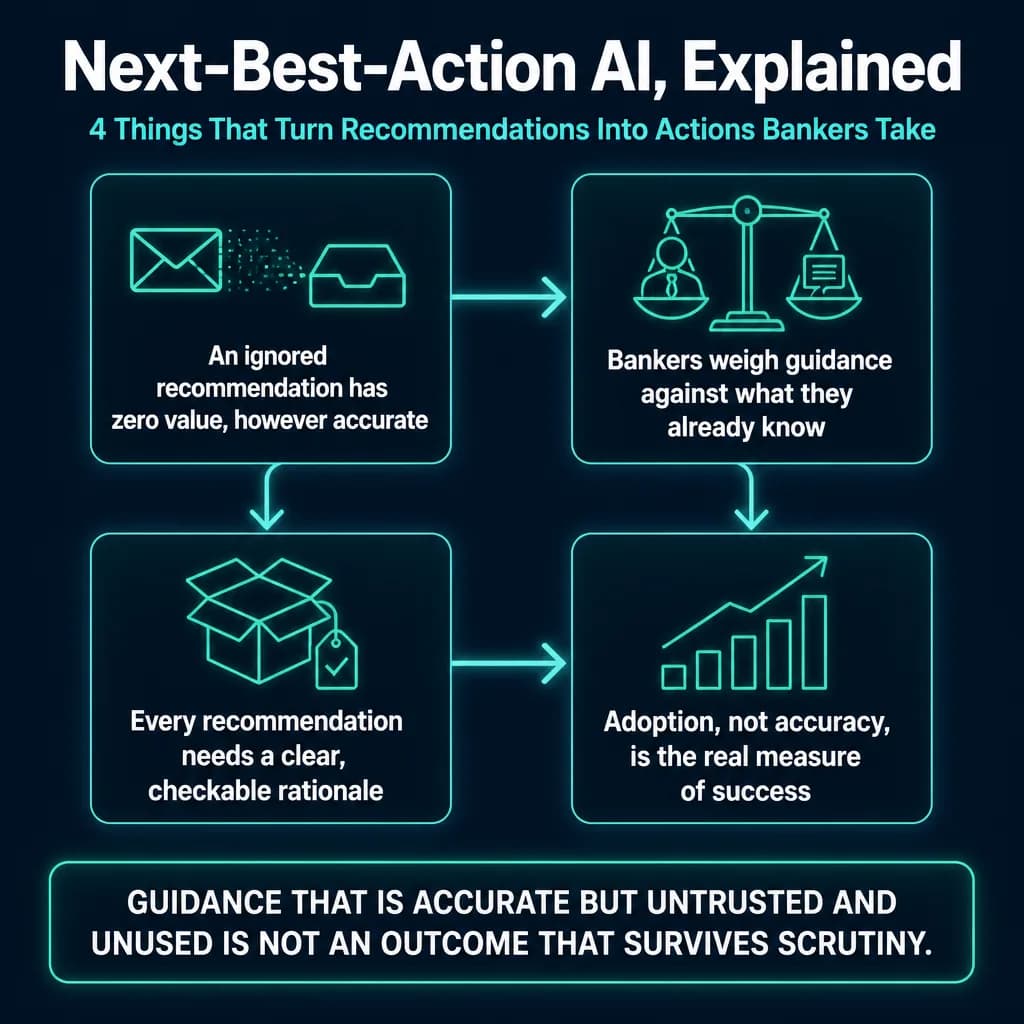
Here is the stance I would hold. A next-best-action system succeeds or fails on whether bankers trust and act on its recommendations, and that trust depends on the recommendations being appropriate, well-timed, and respectful of the banker’s own knowledge of the client, far more than on the statistical accuracy of the underlying model. A system that produces accurate recommendations bankers do not trust delivers nothing, and a system that produces trustworthy, appropriate guidance that bankers act on delivers value even if its recommendations are not maximally optimised. Trust is the mechanism through which the system creates any value at all, so it has to be the primary design objective.
The reasoning is about how relationship managers actually work and why they reject guidance. A good relationship manager knows things about their clients that no model has, the context of the last conversation, the client’s current situation, the timing that would be right or wrong, and they evaluate a recommendation against that knowledge. A recommendation that ignores what the banker knows, that suggests pitching a product to a client who just had a difficult experience, or that is generic enough to feel like it could apply to anyone, tells the banker the system does not understand their client, and after a few such recommendations the banker stops trusting the system entirely. So the system has to produce recommendations that are appropriate and well-timed enough to earn the banker’s trust, which means respecting the banker’s role and knowledge rather than overriding it, and presenting guidance as input to the banker’s judgment rather than as instructions to follow. A system designed to maximise recommendation accuracy without designing for trust will be accurate and ignored.
Engineering inside the constraint
The system is designed to earn trust, which means producing recommendations that are appropriate, well-timed, and clearly reasoned. Each recommendation comes with its rationale, why this action, why this client, why now, so the banker can evaluate it against their own knowledge rather than being asked to follow an opaque suggestion, and this transparency is what lets a banker trust a recommendation they can see the logic of. The recommendations are designed to respect the banker’s knowledge of the client, presented as informed input to the banker’s judgment rather than as directives, because a system that positions itself as advising a skilled professional earns more trust than one that positions itself as instructing them.
Appropriateness is engineered as a hard requirement. The system is constrained to recommend only actions that are suitable and inside the advice boundary, so it does not suggest guidance that would put the banker in a compliance-risky position, because a single inappropriate recommendation that a banker recognises as wrong damages trust in all the system’s recommendations. The system is monitored for fairness, ensuring its recommendations do not steer client segments in ways that disadvantage some or serve the bank over the client, because a client-interest violation is both a compliance failure and, when bankers notice it, a trust failure.
Every recommendation and its basis are captured in a reconstructable record, so the bank can ensure its guidance is appropriate and defensible. The system is evaluated against an explicit standard covering not just recommendation quality but appropriateness, suitability, and fairness, and the bank pays attention to actual banker adoption as the real measure of whether the system works, because adoption is the signal that trust has been earned. Making that evaluation repeatable is the work a rubric-based evaluation engine like PRISM is built to carry. The banker stays the decision-maker throughout, with the system supporting their judgment, which is the placement that respects the relationship the banker owns.
Where it almost broke
A bank deployed a next-best-action system with a sophisticated recommendation engine, and its recommendations were statistically well-founded, tuned to predict which actions would most likely lead to positive outcomes. The bankers used it at first. The recommendations, though, were generated from data patterns without enough sensitivity to timing and context, so bankers regularly received suggestions to pitch products to clients they knew were not in a position to receive them, or generic recommendations that felt disconnected from the specific relationship. Recognising that the system did not understand their clients the way they did, the bankers gradually stopped trusting it, and adoption fell until the system was largely ignored, its statistically sound recommendations going unread.
The recommendations were accurate in a narrow sense and untrusted, and the lack of trust made the accuracy worthless. The fix was to redesign for trust, giving each recommendation a clear rationale the banker could evaluate, improving the timing and context sensitivity so recommendations respected what was happening in the relationship, and positioning the guidance as input to the banker’s judgment rather than as directives. As the recommendations became appropriate and trustworthy, adoption recovered and the system began to deliver value. A next-best-action system that bankers do not trust is an expensive way to be ignored, and trust comes from appropriateness and respect for the banker’s knowledge, not from statistical accuracy alone.
Next-best-action for relationship managers succeeds only when bankers trust the guidance enough to act on it, and that trust rests on recommendations being appropriate, well-timed, clearly reasoned, and respectful of what the banker knows about their clients, far more than on the statistical sophistication of the engine. A system that produces accurate recommendations bankers ignore delivers nothing, and the entire value depends on earning the trust that turns guidance into action. Designing for trust is the work, and recommendation accuracy is only useful once trust makes the banker willing to listen.
A bank deploying next-best-action should measure whether bankers actually act on its recommendations, and treat low adoption as a sign that the system has not earned trust rather than a sign that bankers are resistant. Guidance that is accurate but untrusted and unused is not an outcome that survives scrutiny.
Related: Banking & Financial Services · Reserve Bank Innovation Hub: Automated grievance workflows with natural-language access and a complete audit record · IndusInd Bank Limited: AI-Powered Knowledge Source-Based Process Training and Query Resolution
Tell us the number you need to move.
…outcomes that survive scrutiny.