NotebookLM and Source-Grounded AI: When Constraining the Model Is the Feature
Most enterprise AI pilots fail on the same objection, and it is usually raised by someone in risk. The model produced a useful answer, and nobody could establish where it came from. In a regulated function, an unattributable answer has close to zero operational value regardless of how correct it happens to be. Provenance is the requirement, and generation systems that treat it as an afterthought never clear the review.
Source-grounded AI tools take the opposite starting position. The user supplies a bounded corpus, and the system answers only from that corpus, with inline attribution back to the specific passage. NotebookLM popularised this pattern for individual knowledge work. The design principle behind it is considerably more important than the product.
Constraint as an architectural choice
A general assistant draws on training data, retrieved web content, and conversational context simultaneously, and the user cannot tell which contributed to any given sentence. A source-grounded system deliberately removes two of those three inputs. The corpus becomes the only admissible evidence, and every claim carries a pointer to the passage that supports it.
That constraint delivers three properties enterprises have been asking for since the first pilot. Answers become auditable, because attribution is structural. Scope becomes controllable, because you decide what enters the corpus. Currency becomes manageable, because the answer reflects the documents you loaded rather than an unknown training snapshot of the world.
For a research analyst working through submission documents, a clinical team reviewing protocol material, or a policy unit consolidating consultation responses, this is the difference between a tool that reaches production and one that stays in a sandbox.
Where source-grounding still fails
Grounding constrains the evidence. It does not constrain the reasoning applied to that evidence, and this distinction is where practitioners get caught.
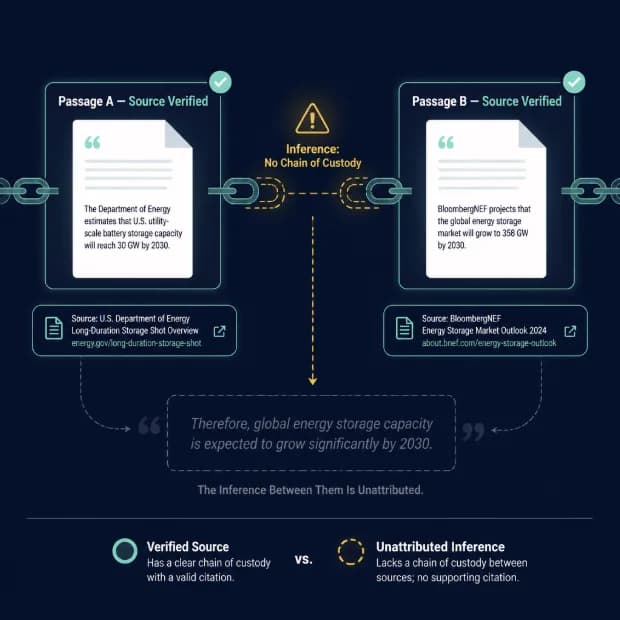
The system will connect two documents that were never meant to be read together. Passage A describes a limitation in one context, passage B describes an outcome in another, and the synthesis presents a relationship that neither source asserts. Each sentence traces cleanly to a real citation. The connective inference between them belongs to the model and carries no attribution at all. Reviewers checking citations one by one will pass this, because every individual pointer is valid.
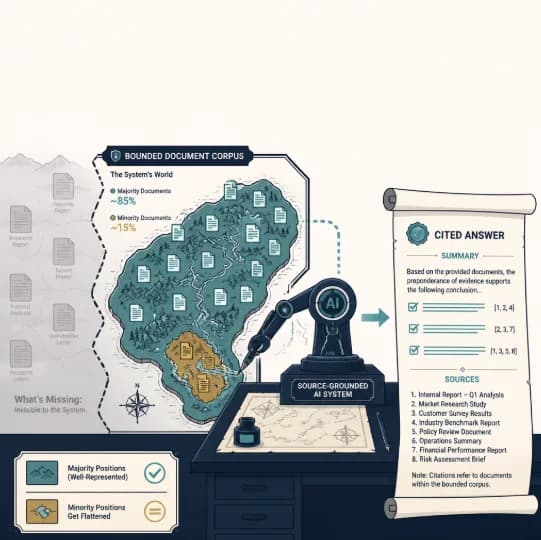
Summarisation introduces a second, quieter distortion. When a corpus contains a strong majority position and a small number of dissenting or qualifying documents, the summary tends to reflect the majority and flatten the minority. In a literature review or a regulatory consultation analysis, the dissent is frequently the most consequential material in the set. The output reads as balanced and is not.
There is also the omission problem, which no attribution mechanism addresses. The model reports what the corpus contains. It cannot tell you what the corpus is missing, and a research answer built on an incomplete document set will be confidently wrong in a way that leaves no trace in the citations. Corpus curation therefore becomes the highest-leverage control in the entire workflow, and it is a human judgement that no tooling replaces.
Enterprise implications
Individual-use grounded tools solve a personal productivity problem, and the enterprise question is different. Four controls decide whether this pattern survives contact with a regulated environment.
Permissions must carry through from the source system into the corpus, so that a notebook cannot become a mechanism for aggregating documents a user was never entitled to read together. Corpus lineage must be recorded, because an answer is only as defensible as the document set behind it, and that set changes over time. Retention and residency terms must cover the uploaded material, which is often the most sensitive content in the organisation. Output evaluation needs to be systematic, since spot-checking citations does not catch synthesis-level error.
That last control is the one most programmes skip. Grounded generation requires rubric-based assessment of whether the synthesis is faithful to the source set as a whole, which is why we operate evaluation through PRISM with criteria for inferential faithfulness alongside citation accuracy. Teams designing governance for retrieval-based systems should treat faithfulness evaluation as a build requirement.
Where it fits
The pattern earns its place wherever a bounded, curated corpus already exists and provenance is mandatory: regulatory document review, clinical and scientific literature work, contract and policy analysis, technical documentation, and institutional memory. Deployment there is straightforward and the return is immediate.
The fit degrades when the answer depends on knowledge outside the corpus, when the corpus is large enough that curation quality becomes unverifiable, or when the question calls for judgement across conflicting evidence. That third case remains firmly human work.
(Cartographer’s Blind Spot- Reframe the system as a map drawn only from known territory)
Source-grounded generation is the most governance-friendly pattern available for enterprise knowledge work, and its guarantees stop at the boundary of what was loaded. If your teams are already operating grounded workflows over curated document sets, the useful next question is how you evaluate whether the synthesis stayed faithful to the whole corpus.
Related: Data Architecture
Tell us the number you need to move.
…outcomes that survive scrutiny.