Order, Delivery and Returns Calls: Voice AI for Retail Operations
The operational phone calls of a retail business carry more emotion than any other part of the customer relationship. A person calling about a delayed delivery is anxious. A person disputing a return is frustrated before the call connects. A person checking an order wants a straight answer quickly. These calls arrive in enormous volume, they scale directly with order count, and their quality swings with how tired and how many the staff are on a given day.
This is the operational reality that voice AI for retail operations has to meet, and it is more demanding than a scripted support bot suggests. Order status, delivery exceptions, and returns are not tidy transactions. They are conversations with an upset or hurried human on the other end, often in the customer’s own language, frequently over a poor connection, where a clumsy automated response does more damage than a hold queue. The volume makes automation necessary. The emotional weight makes doing it badly expensive.
Why retail operational calls are hard to automate well
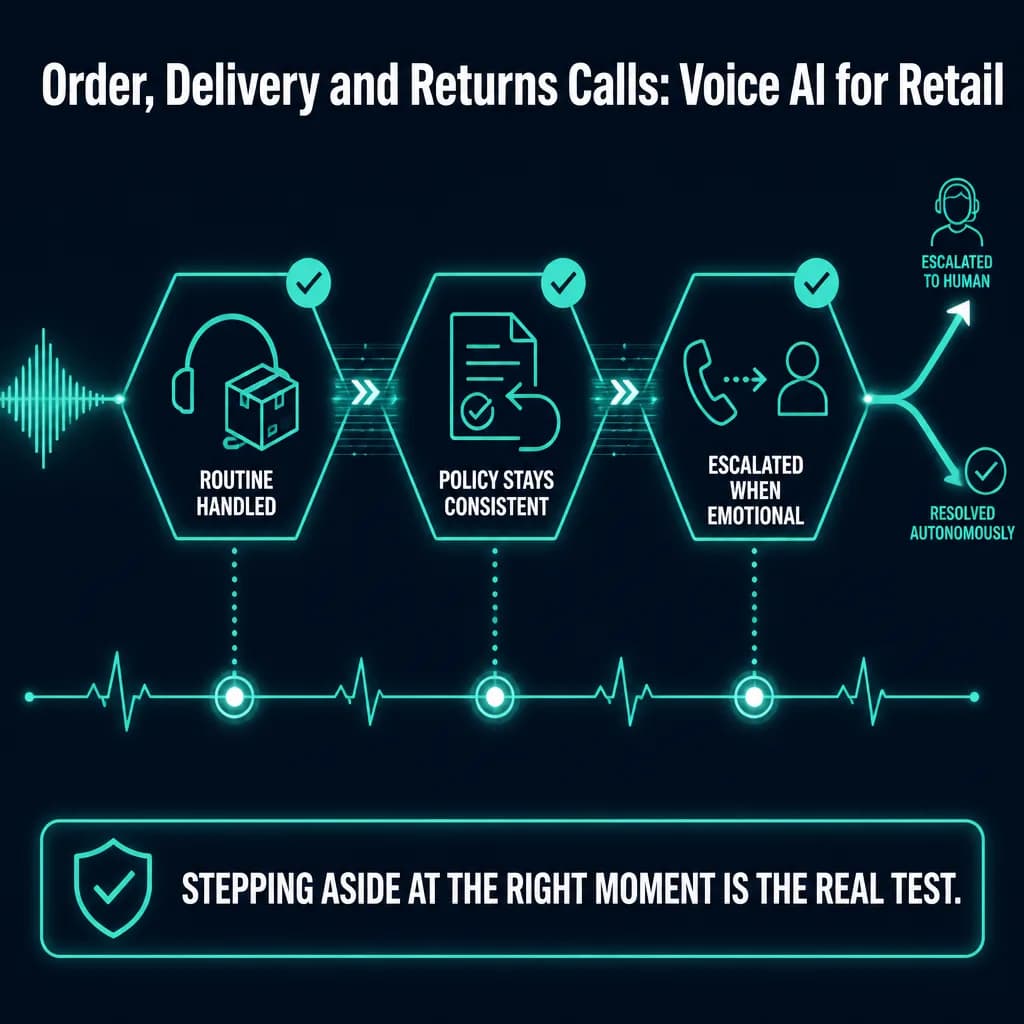
Each of these call types has its own failure surface. An order-status call is simple until the order is in an unusual state the script never covered. A delivery-exception call is time-sensitive and emotional, and a wrong or vague answer compounds the frustration. A returns call carries policy and sometimes money, so an automated agent that promises the wrong thing creates a commitment the business has to honour or retract, both bad.
So the bar for a retail voice agent is high. It has to understand intent in real time, hold a natural conversation through interruptions and objections, cope with noise and language, and stay consistent with policy on every call, including the ones about refunds and returns where consistency is a compliance matter. Passing the calm order-status call is easy. Handling the angry delivery-exception call with grace is the real test.
What we engineered, and the boundary that carries it
We deploy EVIO, our agentic calling platform, across these operational call types, handling the high-volume routine conversations end to end while keeping every response aligned to the retailer’s policy and tone. It manages turn-taking and objections with a human-like cadence, works across languages, and keeps refund and returns messaging consistent with what the business has actually approved.
The design decision that matters most is the handover. The platform carries the clean, repetitive calls on its own and escalates the moment a conversation turns genuinely emotional, ambiguous, or outside policy, routing it to a person with the context already gathered. That boundary is engineered as a control with a defined trigger, so a human handles the returns dispute that needs judgement while the agent absorbs the thousands of routine status checks. Every call is logged, which keeps the operation auditable and lets the business see how policy was applied.
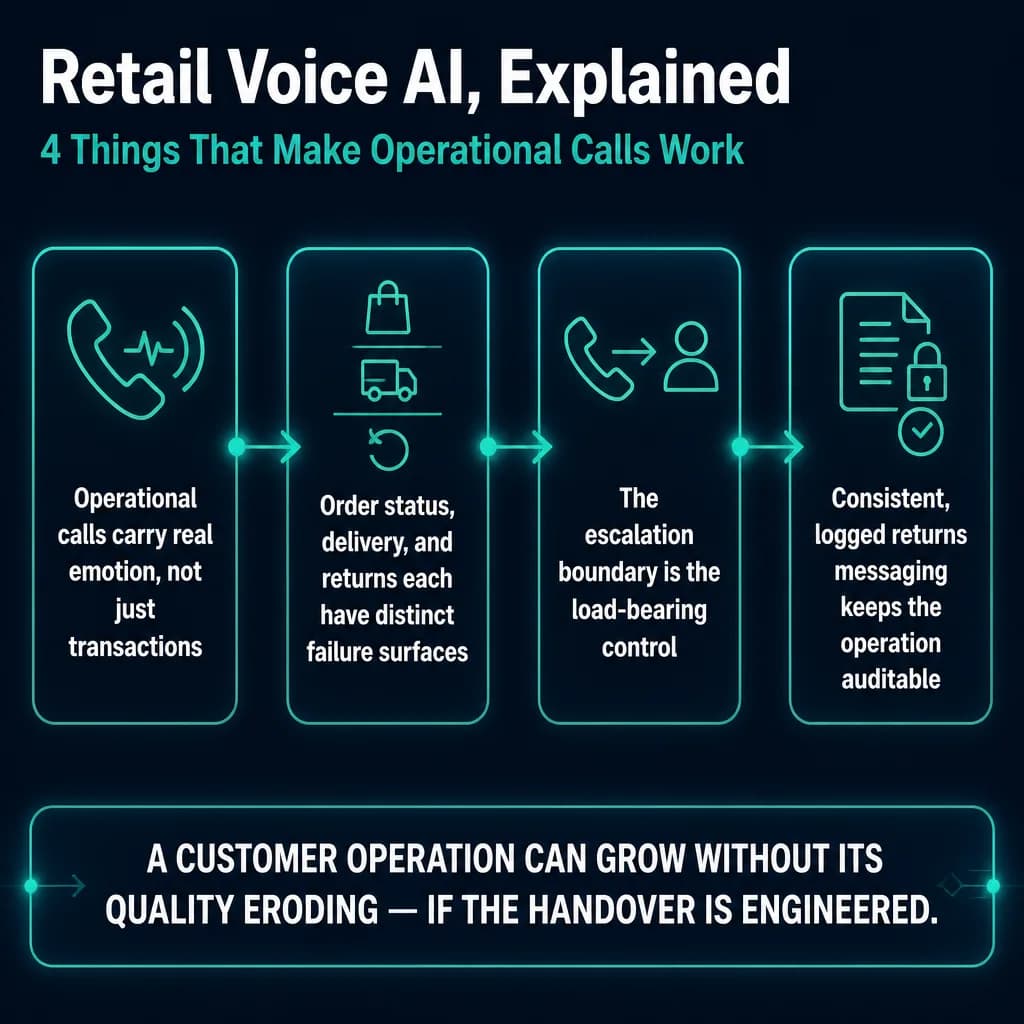
Where it almost breaks
The dangerous version of a retail voice agent is one that stays confident on an emotional call it cannot resolve. A customer whose delivery failed does not want a cheerful loop. A customer owed a refund does not want an agent that improvises a policy. The early risk is always an agent that pushes forward when it should step back, and in a returns or refund context that produces either a broken promise or a compliance problem.
The correction is to tune the escalation to the emotional and policy signals, so rising frustration or a policy-sensitive request triggers a handover before the agent digs a hole. That single discipline, stepping aside at the right moment, is what separates a voice deployment that customers tolerate from one that quietly erodes the relationship the retailer depends on.
Voice AI for retail operations succeeds by carrying the routine volume with consistency while handing the human moments to a human at the right time. The value is a customer operation that grows without its cost and its quality diverging, and it depends entirely on the handover being engineered rather than assumed. An operator operating voice in retail designs that boundary and that audit trail from the start, which is how order, delivery, and returns calls become outcomes that survive scrutiny even when the customer on the line is having their worst day with the brand.
Related: About Us
Tell us the number you need to move.
…outcomes that survive scrutiny.