Perplexity as an Enterprise Answer Engine: Citations, Trust, and Data Exposure
Ask a senior analyst how long it takes to answer a question that spans five sources, and the honest number surprises most executives. The reading is fast. The finding, filtering, and cross-checking consume the day. Multiply that across a research function, a strategy team, or a competitive intelligence unit, and the cost of question-answering becomes one of the larger unmeasured line items in knowledge work.
An enterprise answer engine changes the shape of that cost. Rather than returning a ranked list of documents for a human to synthesise, Perplexity and tools in its category retrieve across live sources, synthesise a direct answer, and attach citations to the claims within it. The synthesis step is the change that matters. The citations are what make it usable at work.
Why grounding with citations changes the calculus

A general-purpose model answering from parametric memory offers no verification path. The user receives an assertion with no way to check it short of independent research, which removes most of the time saving. Retrieval-grounded answering inverts that. The system fetches current sources, composes an answer over them, and links each claim back to its origin.
The operational consequence is that verification becomes sampling. An analyst reads the synthesis, checks the two or three load-bearing claims against their citations, and accepts or discards. That workflow is defensible in a way that unsourced generation never is, and it is the reason this category found genuine enterprise traction while general chat interfaces stalled in pilot.
The failure mode practitioners actually see
Citations create an authority illusion that deserves direct attention. A link beside a sentence signals verification, and users stop checking within days of adoption. The failure is rarely a fabricated URL. It is a real source that partially supports the claim, or supports it in a different context, or is itself a low-quality aggregator repeating an error upstream.
The system optimises for retrievable, well-indexed content. That biases answers toward whatever is publicly abundant, which means vendor marketing, press coverage, and SEO-optimised summaries frequently outrank primary filings, peer-reviewed work, and regulatory text. For competitive intelligence, this produces confident answers assembled from the competitor’s own positioning. For anything touching regulation, it produces secondary interpretation where the primary text was required.
There is a second issue with the shape of the output. Synthesis compresses, and compression removes qualification. A finding hedged with population limits and confidence intervals in the source arrives as a clean declarative sentence. Analysts who never open the citation inherit certainty the underlying evidence does not support.
Data exposure is the deciding question
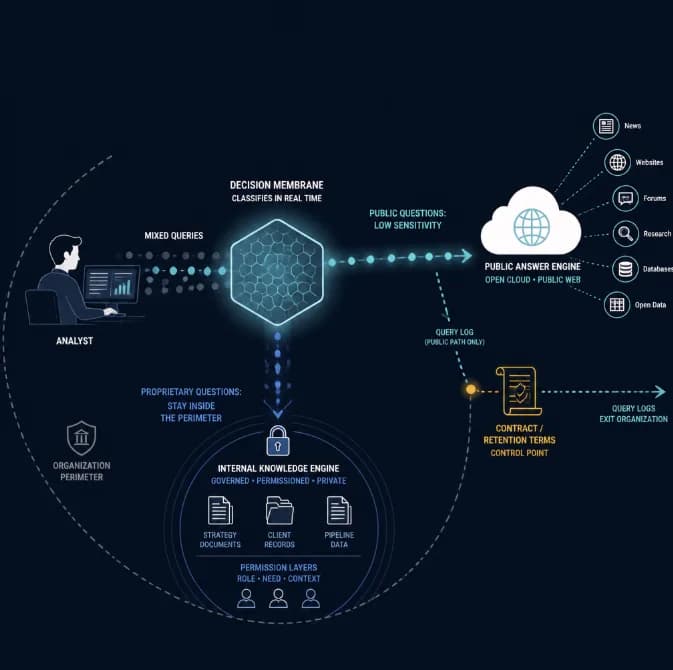
Every query submitted to a public answer engine leaves the organisation. That sentence is understood in the abstract and ignored in practice, because queries are conversational and feel private. Consider what a real research question contains: an unannounced product name, a target company, a jurisdiction, a drug candidate, a deal structure. Query logs from a corporate development team constitute a readable narrative of intent.
Enterprise deployment therefore turns on a small number of contractual and architectural controls. Zero-retention or bounded-retention terms with training exclusion, processing geography aligned to your data residency obligations, single sign-on with provisioning tied to your directory, and audit logging sufficient to answer who asked what. Where the workspace tier permits connecting internal repositories, an additional question applies: whether document-level permissions from the source system are honoured at retrieval time. Systems that flatten permissions during indexing will surface content to people who were never entitled to it, and the breach is invisible until someone quotes the wrong document.
For questions that depend on proprietary institutional knowledge, the correct architecture keeps retrieval inside the perimeter entirely. That is the design principle behind COMPASS, where the reasoning layer operates over governed internal sources with permissions carried through to the answer. Public answer engines and internal knowledge engines solve adjacent problems, and conflating them is where most enterprise programmes go wrong.
Where it fits
The strongest fit is public-domain research where the question itself carries no sensitivity: market structure, technology landscape scanning, regulatory background reading, and first-pass literature discovery. Time savings there are substantial and the exposure is negligible.
The fit weakens sharply as questions become specific to your strategy, your clients, or your pipeline. It weakens again for any output that will be cited in a decision document, where primary sources are the standard and secondary synthesis is a starting point. Teams building formal evidence standards for AI-assisted research should write that distinction into policy before adoption spreads informally.
The organisations that get this right draw a clear line: public questions to the public engine, proprietary questions to a governed internal system, and primary sources for anything that will be defended. If your research teams have adopted an answer engine faster than your policy caught up, mapping which question types are already leaving the perimeter is the place to begin.
Related: Data Architecture
Tell us the number you need to move.
…outcomes that survive scrutiny.