Preserving Institutional Knowledge in Government With Agentic AI
When a senior official retires from a government institution, a library leaves with them. Not the documents, which stay in the system, but the reasoning: why a rule is interpreted the way it is, which precedent settled a recurring dispute, how a policy was actually meant to work in the cases the manual never anticipated. That knowledge lived in a person, and when the person goes, the institution keeps the files and loses the understanding that made them usable.
This slow erosion is a continuity and accountability risk, and it is the problem that institutional knowledge in government most needs solved. Public bodies hold decades of decisions, standards, and precedent spread across repositories, publications, and the memories of long-serving staff. The knowledge is technically present and practically unreachable, because finding the right answer means knowing who to ask and which archive to search, and that map lives in the same heads that are rotating out.
Search was never the hard part

The reflex is to treat this as a search problem and point a keyword system at the archives. Keyword search returns documents that contain a phrase. It cannot tell you why a decision was made, connect a ruling to the standard it rested on, or surface the precedent that a retired expert would have recalled instantly. It finds text and leaves the reasoning buried.
The harder and more valuable capability is making institutional knowledge answerable, so a user can ask a question in plain language and receive an evidence-backed answer drawn from across every repository, with the relationships between decisions, standards, and experts made explicit. This is what our knowledge and reasoning capability, COMPASS, is built to do: unify fragmented sources into a single answerable layer and turn a query into a real response, with the reasoning traceable rather than lost.
In government, an answer without a source is unusable
Here the governance requirement is absolute, and it shapes the whole design. A public institution cannot act on an answer it cannot verify. An AI that responds confidently and cannot show where the answer came from is worse than no system at all, because it invites officials to rely on assertions they cannot defend to an auditor or a citizen.
So source traceability is load-bearing. Every answer has to carry its evidence: the specific document, standard, or precedent it rests on, cited inline, so the official can check the basis before acting. A knowledge system for government is only trustworthy to the degree that each of its answers can be traced to an authoritative source, and building that provenance in is the difference between a usable institutional memory and a plausible-sounding liability.
What this preserves, and what it costs
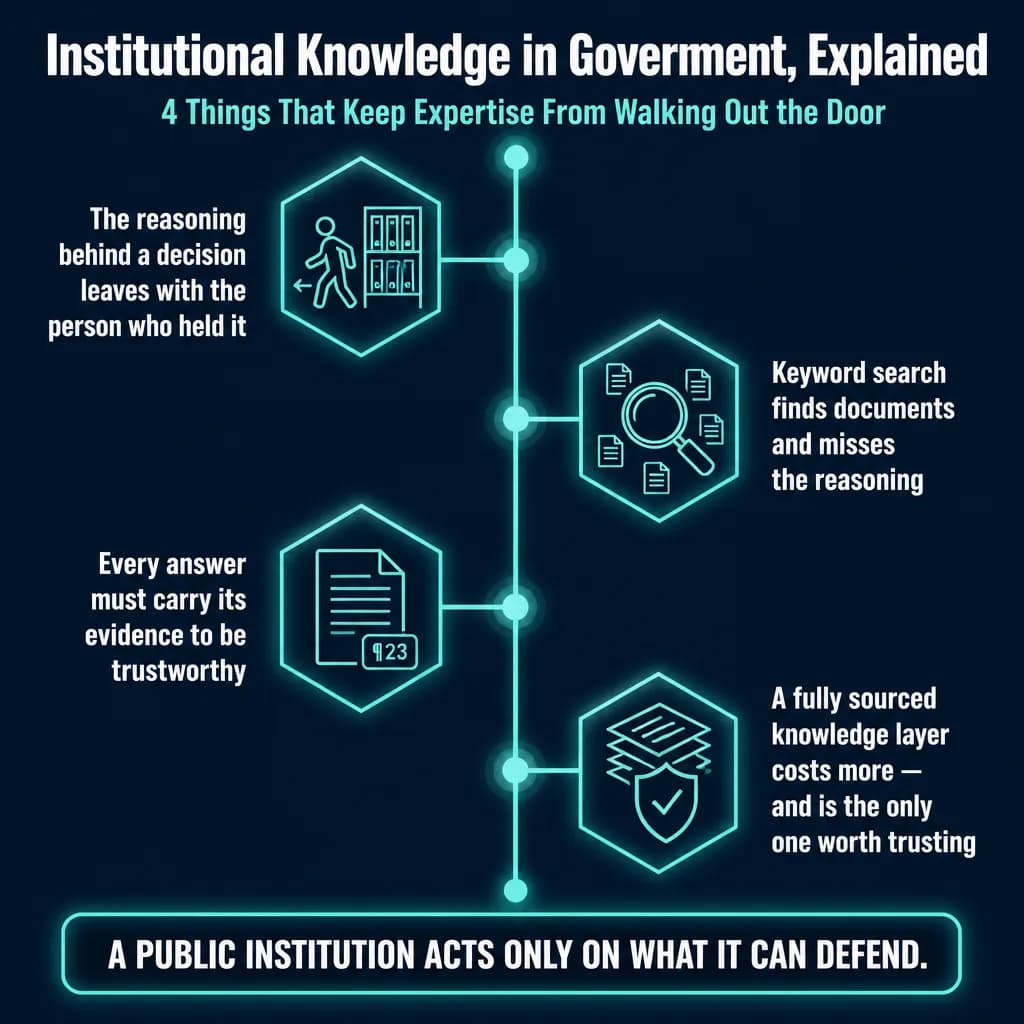
Done properly, the system captures the reasoning that used to walk out the door. The precedent is discoverable, the interpretation is attached to its source, and a new official can ask the institution a question and receive the kind of answer a thirty-year veteran would have given, grounded in the record. The knowledge stops depending on individual tenure and becomes an institutional asset that survives staff turnover.
The near-miss to design against is a system that sounds authoritative and cites loosely, letting an official act on a confident answer that traces back to nothing solid. The correction is strict: an answer with weak provenance is flagged as such, and the system is honest about the limits of what it can support. That honesty is what keeps the tool trustworthy.
The trade-off is that building an answerable, fully sourced knowledge layer is slower and more demanding than deploying a general chatbot over the same documents. Mapping the relationships between sources and enforcing provenance on every answer is real engineering. In government the shortcut is unacceptable, because an unverifiable answer cannot be acted on, so the slower path is the only one that produces something usable.
Preserving institutional knowledge in government means capturing the reasoning that used to live in people and making it answerable, verifiable, and durable across the turnover of staff. Agentic AI can do that only when every answer carries its evidence, because a public institution acts on what it can defend. An operator building for public institutions treats provenance as the foundation of the whole system, which is how decades of hard-won institutional understanding become outcomes that survive scrutiny long after the people who built that understanding have moved on.
Related: About Us
Tell us the number you need to move.
…outcomes that survive scrutiny.