PRISM, Explained: Defensible Evaluation at Enterprise Scale
Evaluation is where bias and inconsistency hide in plain sight. Whenever an organisation scores something at volume, loan applications, job candidates, insurance claims, accreditation submissions, it faces the same quiet problem: two assessors reach different conclusions on similar cases, the standard drifts as people tire, and the reasons behind a given score are rarely written down. The output looks like judgement, and often it is judgement plus fatigue plus whoever happened to review the file. At scale, that inconsistency becomes both a fairness problem and a liability.
This is the problem PRISM is built to solve, and the hard part is not scoring at volume. It is scoring at volume in a way that is consistent, explainable, and defensible when a rejected candidate, a declined applicant, or a regulator asks why. An evaluation system that is fast and cannot justify its scores has automated the inconsistency rather than fixed it, and in a consequential decision that is a step backward.
Why human evaluation at scale drifts
Human evaluation carries variance that is invisible until you measure it. The same reviewer scores differently in the morning and at the end of a long day. Two reviewers weight the same evidence differently. Unstated criteria creep in, and the basis for a score lives in the reviewer’s head rather than on the record. None of this is bad faith. It is the nature of human judgement applied repeatedly under time pressure, and it means that a consequential decision can turn on who reviewed the file and when.
So the requirement is a consistent standard applied the same way every time, with the reasoning made explicit. Evaluation that cannot state why it reached a score cannot be defended, and in decisions about people and money, an indefensible score is a dispute waiting to happen.
What PRISM actually does
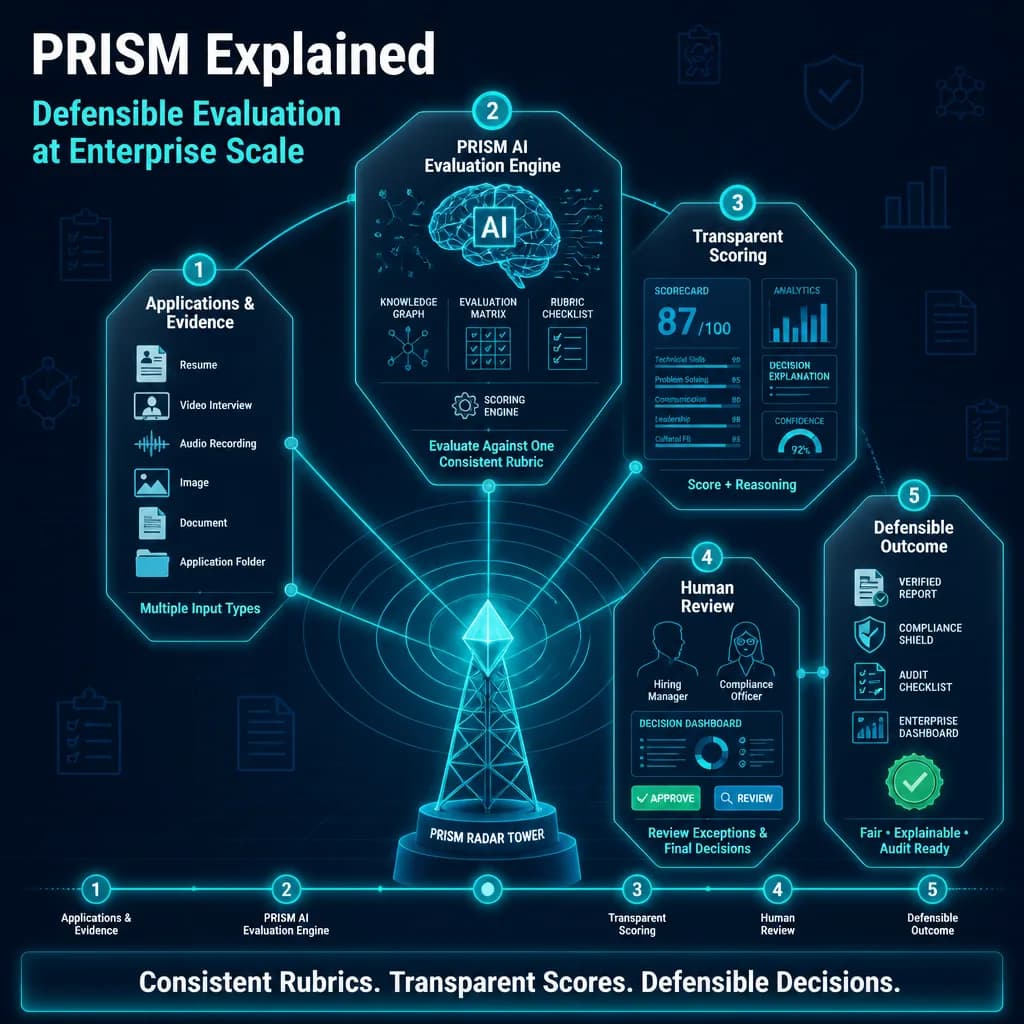
PRISM evaluates almost any input, audio, video, images, or documents, against a rubric you define, applying the same standard consistently at scale and producing a judgement with its reasoning attached. The rubric is the mechanism that matters. It makes the criteria explicit and fixed, so every case is measured against the same definition of good, and the score comes with the basis that produced it.
Deployed for a business school facing thousands of applications, this approach conducted several thousand structured interviews and evaluations, cut evaluation time by around eighty percent, and reduced human and language bias by applying one consistent rubric to every candidate, with faculty conducting final interviews only on the shortlist the system surfaced. The value was not only speed. It was consistency and defensibility: every candidate met the same standard, and every score could be explained, which is what makes a high-volume evaluation process fair and reviewable.

Defensibility is the point, and the trade-off
The load-bearing property is that a PRISM score can be defended. Because the rubric is explicit and applied uniformly, the institution can show a rejected applicant or an auditor exactly why a decision was reached and that the same standard governed everyone. Consistency and transparency together are what let an evaluation survive challenge, and they are engineered into the rubric rather than hoped for from the reviewers.
The trade-off is that a rubric imposes a discipline that free human judgement does not. You have to define the standard explicitly up front, which is harder than letting experienced reviewers apply their instinct, and a rubric can miss the unusual case that a wise human would catch. So the design keeps humans on the exceptions and the final consequential calls, using PRISM to apply the consistent standard at scale and routing the genuine edge cases to people. That combination gives up some of the flexibility of pure human judgement in exchange for consistency and defensibility, which is the right trade wherever a score has consequences.
PRISM turns evaluation from an inconsistent, unexplainable bottleneck into a consistent, defensible process that scales. The value is judgement that reaches every case the same way and can be justified when it is questioned, which is exactly what a consequential decision requires. An operator building evaluation systems makes the rubric and its defensibility the foundation, because a score that cannot be explained cannot be defended, and only consistent, transparent evaluation produces outcomes that survive scrutiny.
Related: Prism, Evaluation Consultant - PYZO · About Us · Indian School of Business: AI-Powered Application Evaluation Platform · Data Security Council of India: AI-Powered Startup Grant Evaluation
Tell us the number you need to move.
…outcomes that survive scrutiny.