Responsible AI in Healthcare: From Pilot to Production Without Cutting Corners
The pilot went well. That sentence has stalled more healthcare AI than any technical failure. A tool performs in a controlled test, a small group of engaged clinicians likes it, the results look strong, and the organisation declares success and moves to scale. Then the corners that were quietly cut to make the pilot succeed become the reasons production fails. The pilot was never the hard part. The hard part is everything the pilot was allowed to skip, and the discipline of not skipping it when the system meets the full messiness of real clinical operations.
A pilot and a production deployment are different problems wearing the same name. A pilot operates in favourable conditions: a curated patient population, motivated clinicians who want the tool to work, close attention from the team that built it, and a scope narrow enough to control. Production has none of that. It operates across the full range of patients, with clinicians who did not volunteer and have no patience for a tool that slows them down, without the builders watching, at a volume that exposes every edge case the pilot never met. A tool validated in the first environment tells you very little about how it behaves in the second, and treating pilot success as production readiness is the most common and most expensive mistake in the field.
Why pilots succeed for reasons that do not scale
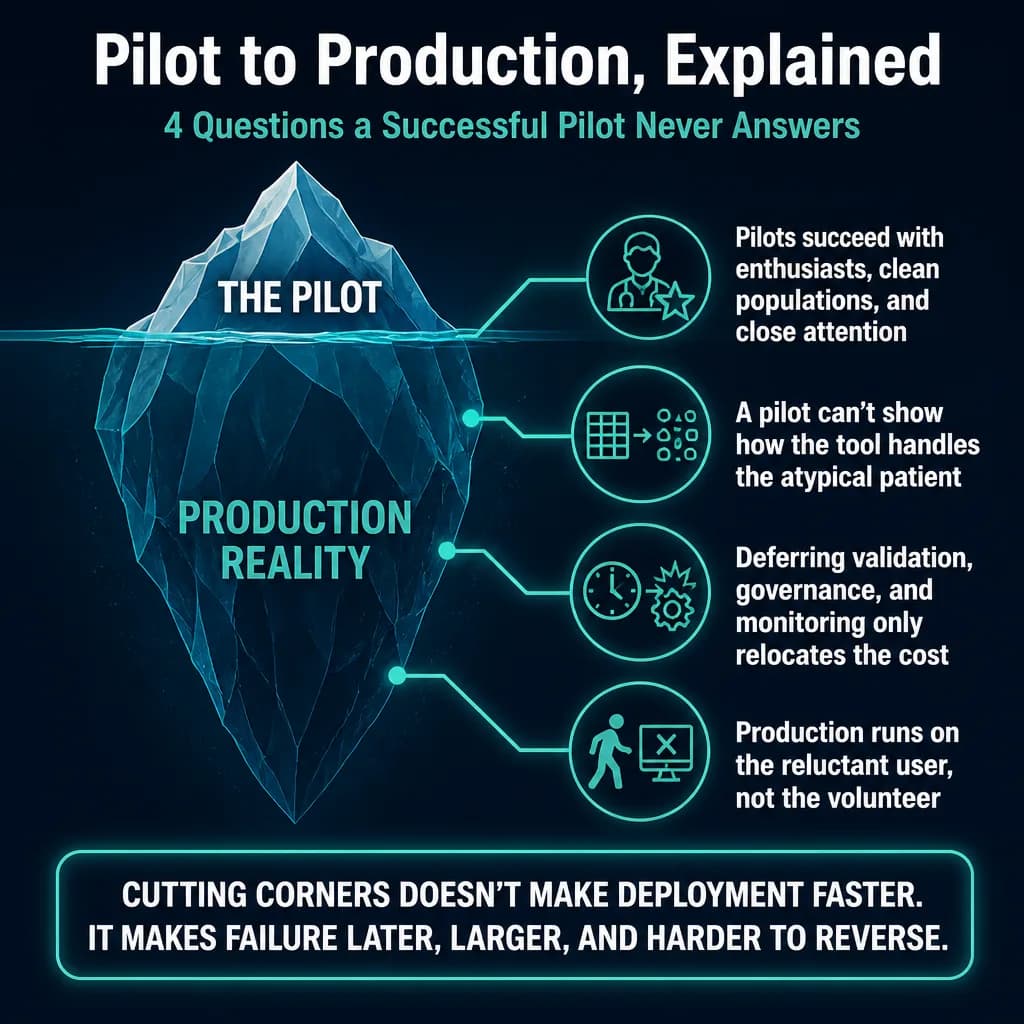
The uncomfortable truth about a successful pilot is that some of its success came from conditions you cannot reproduce at scale. The clinicians in a pilot are usually the enthusiasts, the ones who will work around a rough edge because they believe in the tool. The patients are often a cleaner population than the full caseload. The team is watching closely, catching problems fast and fixing them before they compound. Every one of those advantages disappears in production.
So the questions a pilot answers are narrower than they appear. A pilot can show that a tool works when everything is favourable. It cannot show how the tool behaves on the atypical patient it never saw, how a skeptical clinician uses it under time pressure, how it degrades when no one is watching, or what happens when its inputs drift away from the conditions it was tested in. Those are the questions production asks, and they are exactly the questions a pilot is structured not to ask. Reading pilot success as an answer to them is reading a result the pilot never produced.
The corners that get cut, and what cutting them costs later
Under the pressure to scale a promising pilot, specific things get deferred. Each deferral feels reasonable in the moment. Each one becomes a production failure with a delay.
Validation on the full population gets skipped, because the pilot population looked representative enough. In production, the tool meets the patients it was never tested on, and its performance on them is unknown until something goes wrong. The failure clusters in the rare, atypical cases the pilot’s clean population did not contain. Governance gets deferred, because the pilot was small and closely watched, so who needed a formal framework. In production, the tool is everywhere, no one is watching closely, and the questions the pilot answered informally now have no owner. Monitoring gets treated as optional, because the tool worked at launch. Then its inputs drift, its performance decays, and no one notices because nothing was built to. And the workflow integration that a motivated pilot clinician tolerated becomes the reason a skeptical production clinician abandons the tool entirely.
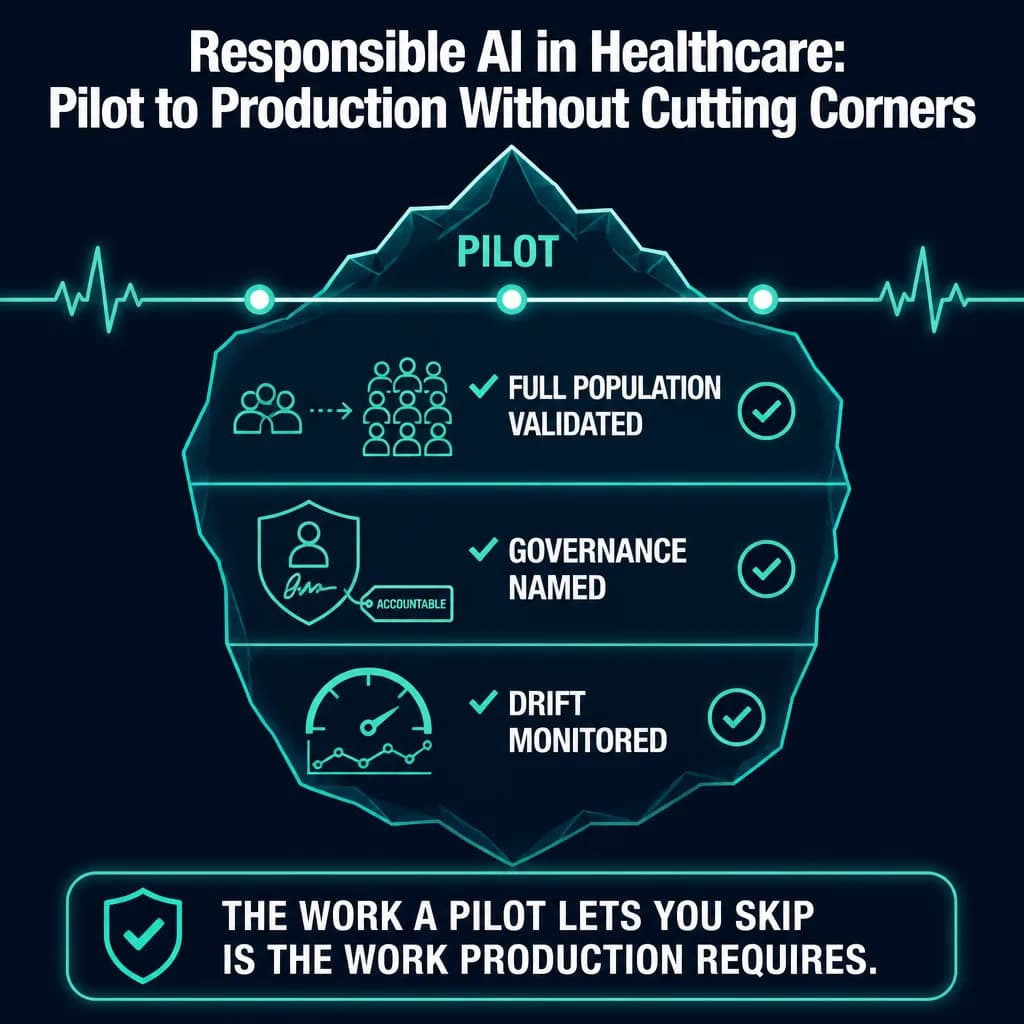
The position worth stating plainly, against the pressure to move fast on a good result: the work a pilot lets you skip is the work production requires. Deferring it does not remove it. It relocates it to the moment the tool is live across the organisation, harder to fix, and affecting real patients at scale. Responsible deployment is not slower because it is cautious. It is the recognition that the deferred work is the actual work, and doing it before production is cheaper than doing it after.
The readiness bar a pilot never has to clear
Moving from pilot to production responsibly means answering the questions the pilot did not. Validation extends to the full population and the real conditions the tool will operate in, so its behaviour on the atypical case is characterised rather than assumed, treating evaluation as an ongoing discipline rather than a one-time gate. Governance moves from the informal attention of a small team to a defined structure with named accountability, because the tool now touches decisions no one is personally watching, which is what governance built as a system rather than a values statement exists to provide. Monitoring becomes a built component, watching for the drift and decay a pilot’s short timeline never revealed, with oversight placed where the clinical consequence lives. And the workflow gets engineered for the clinician who did not volunteer, because the reluctant user is the one production has to carry.
The trade-off is real and worth naming. All of this takes time between a successful pilot and a full deployment, and that gap is frustrating when the pilot looked so promising. The pressure to skip it is enormous and it comes from good intentions: the tool works, patients could benefit, why wait. The answer is that the tool worked under conditions production will not reproduce, and the wait is where you find out whether it works under conditions production will.
An enthusiastic pilot group is not the whole ward
An organisation pilots a clinical AI tool with a group of enthusiastic clinicians on a defined patient population, sees strong results, and moves quickly to deploy it system-wide. In production, three things surface that the pilot never could. The tool underperforms on patient subgroups the pilot population had underrepresented. Clinicians who never chose the tool find it disrupts their workflow and begin ignoring its output. And its accuracy on incoming data has drifted from the pilot conditions, which no one detected because monitoring had been deferred as a later phase. None of these were model failures. They were the predictable consequences of treating a pilot as production readiness. The correction was to do the deferred work: validate across the full population, stand up governance with clear accountability, build monitoring for drift, and re-engineer the workflow for the clinician who had no investment in the tool succeeding. The tool that failed at scale was the same tool that had succeeded in the pilot. What changed was whether the work production required had actually been done.
Responsible AI in healthcare is not a slower, more cautious version of the same deployment. It is the recognition that a successful pilot has answered the easy questions and left the hard ones for production, and that the work of answering them, validation across the real population, governance with real accountability, monitoring for real drift, integration for the real clinician, is the work that determines whether patients are safe at scale. Cutting those corners does not make deployment faster. It makes failure later, larger, and harder to reverse.
The question to bring to any healthcare AI moving from pilot to production is not whether the pilot succeeded. It is which questions the pilot was structured not to ask, and whether you have answered them before the tool reaches the patients the pilot never saw. That is the difference between a promising pilot and outcomes that survive scrutiny.
Related: Healthcare & Life Sciences · Koita Foundation: An AI-powered knowledge hub with citation-backed retrieval across seven repositories
Tell us the number you need to move.
…outcomes that survive scrutiny.