Scaling Outbound Conversations Without Adding Headcount: A Voice AI Story
A large online marketplace had a conversation problem that money alone could not fix. More than a million customer conversations moved through its channels every month: order status, supplier discovery, lead follow-ups, verification calls, returns, support. Every one of those conversations was handled by a person, and the only known lever to handle more of them was to hire more people. That lever scales cost in a straight line, and it scales inconsistency along with it.
This is the operational bind that voice AI is meant to break, and breaking it is harder than a demo suggests. The volume was linear in headcount. Peak demand forced a choice between overstaffing for the busiest hours and making customers wait through them. Multilingual coverage multiplied the staffing math again, because a fluent agent in one region was no help in another. What the business needed was a way to sever the link between conversation volume and headcount while holding the quality of the conversation steady.
Why conversational voice AI is hard to operate well

A voice agent that mishears a caller, talks over them, or gives an inconsistent answer does more damage than a slow queue. In a marketplace built on trust between buyers and sellers, one bad automated call can cost a relationship. So the bar for deployment sits high. The agent has to manage turn-taking, handle interruptions and objections, cope with background noise, and hold a natural conversation across languages, while keeping its messaging consistent and compliant on every call.
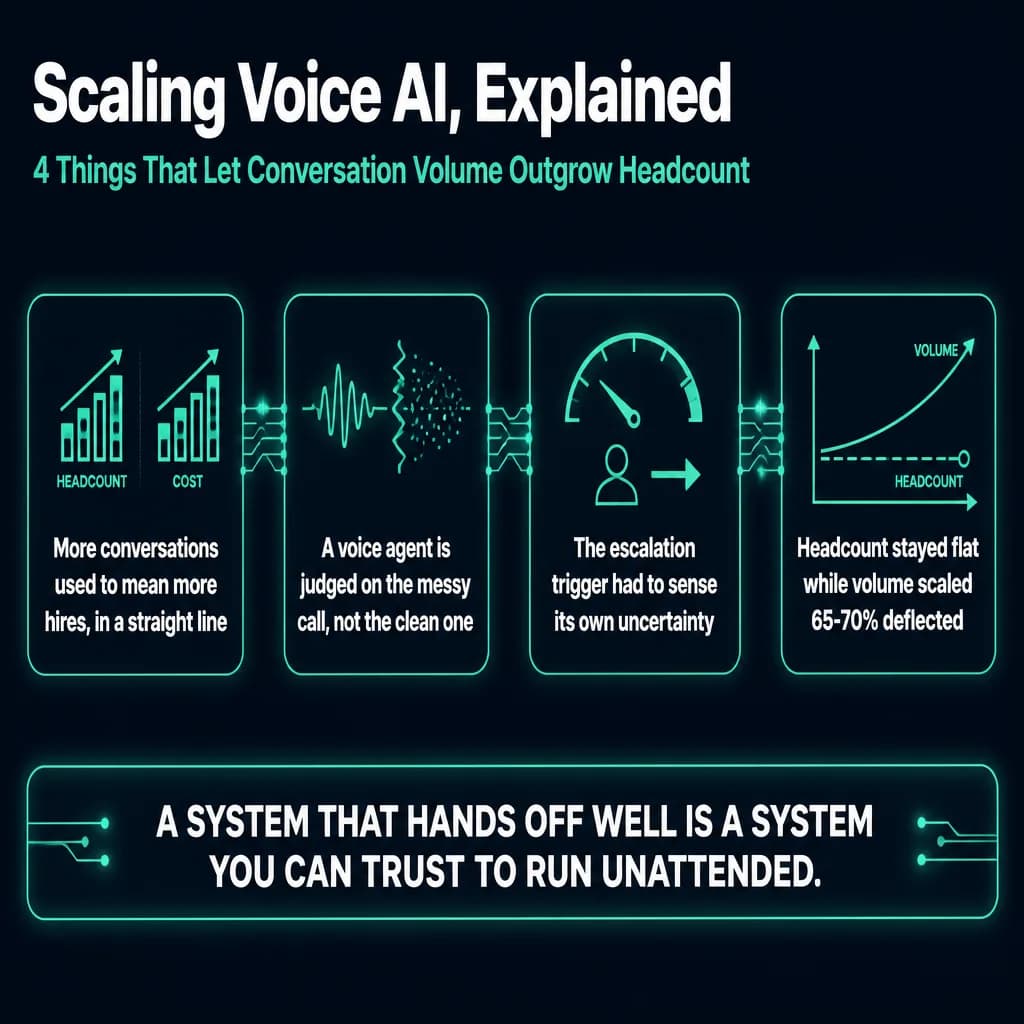
Most voice bots fail that bar and get switched off within a quarter. They perform on the clean call and fall apart on the real one, where a customer interrupts, changes the subject, or speaks over a noisy line. Passing the clean call is the easy part. Surviving the messy one is the work, and it is the reason so many voice deployments never leave the pilot.
The voice system we put into their channel
We deployed EVIO, our agentic calling platform, across the marketplace’s support, sales, and verification workflows, for both voice and chat. It reads intent and context in real time, so a buyer asking about an order and a seller responding to a verification request are handled as the different conversations they are. It manages interruptions and turn-taking with a human-like cadence, holds the conversation in the customer’s own language, and keeps every message consistent with the approved, compliant script.
The design decision that mattered most was the handover. The platform handled the repetitive, high-volume conversations on its own and escalated to a person the moment a call moved outside what it could handle well. That boundary was engineered as a control, with a defined trigger, so the human team spent its time on the conversations that genuinely needed judgement. Every interaction was logged for auditability, which kept the compliance function comfortable with letting the system operate continuously.
The escalation path that filled with easy calls
The early version was confident on a clean line and brittle on a hard one. On a noisy connection, or when a customer raised an objection the script had not anticipated, it would keep pushing forward instead of recognising that it was out of its depth. In a support context that produces a frustrated customer. In a verification or sales context it risks an interaction the compliance team would never approve.
The fix was to make the escalation trigger more sensitive to its own uncertainty. When the agent’s confidence dropped, or the conversation drifted from an approved path, it handed the call to a person. That change turned a brittle system into a dependable one, and it reinforced the principle that the quality of an automated conversation is decided by how gracefully it steps aside when it should.
What it delivered
Once the handover was right, the volume moved. The platform handled more than a million conversations a month autonomously, deflecting sixty-five to seventy percent of the repetitive, high-volume queries away from the human team. Customer support operational costs fell by around forty percent. Conversational coverage operated twenty-four hours a day without additional staffing, and resolution times during peak demand improved by roughly thirty percent, because the queue no longer depended on how many people were rostered that hour.
The headcount stayed flat while the conversation volume scaled, and the human team moved to the objections, the edge cases, and the relationships that actually needed a person. That is the real before-and-after. The cost of a conversation stopped rising with the number of them.
Scaling outbound conversations came down to a single move. Give the human team back the conversations that need a human, and let an agentic calling platform carry the rest, at a volume and a consistency no roster could match. Done with a real handover boundary and a full audit trail, that is a customer operation that grows without its cost growing in step, which is what outcomes that survive scrutiny look like on the phone.
Related: About Us
Tell us the number you need to move.
…outcomes that survive scrutiny.