Selecting a Model for Enterprise RAG: A Retrieval-First Evaluation Framework
Teams selecting a model for a retrieval-augmented generation system usually evaluate the wrong thing. They operate the candidate models through general capability tests, pick the strongest, and wire it into their RAG pipeline, and then they are surprised when the system underperforms despite using a top model. The surprise comes from a mistaken assumption about where RAG quality comes from. In a retrieval-augmented system, the model is doing a specific and constrained job, and its general capability is a poor predictor of how well it does that particular job.
The framing worth adopting is that RAG is a retrieval problem with a generation step attached, and the model’s role is narrower than general model selection assumes. The system retrieves relevant information and the model reasons over what it was given to produce a grounded answer. The quality of that answer depends first on whether retrieval surfaced the right information, and second on how faithfully the model works with what it received. A brilliant model reasoning over bad retrieval produces confident, well-written, wrong answers, and no amount of model capability fixes a retrieval problem.
Retrieval quality sets the ceiling

The first thing a retrieval-first framework establishes is that retrieval quality caps what the model can achieve. If the retrieval step fails to surface the information needed to answer a query, the model has nothing to work with, and its options are to admit it cannot answer or to fabricate something plausible from its general knowledge. Neither is the grounded, sourced answer the RAG system was built to produce, and both are failures that originate in retrieval, not in the model.
This reorders the evaluation. Before comparing models, evaluate whether your retrieval reliably surfaces the right information for the range of queries the system will face, because that ceiling constrains every model equally. A weak retrieval layer makes even the best model look mediocre, and a strong one lets a modest model perform well, because the modest model is being handed exactly what it needs. A production AI system built on RAG is only as good as its retrieval, and model selection conducted before retrieval is understood is optimising the wrong component.
The model properties that actually matter for RAG
Here is the position worth holding. For a RAG system, a model’s faithfulness to provided context matters more than its general capability, and a model that reasons brilliantly but strays from its retrieved context is worse for RAG than a less capable model that stays grounded. The job is to answer from what was retrieved, and a model that supplements retrieved context with its own general knowledge, or contradicts the context when it disagrees, is failing at the specific task even while it impresses on general ones.
So the RAG-specific properties to evaluate are different from a general comparison. How faithfully does the model ground its answers in the provided context rather than its parametric knowledge? How does it behave when the retrieved context is insufficient, does it signal that it cannot answer, or does it fabricate to fill the gap? How well does it handle context that is partially relevant, extracting what matters and ignoring the rest? These are the behaviours that determine RAG quality, and none of them appears in a general capability score. A governed AI deployment built on RAG selects the model on grounding and faithfulness, because those are what make the answers trustworthy and auditable against their sources.
Build the evaluation from your own retrieval
A retrieval-first framework means your evaluation operates the models against your actual retrieval output, not against general test sets. Assemble a representative set of queries your system will face, operate them through your retrieval to get the real context each model will receive, and evaluate how well each candidate produces grounded, correct answers from that context. This measures the model doing the exact job it will do in production, which is the only measurement that predicts production behaviour.
This evaluation catches what general tests miss. It shows how each model handles your retrieval’s characteristic gaps and noise, how faithfully it grounds in your actual documents, and how it behaves when your retrieval surfaces partial or imperfect context, which it will. The evaluation set you build is also a governance asset: a documented, retrieval-grounded comparison of candidate models is exactly the evidence behind a defensible model choice for a RAG system, and it doubles as the baseline you repeat whenever you consider changing models or tuning retrieval. Owning the RAG deployment means evaluating the model on your retrieval, not on someone else’s benchmark.
The trade-off worth naming
Optimising for faithfulness has a cost worth naming. A model tuned to stay strictly within its retrieved context will sometimes decline to answer questions that a more liberal model would have answered from general knowledge, and some of those declined answers would have been correct. Strict grounding trades some helpfulness for trustworthiness, and the right point on that trade depends on the stakes. For a RAG system where every answer must be sourced and auditable, strict grounding is worth the occasional unanswered query. For a lower-stakes assistant, a little more latitude may serve users better. The framework surfaces the trade so you set it deliberately rather than inheriting whatever the model happens to do.
Where the selection almost broke
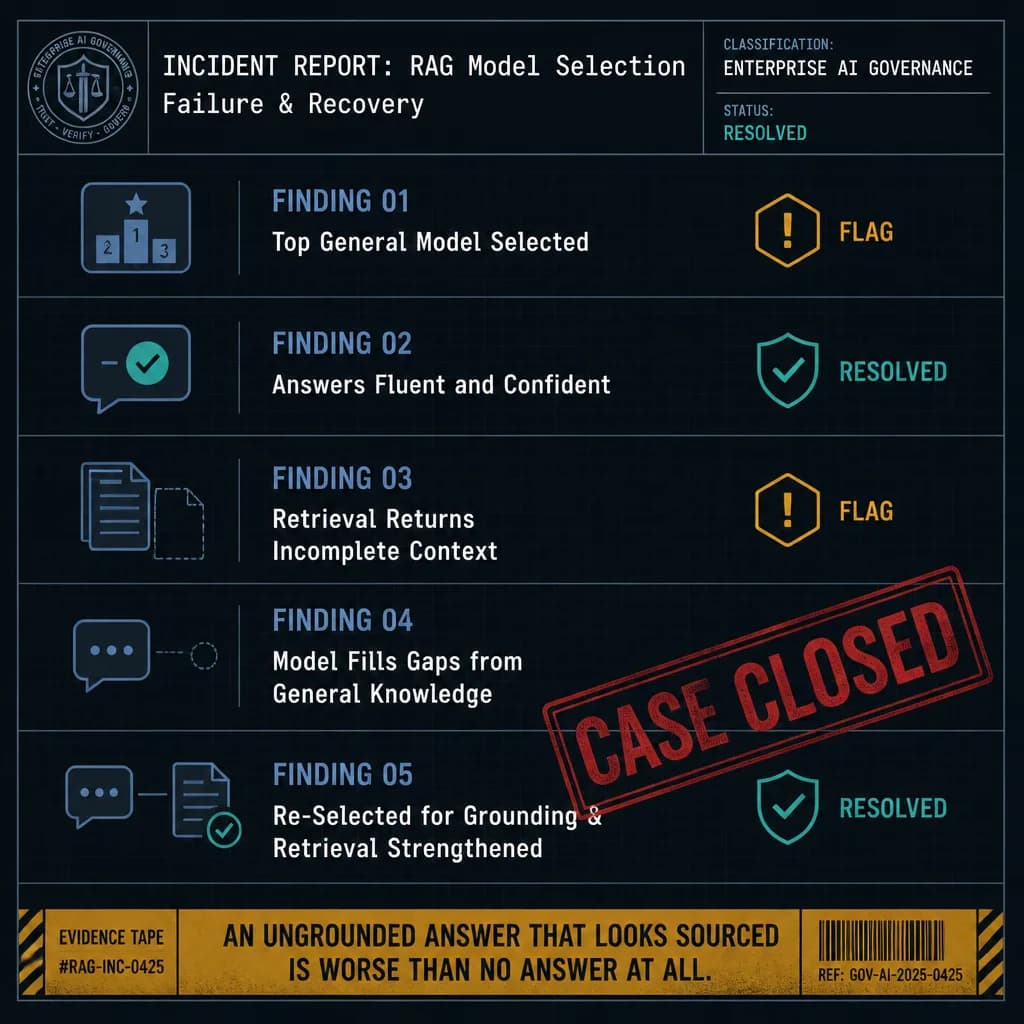
A team built a RAG system for an internal knowledge workload and selected the highest-scoring general model available, expecting strong results. The answers were fluent and often wrong in a specific way: when retrieval surfaced incomplete context, the model filled the gaps from its general knowledge, producing answers that read as authoritative and were not grounded in the organisation’s actual documents. In a system meant to answer from a trusted internal source, ungrounded answers that looked sourced were worse than no answer at all.
The model’s general capability had been beside the point. Its behaviour on insufficient context was wrong for RAG. The team re-evaluated candidates on their actual retrieval output, selected a model that stayed grounded and signalled when context was insufficient rather than fabricating, and strengthened the retrieval so the model was handed better context to begin with. Both fixes came from a retrieval-first view, and the general leaderboard would have led them to the same mistake again.
Selecting a RAG model by general capability is optimising a component whose general capability was never the constraint, and the fluent, ungrounded wrong answer is the failure that reveals the mistake, because it looks exactly like success until someone checks it against the source. RAG quality is made in retrieval first and in faithful grounding second, and a model chosen for brilliance it cannot apply within its retrieved context will disappoint no matter how it scores.
The teams that build RAG systems that work are the ones that evaluate retrieval before models, select for grounding and faithfulness over raw capability, and test candidates on their own retrieval output rather than a public benchmark. They set the grounding trade deliberately and keep the evaluation as a living asset. If you are choosing a model for a RAG system, the question worth asking before any capability comparison is how the candidate behaves when your retrieval hands it imperfect context, because that behaviour, and not its general score, determines whether your system produces answers you can trust and trace.
Related: Data Architecture
Tell us the number you need to move.
…outcomes that survive scrutiny.