Telematics and Usage-Based Insurance: The Data Pipelines Behind UBI Pricing
Usage-based insurance sells a simple, appealing idea to the customer: drive well, pay less, and let the way you actually drive determine your premium rather than a crude proxy like your age or postcode. Behind that simple promise sits one of the most demanding data problems in insurance. Every priced customer generates a continuous stream of telematics data from their vehicle or phone, and that stream has to be collected, cleaned, interpreted, and turned into a driving score that directly sets a premium, reliably, for every customer, all the time. The pricing model gets the attention, and the data pipeline is what actually determines whether UBI works, because a driving score built on bad data prices customers wrongly and a pricing decision resting on a broken pipeline is a fair-pricing failure the insurer owns. Telematics and usage-based insurance depends far more on the integrity of the data pipeline than on the sophistication of the scoring model.
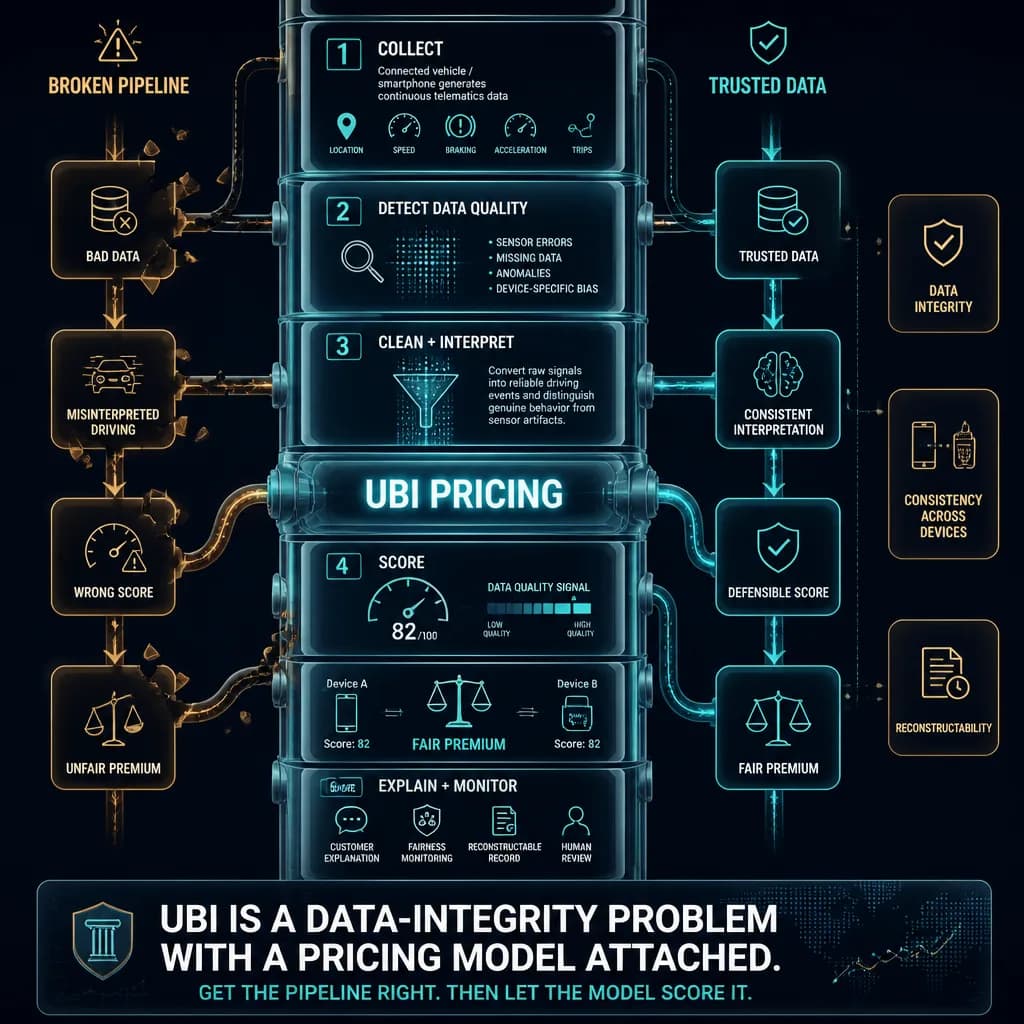
The mistake is treating UBI as a pricing-model problem with a data feed attached. It is a data-integrity problem with a pricing model attached, and the failures that hurt customers and expose the insurer almost all originate in the pipeline rather than the model.
The constraint that owns the workflow
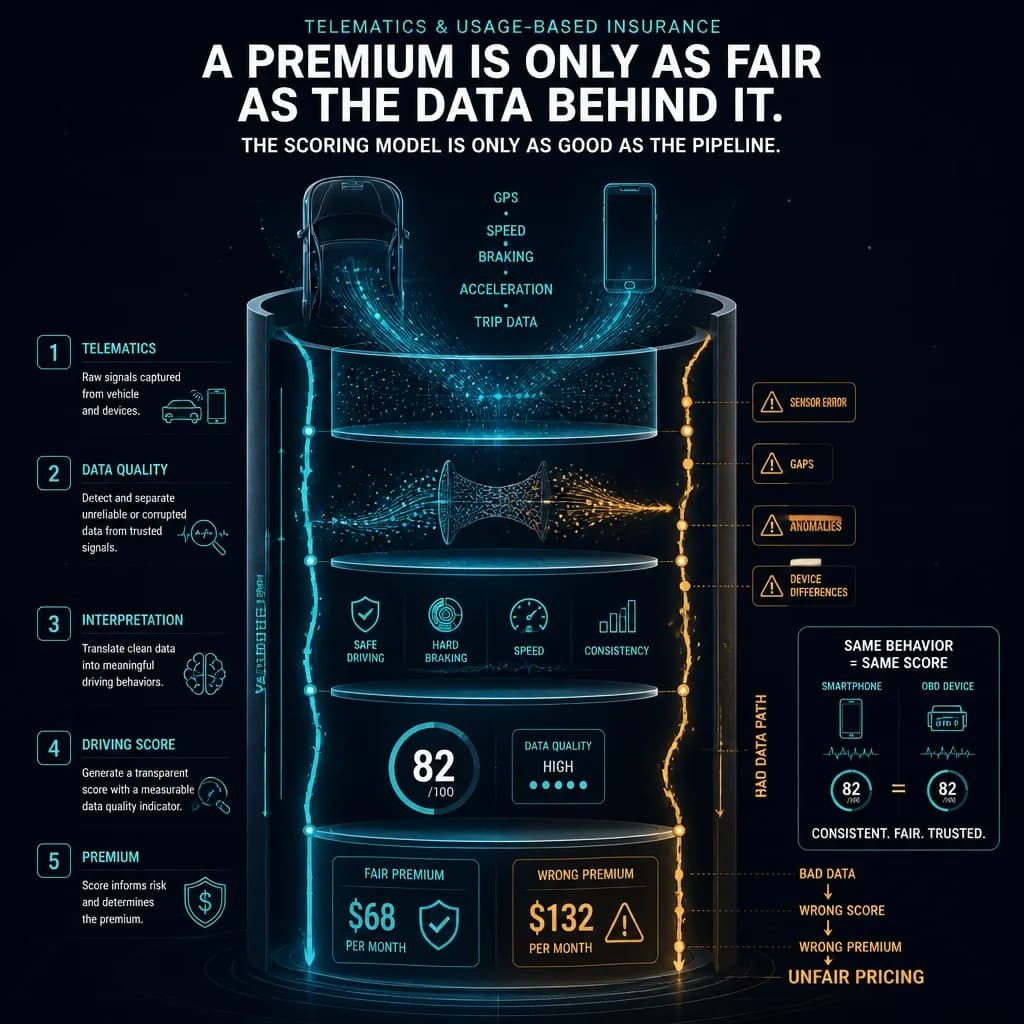
UBI pricing sits under obligations that make data integrity a regulatory concern. Insurance pricing must be actuarially justified and not unfairly discriminatory, and when the premium is driven by a telematics-derived score, the data producing that score has to be accurate and the scoring has to be defensible, because a customer’s premium depends on it directly. The data collected is personal and often sensitive, including location and behavior, so it carries data-protection obligations around consent, purpose, and retention that shape what the insurer can collect and how it can use it. Pricing decisions have to be explainable to the customer, so the insurer has to be able to tell a customer why their driving produced their premium. And the pricing basis has to be reconstructable, so the insurer can defend that a premium was set fairly on accurate data.
The failure modes are pipeline failures with pricing consequences. Bad data producing a wrong score, where sensor error, gaps, or misinterpretation lead to a driving score that misprices a customer. Inconsistent data quality across customers, where the pipeline works well for some vehicles or devices and poorly for others, so pricing accuracy silently varies by the equipment a customer happens to have. And the fairness failure, where data quality or interpretation differs systematically across customer groups, importing unfairness into pricing through the pipeline rather than the model.
The position: the pipeline is the product
Here is the stance I would hold against the model-centric framing. In UBI, the data pipeline is the product, and the scoring model is a relatively small component sitting on top of it. The hard, value-determining, risk-carrying work is collecting telematics reliably, cleaning it correctly, handling the gaps and errors honestly, and interpreting driving behavior consistently across every customer, vehicle, and device. A brilliant scoring model fed by an unreliable pipeline prices customers wrongly, and the wrongness traces to the data, not the model. Get the pipeline right and a straightforward scoring model prices fairly. Get the pipeline wrong and no model can save the pricing.
The reasoning is about where UBI actually breaks. Telematics data is messy in ways that directly corrupt scoring. Sensors drift and fail, connectivity drops leave gaps, a phone in a passenger’s pocket records driving the customer did not do, a hard-braking event might be a genuine near-miss or a sensor artifact, and a trip might be missing entirely. Every one of these is a data-quality problem that, if handled badly, produces a driving score that misprices a real customer, and the customer has no idea their premium rests on a misread sensor. The interpretation layer, deciding what the raw data means about driving behavior, is where fairness lives or dies, because inconsistent interpretation across devices or customer groups prices people unfairly through no fault of their own. So the engineering has to concentrate on pipeline integrity, because that is what determines whether the premium is fair, and the model is the easy part.
Engineering inside the constraint
The pipeline is built for reliability and honesty about its own quality. Data collection is instrumented to detect sensor errors, gaps, and anomalies, so the system knows when the data underlying a customer’s score is degraded rather than silently scoring on bad input. Cleaning and interpretation handle the ambiguities explicitly, distinguishing genuine driving events from artifacts where possible and, where the data is too poor to score reliably, treating that as a condition to handle rather than a number to fabricate. A driving score should carry a signal of the quality of the data behind it, so a score built on sparse or degraded data is not treated with the same confidence as one built on clean data.
Consistency across customers, vehicles, and devices is engineered and monitored, because pricing accuracy that varies by equipment is unfairness the insurer owns. The interpretation of driving behavior has to be consistent, so the same driving produces the same score regardless of the device recording it, and the system is monitored for quality differences across groups that would import unfairness into pricing. Managing this continuous, high-volume, error-prone data flow reliably is exactly the kind of end-to-end pipeline work a self-healing process automation layer like FORGE is built to carry, detecting and handling the data-quality breaks that would otherwise flow silently into pricing.
Every driving score and the data behind it are written to a reconstructable record, so the insurer can explain to any customer why their driving produced their premium and defend that the pricing rested on accurate data. The data-protection obligations are engineered in, with consent, purpose limitation, and retention governed rather than assumed. The scoring and its fairness across groups are evaluated against an explicit standard, operated repeatably as the pipeline and model change, which is the work a rubric-based evaluation engine like PRISM is built to carry. Human oversight handles the disputes and the edge cases, so a customer who challenges their score reaches a person who can examine the data behind it.
Where it almost broke
An insurer launched a UBI product with a sophisticated scoring model and priced customers on their telematics-derived driving scores. The model was sound and the product grew. A pattern surfaced in complaints and cancellations: a subset of customers were receiving poor driving scores and high premiums that did not match how they drove. Investigation traced the problem to the pipeline, where a particular category of device produced data with a systematic bias in how it recorded certain events, and the interpretation layer, tuned on the more common devices, was misreading that data as poor driving. The scoring model was working perfectly on the numbers it received, and the numbers it received for those customers were wrong, so it was confidently mispricing them.
The model was never the problem. The pipeline was interpreting data inconsistently across devices, and the inconsistency flowed straight into unfair pricing that the customers experienced and the insurer owned. The fix was in the pipeline, calibrating interpretation per device type so the same driving produced the same score regardless of equipment, adding data-quality detection so degraded or biased data was flagged rather than scored blindly, and monitoring pricing accuracy across device and customer groups. A UBI product that gets the model right and the pipeline wrong will misprice real customers, because the premium is only ever as good as the data underneath it.
Telematics and usage-based insurance can deliver the fair, behavior-based pricing it promises, rewarding good driving with lower premiums and giving customers a premium that reflects how they actually drive. That promise depends on the data pipeline far more than the scoring model, because the premium is only as fair as the data producing it, and the failures that misprice customers almost all originate in collection, cleaning, and interpretation rather than in the model. An insurer that invests in the model and neglects the pipeline has built sophisticated pricing on unreliable ground.
An insurer building a UBI product should ask how its pipeline handles bad data, inconsistent devices, and the quality differences that vary across customer groups, because that is where fair pricing is won or lost. A driving score built on data the insurer cannot vouch for is not an outcome that survives scrutiny.
Related: Banking & Financial Services · Reserve Bank Innovation Hub: Automated grievance workflows with natural-language access and a complete audit record · IndusInd Bank Limited: AI-Powered Knowledge Source-Based Process Training and Query Resolution
Tell us the number you need to move.
…outcomes that survive scrutiny.