The Best Coding Models for Software Teams: A Production Selection Guide
Selecting a coding model for a software team is usually done on the wrong evidence. Someone looks at coding benchmarks, picks the model with the highest score, and rolls it out, and the team’s experience with it turns out to have little to do with the benchmark that selected it. Coding benchmarks measure a model’s performance on defined coding problems, and a software team’s real work is not a set of defined problems. It is messy, contextual, embedded in a large existing codebase, and shaped by the team’s actual workflow, and the model that tops a benchmark is not necessarily the one that serves that reality best.
The gap between coding benchmark performance and coding usefulness in a real software team is wide, and it comes from the difference between the benchmark’s conditions and the team’s. A benchmark presents self-contained problems. A software team works in a large codebase with its own conventions, integrates the model into an existing workflow, and needs the model to be useful across the full range of its work, not just on the isolated problems a benchmark contains. Selecting on the benchmark optimises for conditions the team does not work in, and the selection guide that matters evaluates the model in the team’s actual conditions.
Benchmark performance is not team usefulness
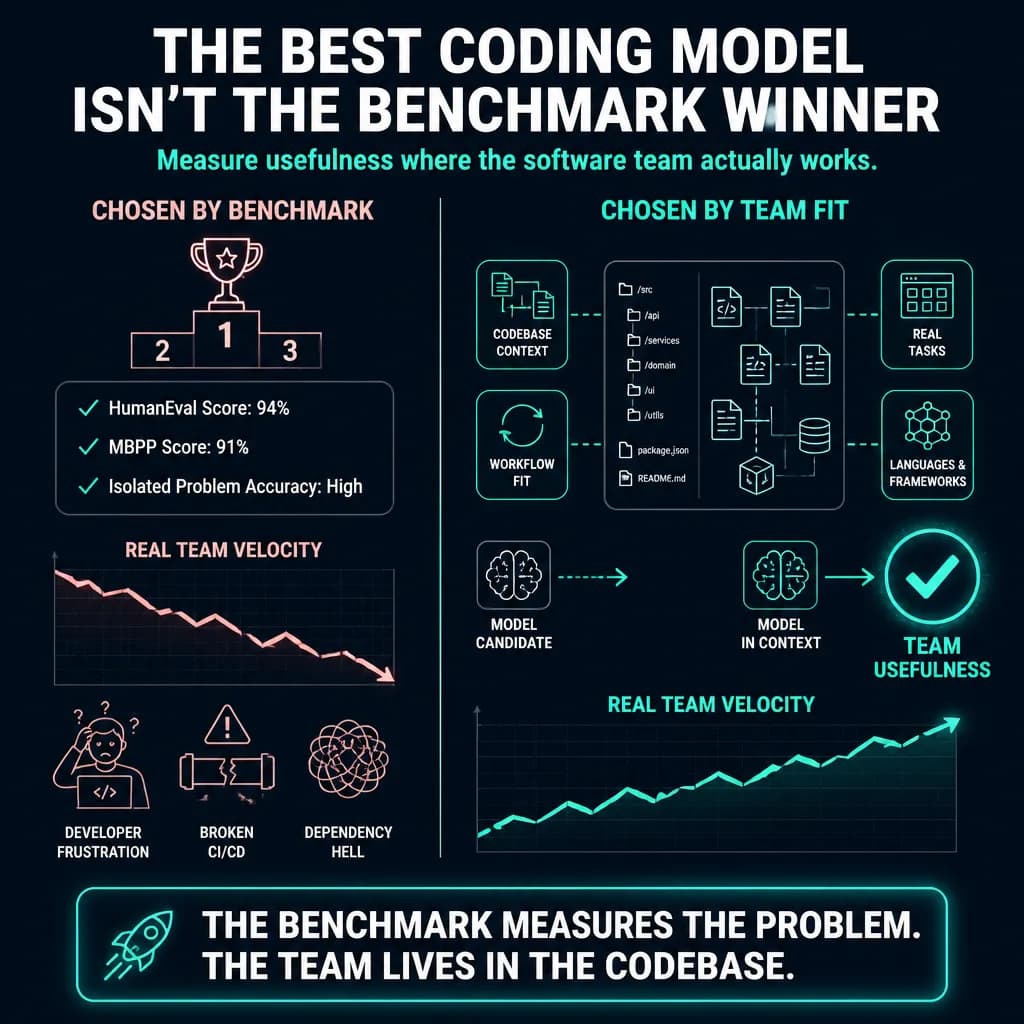
The first thing the guide establishes is that a coding model’s benchmark performance and its usefulness to a software team are different things. Benchmark performance measures the model on isolated coding problems under conditions designed to test capability. Team usefulness measures how much the model helps the team do its actual work, in its actual codebase, within its actual workflow, and those conditions differ enough from the benchmark that the benchmark’s ranking does not reliably predict the team’s experience.
Seeing this distinction stops teams from selecting on the wrong evidence. The highest-scoring model on a coding benchmark is not automatically the most useful model for a given team, because the benchmark did not test the conditions that determine the team’s experience: the large codebase, the integration into the workflow, the range of real work. A production AI system for a software team is selected on team usefulness in the team’s conditions, and the coding benchmark, measuring isolated problems, is a filter at best and a misleading selector at worst.
What actually determines coding usefulness
Here is the position worth holding. A coding model’s usefulness to a team is determined more by how it performs in the team’s actual codebase and workflow than by its benchmark score, and a model that scores well on isolated problems but handles a large real codebase poorly is less useful than a model that scores modestly and works well in the team’s real conditions. The benchmark measures the isolated problem, and the team lives in the codebase, and the codebase is where usefulness is decided.
The factors that determine coding usefulness are the ones the benchmark does not test. How well does the model work with a large existing codebase, understanding its context and conventions rather than treating each problem as isolated? How well does it integrate into the team’s workflow, fitting how the team actually works rather than requiring the team to work around it? How does it perform across the full range of the team’s work, the routine and the hard, rather than just on benchmark-style problems? How does it handle the team’s specific languages, frameworks, and patterns? These determine whether the model helps the team, and a governed AI deployment for coding evaluates them in the team’s conditions, because they, not the benchmark, predict the team’s experience.
Evaluate in the team’s real conditions
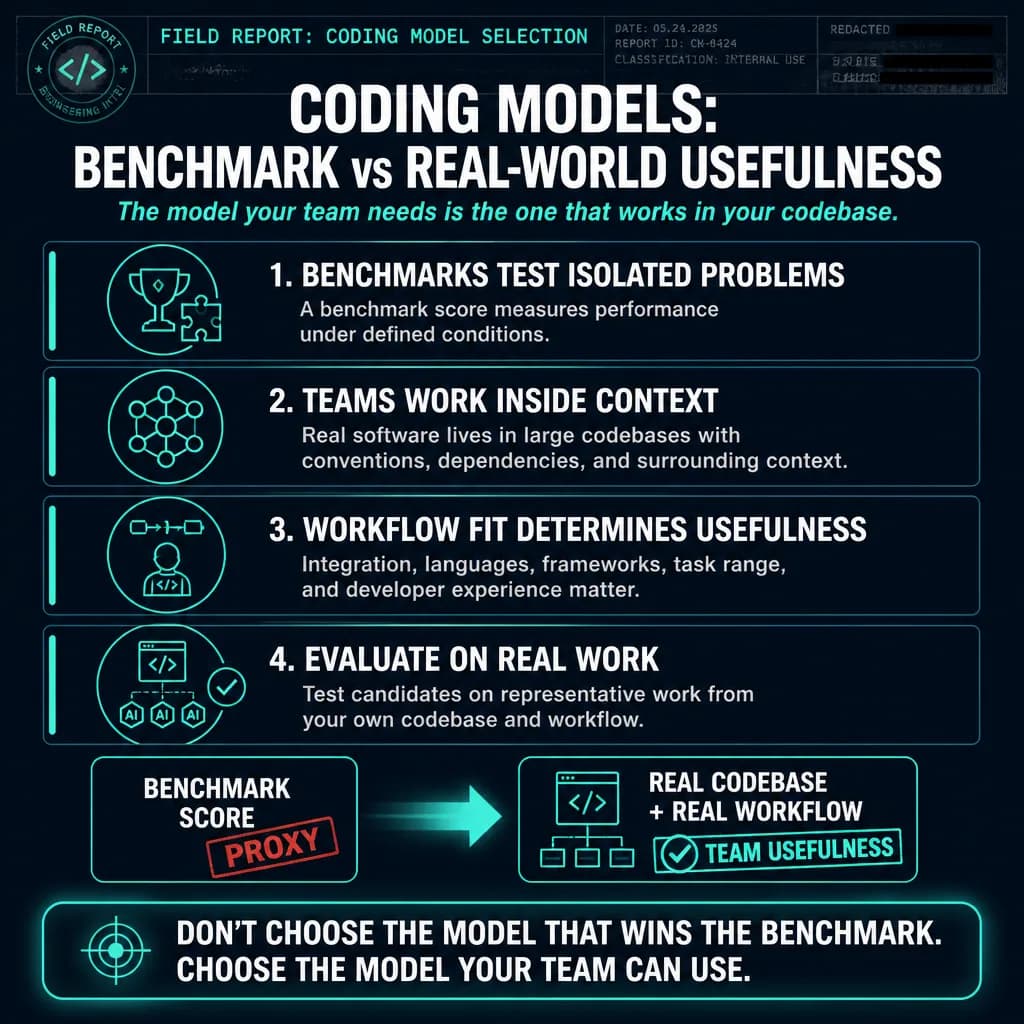
The selection guide’s core method is to evaluate candidate models in the team’s actual conditions, not on benchmarks. Give the candidates real work from the team’s codebase, in the team’s workflow, and assess how useful each one actually is, which measures the thing that matters rather than a benchmark proxy for it. This is more work than reading benchmark scores, and it is the work that produces a selection the team’s experience will validate rather than contradict.
This evaluation catches what benchmarks miss. It shows how each model handles the team’s real codebase and its context, how well it fits the workflow, how it performs across the range of real work. The evaluation also surfaces the team’s own preferences and friction, which matter for adoption, because a model the team finds useful and pleasant to work with gets used and one they find frustrating gets abandoned regardless of its benchmark score. Owning the selection means evaluating in the team’s conditions, because that is where coding usefulness lives and where the benchmark cannot reach.
The trade-off worth naming
Evaluating models in real conditions costs more effort than reading benchmarks, and skipping that effort to select on benchmarks risks a model that scores well and serves the team poorly, which costs far more than the evaluation would have. The trade is real: the evaluation takes time and access to real work, and it produces a selection grounded in the team’s actual experience rather than a benchmark proxy. For a coding model, which the team will use daily across its work, the evaluation effort is small against the cost of deploying a model that benchmarks well and frustrates the team, and skipping it to save the effort is a false economy the team pays for every day.
Where the selection almost broke
A team selected a coding model on the strength of its leading coding benchmark scores, expecting strong results. In practice, the model struggled with the team’s large existing codebase, treating problems in isolation rather than understanding the surrounding context and conventions, and the team found it produced code that scored well on isolated correctness and fit poorly into their actual system, requiring rework to integrate. The benchmark had measured isolated problems, and the team worked in a codebase, and the model was better at the former than the latter.
The benchmark had selected on the wrong evidence. The team re-evaluated candidates on real work from their codebase, in their workflow, and selected a model that handled their codebase’s context well even though its benchmark ranking was slightly lower. The team’s experience improved, because the model now fit the conditions they actually worked in. The benchmark would have led them to the same mistake, because it never tested the codebase that determined usefulness.
Selecting a coding model on benchmarks optimises for conditions the team does not work in, and the team’s daily experience, in a real codebase and a real workflow, is where the selection is validated or contradicted. The benchmark measures the isolated problem, and the team lives in the codebase, and a model that is good at the former and poor at the latter will disappoint the team no matter how it scores.
The teams that select coding models well are the ones that evaluate candidates in their own conditions, on real work from their codebase and within their workflow, rather than on benchmark scores. They weigh how the model fits the team’s reality above how it ranks on isolated problems, and they account for the team’s own experience of working with it. If you are selecting a coding model for a software team, the question worth asking is not which model tops the coding benchmark but which one is most useful in your actual codebase and workflow, because that usefulness, and not the benchmark, is what the team will live with every day.
Related: Data Architecture
Tell us the number you need to move.
…outcomes that survive scrutiny.