The Cost of a Missing Field: Engineering Complex Application Journeys That Complete
The application looks finished. The user has spent fifteen minutes on it, entered dozens of fields, uploaded documents, and reached the final screen. Then a validation error fires on something entered six steps back, the form cannot submit, and a meaningful fraction of users simply leave. Every abandoned application at that point represents real acquisition cost already spent and a customer who wanted the outcome badly enough to start. The cost of a missing field is not the field. It is the entire journey that collapses because one requirement went unmet, and in regulated onboarding that cost is measured in lost customers and stalled revenue.
If you own a complex application journey, whether that is account opening, loan origination, insurance underwriting, or any multi-step submission, completion rate is the number that governs the economics. The reasoning is straightforward and the consequences are not. Long forms with many interdependent requirements have completion rates that would alarm anyone who looked closely, and most of the loss happens not because users lacked intent, but because the journey made it too hard to supply everything correctly before something broke.
Why complex applications fail to complete

The failure is structural, and it compounds with length. Every field a user must complete is a point at which they can stall, make an error, or abandon, and a long application stacks dozens of these points in sequence. Interdependencies make it worse. One answer determines which fields appear later, a document requirement depends on a selection made earlier, and eligibility for one section is gated by another, so the user is navigating a dependency graph they cannot see, guessing at what the form will demand next.
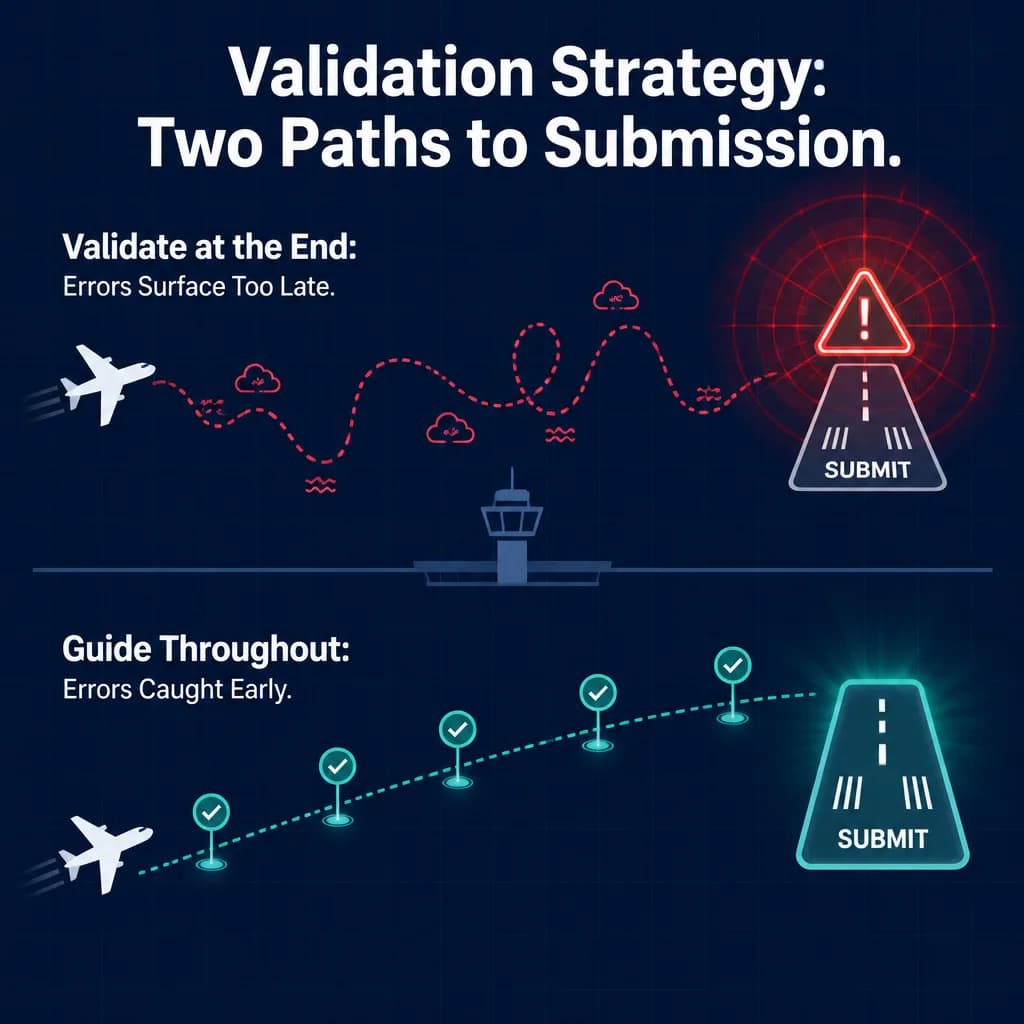
The most damaging pattern is the late-surfaced error. A requirement missed early stays invisible until the user reaches submission, and only then does the system reveal that something six steps back was wrong or incomplete. The user now has to find their way back, remember context they have lost, and fix a problem the system knew about long before it told them. In regulated onboarding this is routine, because the requirements are extensive and often conditional, and each unmet one is a wall the user hits at the worst possible moment. Errors discovered at the end cost far more than errors caught at entry, and a journey that batches its validation to the final screen is engineered, unintentionally, to lose people right before the finish.
The shift from validating late to guiding throughout
The correction is to move quality from the end of the journey to every point along it. Rather than collecting everything and validating at submission, the journey validates and guides continuously, catching each requirement at the moment it is entered and surfacing what is needed before the user moves past it. This is the same principle as establishing input integrity at the point of entry, applied across a long multi-step journey rather than a single intake.
Guidance is the active half. The journey should make the path visible: what is required, what has been completed, what remains, and what specifically is needed for the current step. When a requirement depends on an earlier answer, the journey should surface that dependency when it becomes relevant rather than letting the user discover it at the end. When a field has a known valid set, the interface should constrain to it so an invalid entry is hard to make. The engineering work is in mapping the full requirement structure of the application, including its conditional branches, and then shaping the journey so the user is guided through exactly the path their situation requires. This is the class of problem our LOUPE guided form-filling co-pilot is engineered around, turning a static form that validates late into a journey that steers the user through completion.
The document problem, and validating what cannot be typed
Complex applications rarely consist only of typed fields. They require documents, and documents are where completion quietly dies, because a user who has finished every field can still be blocked by an upload that is wrong, illegible, expired, or the wrong type entirely. Traditional forms accept the upload and validate it later, sometimes days later in a manual review, which means the user completes the application, believes they are done, and then learns after the fact that a document was rejected and the process has stalled.
Validating documents at the point of upload changes the economics of the journey. If the system can check at upload time that a document is the right type, is legible, and contains what the application requires, the user can correct it while they are still present and engaged, rather than being pulled back into an abandoned process later. This is where agentic capability earns its place in the journey, extracting and checking document content in the moment rather than deferring it to a downstream queue. The trade-off is real: in-the-moment document validation is more engineering and more compute than accepting a file and checking it later. What it buys is the difference between a user who corrects a document while present and a user who has already left by the time the problem is found.
The upload step that ended the application
We operated a complex onboarding journey with a completion rate that told a clear story: a large share of users who started never finished, and the drop-off clustered near the end. The traces showed the pattern plainly. Users were reaching the final submission and hitting validation errors on requirements from much earlier in the journey, then abandoning rather than navigating back to fix them. The application was well-built in every respect except the one that mattered, which was guiding people to complete it.
The fix moved quality forward across the whole journey. We made the requirement path visible, so users could see what was needed and what remained rather than discovering it at the end. We validated each step at the point of entry, so an error surfaced immediately where it could be fixed cheaply. We added document validation at upload, so a wrong or illegible file was caught while the user was still there. And we surfaced conditional requirements when they became relevant rather than batching them to submission. Completion rate rose substantially, and the gain came almost entirely from users who previously would have abandoned near the finish. The intent had always been there. The journey had been losing it.
Completion is a property you engineer
The lesson that survives every onboarding deployment is that completion is a property you engineer into the journey. Hoping users reach the end is a plan with no mechanism behind it. The cost of a missing field is the entire application it collapses, and that cost is paid in customers who had the intent to finish and were defeated by a journey that told them too late what it needed.
The teams whose complex applications complete are the ones who stopped treating the form as a container to fill and validate at the end, and started treating the journey as something that actively guides a person through to submission, catching every requirement at the moment it can be fixed cheaply. A user who wanted the outcome and abandoned near the finish is the most expensive kind of failure, because everything was spent and nothing was gained. Guiding them through, step by step, requirement by requirement, is what turns intent into completion.
Related: Agentic AI
Tell us the number you need to move.
…outcomes that survive scrutiny.