The Model Context Protocol: Standardising Tool Access, and What It Costs
Connecting an agent to tools has been a bespoke effort, each tool integrated into each agent through custom work, and the Model Context Protocol standardises it, providing a common way for agents to access tools. Before a standard, every tool an agent uses is a custom integration, and the effort of integrating tools multiplies across the tools and the agents, which does not scale. The Model Context Protocol standardises tool access, replacing the custom integrations with a common protocol, and understanding what it standardises and what it costs is what lets you decide whether and how to adopt it, because the standardisation provides real benefits and carries real costs. The standard is a set of trade-offs, the benefit of standardised tool access against the costs of adopting the standard.
If you build agents that use tools, the tool integration is a significant effort, and standardising it with a protocol reduces that effort by replacing custom integrations with a common standard, at the cost of adopting and depending on the standard. The standardisation provides the benefit of reusable, consistent tool access, and it carries the costs of conforming to the standard and depending on it, and understanding both is what lets you make a sound decision about adopting it. Understanding what the Model Context Protocol standardises and what it costs is what lets you evaluate it rather than adopt it on the promise of standardisation.
What the protocol standardises
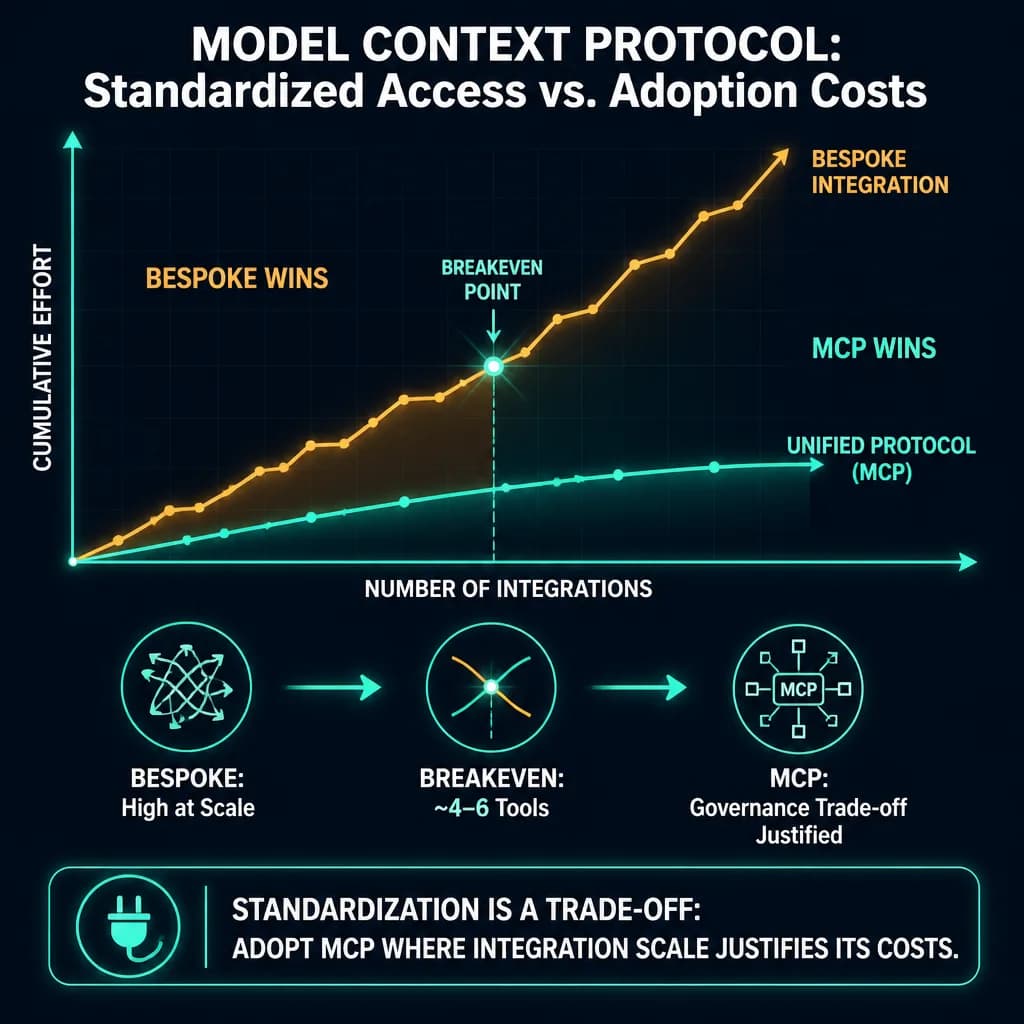
The Model Context Protocol standardises how agents access tools, providing a common protocol that agents and tools implement, so that a tool implementing the standard is accessible to any agent implementing the standard without custom integration. This replaces the bespoke integration, where each tool is integrated into each agent through custom work, with a standard integration, where a tool implemented once to the standard is accessible to any agent that speaks the standard, which is the benefit the protocol provides. The standardisation reduces the integration effort, because a tool integrated once to the standard is reusable across agents rather than requiring custom integration per agent, and the effort of tool access scales with the standard rather than multiplying across the tools and agents.
This standardisation matters because tool integration effort multiplies without a standard, and the standard reduces the multiplication. Without a standard, integrating a set of tools into a set of agents is a custom integration per tool per agent, which multiplies the effort, and with the standard, integrating a tool once to the standard makes it accessible to all the agents, which reduces the effort to integrating each tool once. This is the standardised tool access that the protocol provides, reusable and consistent, replacing the bespoke integration that does not scale. The protocol standardises tool access by providing a common protocol that makes tools reusable across agents, which reduces the integration effort that multiplies without a standard, and this reduction is the benefit the protocol provides.
What the protocol costs
Adopting the Model Context Protocol carries costs that the benefit of standardisation obscures, and understanding them is what lets you evaluate the adoption. Adopting the standard means implementing it, conforming your agents and tools to the protocol, which is engineering effort and a constraint, because conforming to the standard constrains how your agents access tools to the standard’s approach. The standardisation’s benefit comes with the cost of conforming to the standard, which is effort to implement and a constraint on how you build, and this cost is part of the adoption that the benefit of reusable tool access does not eliminate.
Adopting the standard also creates a dependency on it, because your tool access now depends on the standard, its evolution, and its ecosystem, which is the lock-in that adopting any standard creates. A dependency on the standard means your tool access is tied to the standard’s approach and evolution, and moving off the standard later has a switching cost, which is the dependency cost of adopting it. The standard also concentrates the tool access into a governance-critical layer that has to be governed, because standardised tool access is a point through which agents reach tools, and governing that access is a cost the standardisation introduces. The protocol costs the effort of conforming to it, the dependency on it, and the governance of the access it concentrates, which are the costs of the standardisation that the benefit of reusable tool access obscures, and understanding them is what lets you weigh the adoption.
The trade-off, and adopting deliberately
Adopting the protocol trades the costs of the standard for the benefit of standardised tool access, and naming that trade-off keeps the adoption deliberate. The benefit, reusable and consistent tool access that reduces the integration effort, is real where you integrate enough tools across enough agents for the standardisation to pay off, and the costs, conforming to the standard, depending on it, governing the access, are real, so the decision to adopt should weigh the benefit against the costs rather than adopting on the promise of standardisation alone. An organisation that integrates many tools across many agents benefits from the standardisation enough to justify its costs, and one that integrates few tools benefits less, so the adoption should match the actual integration need.
The deeper judgment is adopting deliberately based on whether the standardisation is worth its costs for your situation, because the benefit depends on the scale of your tool integration, which not every situation has. A situation with extensive tool integration across many agents benefits from the standard enough to justify adopting its costs, and a situation with limited tool integration may not, adopting the standard’s costs for a standardisation benefit that its limited integration does not need. Adopting deliberately, based on whether the scale of your tool integration justifies the standard’s costs, and understanding the conforming, dependency, and governance costs, is what makes the adoption decision sound. The protocol’s standardisation is valuable where the tool integration scale justifies it and a cost where it does not, and adopting it deliberately based on the actual need and understanding the costs is what gets the decision right. Weighing the benefit against the costs, and adopting where the integration scale justifies it, is what makes the protocol adoption deliberate rather than reflexive.

Where it almost broke
We saw an organisation consider adopting the Model Context Protocol on the promise of standardised tool access, attracted by the reduction in integration effort, and the consideration had focused on the benefit without weighing the costs of conforming to the standard, depending on it, and governing the access it concentrated. Examining it showed the organisation’s situation had a moderate tool integration need, and adopting the standard would have committed it to the conforming effort, the dependency, and the governance of the concentrated access, costs that its moderate integration need did not clearly justify, so adopting on the promise of standardisation risked taking on the costs for a benefit its situation did not fully need.
The correction weighed the adoption deliberately. We evaluated whether the organisation’s tool integration scale justified the standard’s costs, understanding the conforming effort, the dependency, and the governance the standard would require, and weighed these against the integration effort the standardisation would save. For the organisation’s situation, the standardisation was worth adopting for the parts of its tool integration that were extensive enough to benefit, while the parts with limited integration did not clearly justify it, so the adoption was matched to where the benefit exceeded the costs. The decision was sound because it weighed the standard’s costs against the benefit and matched the adoption to the actual need, rather than adopting on the promise of standardisation. The lesson was that the protocol standardises tool access and costs the conforming, dependency, and governance the standard requires, and adopting deliberately based on whether the integration scale justifies the costs is what makes the decision right.
Weigh the standard’s costs against its benefit
The reframe that makes protocol adoption sound is weighing the standard’s costs against its benefit rather than adopting on the promise of standardisation. The Model Context Protocol standardises tool access, reducing the integration effort that multiplies without a standard, and it costs the conforming effort, the dependency, and the governance of the access it concentrates, which are the costs the benefit of reusable tool access obscures. The standardisation is valuable where the tool integration scale justifies it and a cost where it does not.
The teams that make sound protocol decisions are the ones that weighed the standard’s costs against its benefit, evaluated whether their tool integration scale justified the costs, and adopted deliberately based on the actual need. The Model Context Protocol provides standardised tool access and carries the costs of conforming to the standard, depending on it, and governing the concentrated access, and adopting on the promise of standardisation without weighing the costs takes them on for a benefit the situation may not fully need. Weighing the standard’s costs against its benefit, and adopting where the integration scale justifies it, is what turns a protocol decision from a reflexive adoption of a promising standard into a sound judgment about whether the standardisation is worth its costs.
Related: Agentic AI
Tell us the number you need to move.
…outcomes that survive scrutiny.