What Is an AI Operator? The Category Built for the Work After the Demo
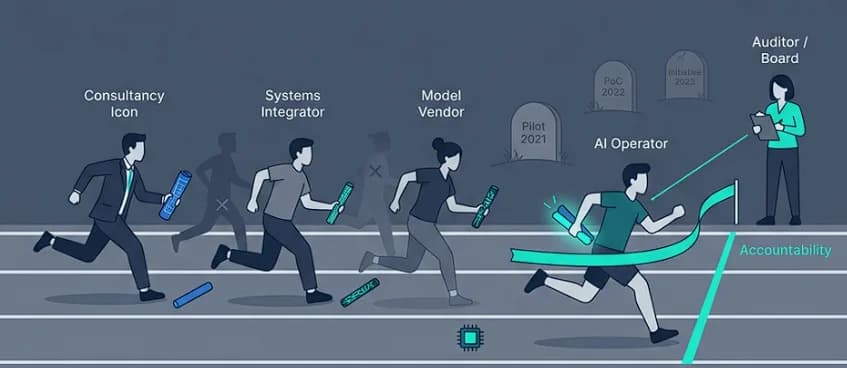
Every enterprise AI portfolio has a graveyard. A pilot that drew applause in the steering committee. A proof of concept a vendor demoed on a Friday and never mentioned again. A model that scored well in evaluation and then went quiet. Eighteen months later, no one in the room can say who owns it, whether it still operates, or what it would take to put it in front of a regulator. The capability was never in question. The ownership was.
If you have funded AI, you have probably funded at least one of these. The money cleared. The demo worked. The value never arrived. This is the problem an AI operator exists to solve, and it is worth being precise about what the term means, because the market has started using it loosely enough to mean nothing.
What an AI operator actually owns
The roles that grew up around enterprise AI are organised around the easy half of the work. A consultancy sells the thinking, bills for the strategy, and leaves before a line of it operates. A systems integrator assembles the components, bills for the wiring, and hands over a working pilot. A model vendor ships the capability and points you to the documentation. Each does real work. None of them is on the hook for what the system does at 2am on a Tuesday when it declines a loan and a customer asks why.
That gap is not an accident of execution. It is structural. The demo is where the cleanest, highest-margin, lowest-liability work ends, so that is where most of the market chooses to stop. Proving a model can do something is a contained problem with a satisfying finish. Standing behind what it does, every day, in front of people who can shut it down, is open-ended and uncomfortable. The first earns applause. The second earns trust, and almost nobody wants to carry it.
An AI operator is the party that carries it. We define the category by a single test: who answers for the outcome to an auditor, a regulator, or a board. The question is who is accountable when it is questioned, and advisory or integration work sits well upstream of that answer. By that definition, an operator engineers the system, operates it in production inside the enterprise, monitors it, corrects it, and stands behind the results it produces. The working system is the deliverable, and the deck is a means to it.
Why operating is a different problem from demonstrating
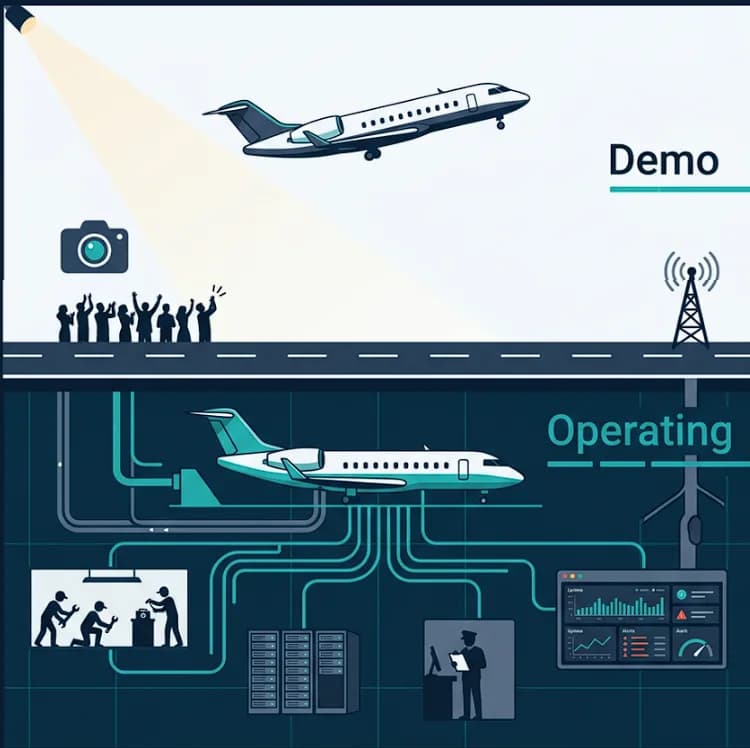
A demonstration proves a capability under conditions you control. Operating means holding that capability steady under conditions you do not. Consider the difference between a test flight and scheduled passenger service. Anyone with a competent pilot can fly the aircraft once for the cameras. Operating scheduled service means maintenance, dispatch, incident response, and a regulator who can ground the fleet on a finding. The aircraft is the same. The obligation is not.
The same gap separates a model that works in evaluation from a system an enterprise can depend on. Models drift as the world they were trained on moves underneath them. Inputs arrive in shapes no one anticipated. An interface upstream changes and a workflow that operated cleanly for months begins to fail in ways that are quiet until they are expensive. None of this shows up in a demo, because a demo is a single good operate preserved under glass. Operating is every pass after that, including the bad ones.
This is where governance, explainability, and human oversight stop being compliance language and become the actual machinery of the system. A decision a regulated business cannot explain is a decision it cannot defend, which means in practice it cannot make it at scale. So an operator designs the audit trail, the fallback path, and the point of human handover into the system from the start, because retrofitting them after the first incident is how good AI quietly dies in regulated sectors. They are load-bearing components of the architecture.
The trade-off, named
An operator is not the cheapest or fastest partner to engage, and pretending otherwise would be dishonest. A consultant gives you a strategy in weeks and a clean exit. An operator stays, which means a deeper engagement, a higher bar before anything ships, and a relationship that does not end at handover. You are buying accountability, and accountability is not a quick transaction. For a one-off internal tool with no audience and no consequence, that weight is not worth carrying, and you should not pay for it. For a system that makes decisions a regulator will examine, it is the only thing that matters.
Picture a lender trying to move document checks off manual review. The model is the easy part; a capable one can be stood up in a sprint. The hard part is the model-risk committee that will ask why a specific application was flagged, the audit that requires every decision to be reconstructable months later, and the failure mode where one unexplained output stalls the whole programme. An operator engineers for that committee before the committee meets. That is the work the demo skipped, and the reason the demo’s success told you so little.
The graveyard in your portfolio was not filled by bad models. It was filled by systems no one owned past the applause. The category exists for the work after the demo, because that is where enterprise value is actually won or lost, and where the discipline of operating AI in regulated environments earns its keep. The question worth asking of any AI partner is not whether they can demonstrate something impressive. It is whether they will still be answerable for it when you have stopped watching, and the people who can shut it down have started. That is the line between a model that works once and outcomes that survive scrutiny.
Related: About Us
Tell us the number you need to move.
…outcomes that survive scrutiny.