When the SOP Changes Every Week: Keeping Workforce Training Current
On Monday morning a revised procedure lands in the shared drive. A regulator has tightened a disclosure, or a product team has changed an eligibility rule, and the operations head signs off the new version before lunch. By Wednesday the frontline team is still following last month's process, because the module that teaches it took six weeks to script and approve. Updating training content with AI is usually pitched as a way to produce more courses faster. The harder problem is keeping what people learn in step with a procedure that keeps moving, and keeping a record behind every change that an auditor can follow.
Why a training library falls behind its own procedures
Most enterprise training is produced as a project. A subject expert explains the process, an instructional designer turns it into a module, a studio records it and compliance reviews the final version. That sequence makes sense for content that holds still for a year. It breaks down for procedures that change every few weeks, which in banking and insurance operations now describes a growing share of the rulebook.
The problem compounds with volume. An operations function with a few hundred SOPs, each revised a handful of times a year, produces a revision on most working days, and no production team can re-record at that cadence. The training library drifts behind the procedures it was meant to teach, one version at a time.
The gap has a cost that rarely appears on a dashboard. Staff learn the old rule and apply it with confidence. The error surfaces weeks later in a quality audit or a customer complaint, long after anyone remembers which version they were taught. Supervisors compensate with huddles and forwarded emails, which keeps people informed but leaves no record of who understood what. When a regulator asks how the institution ensured staff were trained on the revised process, a forwarded email is a weak answer.
Treating the approved SOP as the single source
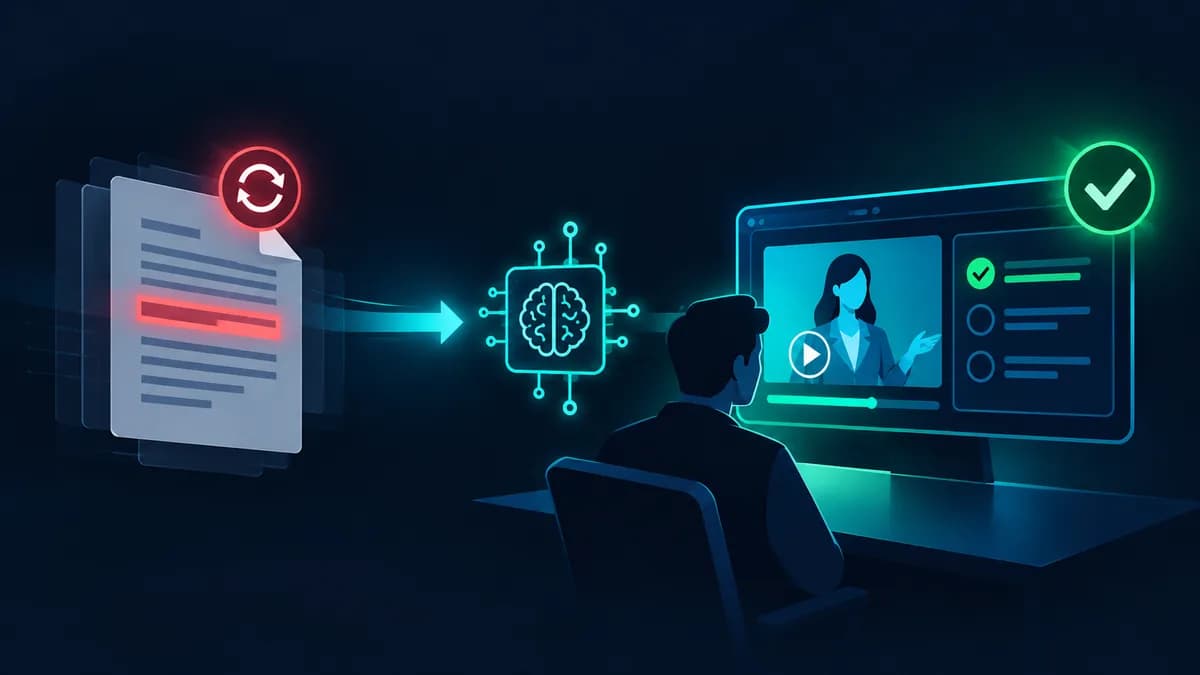
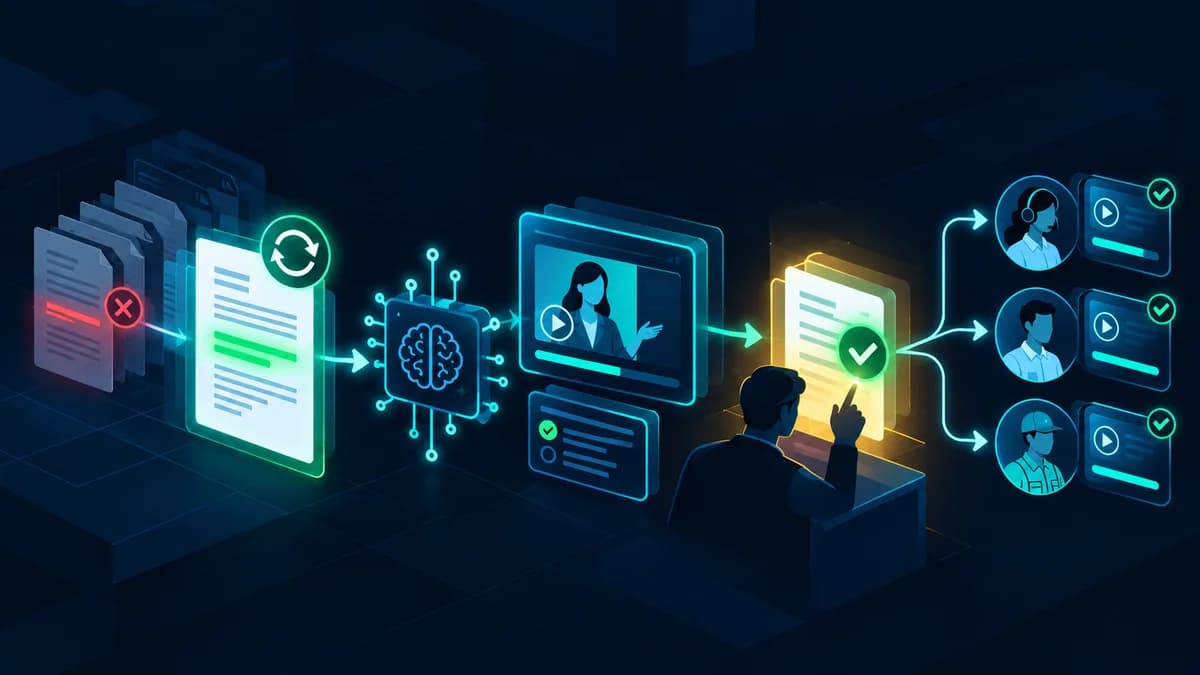
The workable pattern inverts the production model. The approved SOP becomes the single source, and every lesson and assessment is generated from it and versioned against it. When the document changes, the system identifies which sections moved and regenerates only the lessons those sections feed. The changed material then goes to the process owner for approval before any learner sees it.
Two engineering choices decide whether this holds up in production. The first choice is the granularity of each lesson. A lesson mapped to a whole forty-page SOP has to be regenerated every time a comma changes, which floods reviewers and teaches staff to ignore update notices. Lessons mapped to individual clauses change only when their clause changes, so a revision to a refund threshold produces one new three-minute lesson and leaves the other thirty untouched.
The second is the approval boundary. Generated content stays a draft until a named owner signs it off, and the sign-off is recorded against the SOP version it was checked against. That record turns a training system into evidence. For any employee, the institution can show which version they were taught and how they scored on the assessment that followed.
Format matters as much as freshness. A three-minute lesson delivered in the voice and likeness of the team's most trusted trainer gets watched on a shift break, while a forty-minute recorded module gets scheduled and postponed. Generating lessons from the latest approved SOP, and checking that each change landed, is the job ATLAS is engineered to do.
Assessing the change itself after every revision
After a revision, the useful question is narrow. Can the person at the counter apply the one rule that moved, in the situation where it applies? A full course completion says very little about that.
Targeted assessment answers the question with a handful of scenario questions or a short role-play drawn from the changed clause, sent only to the roles the clause affects. A collections agent receives the revised hardship script, while the branch cashier is left alone. Results flow back to the process owner by team and by question. A cluster of wrong answers on one question usually means the SOP itself is ambiguous, which is information the policy team needs as much as the training team does.
Language matters here more than it first appears. A revised rule taught in English to a team that works in Marathi or Tamil is technically delivered and practically missed. Lessons are generated in the languages the floor actually speaks, and assessed in the same language, so a wrong answer reflects the rule and never the translation.
The lesson that taught a superseded limit
An insurance operations team adopted generated lessons, and for the first two months the update cycle worked as designed. Then a revised claims SOP was uploaded while an earlier draft of the same document was still present in the source folder. The system ingested both versions without telling them apart. Lessons for the changed clause were generated from the draft, which carried a higher approval limit that legal had later removed.
The process owner approved the lesson because it matched what they remembered discussing. A full shift of claims handlers completed it before a quality reviewer noticed a claim approved above the correct limit. Nothing had reached a regulator, but the institution had trained its own staff on a rule it never adopted.
The correction went into the pipeline itself. Only documents carrying a published status and a version number can now feed lesson generation, and every generated lesson displays the SOP version it came from. The approver checks the lesson against a reference instead of against memory. Affected staff received a corrective lesson within the day, and the assessment record showed exactly who had been taught the wrong limit.
The Monday revision will keep arriving, and in regulated operations it arrives more often each year. Keeping pace means treating each lesson as a derivative of the procedure, versioned with it and approved against it, so a change to the rulebook reaches the floor in days with a record behind it. The question for any operations leader is easy to ask and uncomfortable to answer. If the SOP changed this morning, how long until every affected person has learned the new rule, and could you prove it to an auditor by name and by version? A training system that can answer both is how workforce readiness joins the outcomes that survive scrutiny.
Related: Agentic AI
Tell us the number you need to move.
…outcomes that survive scrutiny.