Why Enterprises Choose Es Magico to Operate AI in Regulated Environments
The fear that actually keeps a regulated buyer awake is not whether the model will be accurate. It is what happens on the day a regulator asks why a specific decision was made, and who is standing next to them when they have to answer. That moment is the real test of an AI partner, and almost nothing on a standard procurement scorecard predicts how it goes.
This is the quiet problem with how enterprises select AI for regulated environments. The criteria are inherited from software procurement: model accuracy, security certifications, reference calls, price. Each is necessary, and none of them measures the thing that matters in BFSI, healthcare, or government, which is how the partner behaves when something goes wrong in production under scrutiny. The scorecard measures the system at rest. The regulator inspects it under fire.
The standard criteria select for the wrong thing

A regulator does not audit your RFP. They audit the live system and the people behind it, often months after a decision was made. They ask you to reconstruct why one loan was declined, why one claim was flagged, why one clinical recommendation was surfaced, and to show the controls that governed it. That is a test of the operating system and the team accountable for it, and the accuracy figure you cited at selection sits well outside what is being examined.
This is why the conventional criteria mislead. A high benchmark score describes the model on a known set, and its behaviour on the long tail of real inputs sits well outside that description. A security certification describes a control environment, and whether a specific past decision can be explained sits well outside its scope. A glowing reference describes someone else’s deployment. All of them are real signals, and all of them go quiet at exactly the moment the regulated buyer cares about most. The evidence that predicts survival is harder to put on a scorecard, which is precisely why partners who look strong on paper keep failing in the room.
The questions that actually predict survival
A better selection process asks a different set of questions, and they are worth using against any partner, including us.
Who answers for a specific past decision, months later? If the partner will have left by then, accountability sits with a team that did not engineer the system and cannot fully explain it. That gap surfaces in the worst possible meeting. An operator who engineered the system is the one who can reconstruct the decision, because they built the trail that makes reconstruction possible.
Is governance designed in or retrofitted? Ask when explainability, audit logging, and human oversight were added. If the answer is “after the pilot” or “during hardening,” the controls are bolted on, and bolted-on controls are the ones that fail under examination. Build them in from the first decision or you are recovering them after an incident, which in regulated work is the same as not having them.
Is the outcome agreed and measured the same way before and after? A partner who will not commit to a number before the work is a partner who does not intend to be measured against one. The discipline of agreeing the measure up front is what rules out the vanity metric and keeps the system honest once it is live.
Does the partner know your sector’s actual constraint? The specific rule that governs the workflow, in place of the industry in general. The adverse-action requirement behind a credit decision. The filing deadline behind a suspicious-activity report. The handover protocol behind a clinical recommendation. The auditability mandate behind a public accreditation. Generic AI breaks on contact with these, because they are not edge cases in regulated work. They are the work.
Why these criteria point to an operator, and what it costs
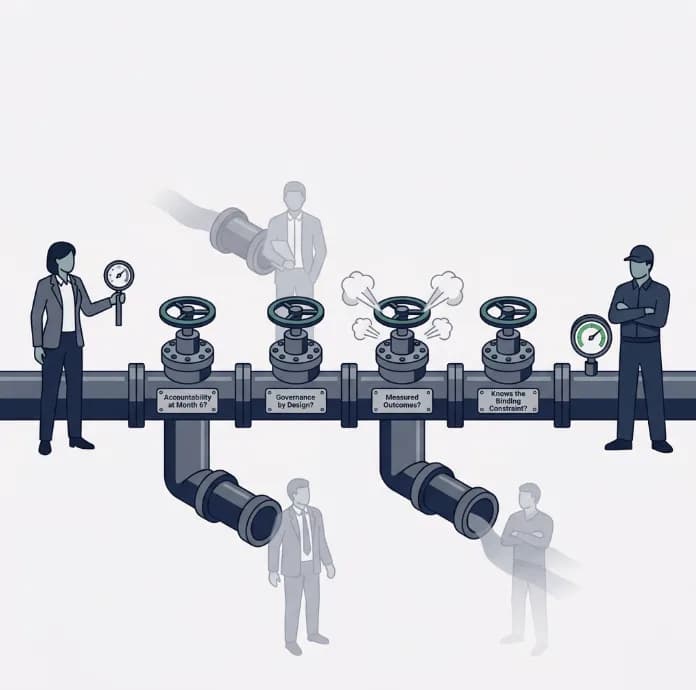
Notice that none of these questions is answered by a better model. They are answered by accountability, by governance engineered in, by a measured outcome, and by sector fluency. Those are the properties of an operator who operates the system in production, and they sit well outside the reach of a consultant who advises and leaves or an integrator who wires and hands off. The criteria do not favour us by accident. They favour the operator model because the regulator’s questions favour it.
This is not free, and pretending otherwise would fail the same honesty test we are describing. An operator costs more than a consultant and will not give you the clean handoff at go-live, because the absence of that handoff is the point. If your workload sits outside real scrutiny, you do not need this, and you should not pay for it. Where scrutiny is real, it is the only thing that holds up.
The evidence that we meet this bar is the company we keep in the hardest rooms. Our work spans the Reserve Bank of India and a banking sector that includes IndusInd Bank and HSBC, where every automated decision is built to be questioned. It spans Cipla and the Koita Foundation, where the stakes are patient safety and the most sensitive data an enterprise holds. It spans the Indian School of Business, where institutional standards and public accountability set the bar. These are organisations that operate under exactly the scrutiny the questions above are designed to surface.
Enterprises that operate AI in regulated environments do not choose us because of a benchmark or a certificate. They choose us because when the examination comes, the people who engineered the system are the ones in the room, accountable for what it produced and able to explain it. That is the difference the scorecard cannot capture, and it is the whole of what we stand behind: outcomes that survive scrutiny.
Related: About Us
Tell us the number you need to move.
…outcomes that survive scrutiny.