Why Most Enterprise Agent Pilots Never Reach Production
The pilot succeeds and the production deployment never happens, which is the common and frustrating outcome of enterprise agent pilots. An organisation builds an agent pilot, demonstrates it works, and then the pilot stalls, never making the transition to production, and this pattern repeats across enterprises often enough to be the norm rather than the exception. Why most enterprise agent pilots never reach production is a question with a consistent answer: the pilot proves the agent’s capability and skips the operational work that production requires, so the gap between the working pilot and production deployment is the operational engineering the pilot never did. The pilot succeeds at the easy part and stalls at the hard part, which is everything between a working demonstration and a production system.
If you build agent pilots, the pattern of pilots that succeed and never reach production is the pattern to understand, because it is not caused by the agents failing to work but by the pilots skipping what production requires. The pilot demonstrates capability, which is necessary and insufficient for production, and the operational work that production requires, the observability, governance, reliability, and the rest, is what the pilot skips and what its transition to production requires. Understanding why pilots stall is what lets you build pilots that can transition to production rather than pilots that prove capability and stall at the operational gap.
Why pilots succeed and stall

An agent pilot is designed to demonstrate capability, to show the agent can do the task, and it succeeds at this because demonstrating capability under controlled pilot conditions is the achievable part. The pilot operates on cooperative conditions, limited scope, and close attention, which are exactly the conditions that let capability be demonstrated without the operational work production requires, so the pilot proves the agent works without building the observability, governance, reliability, and evaluation that operating the agent in production requires. The pilot succeeds at demonstrating capability precisely because it skips the operational work, which is what makes the demonstration achievable in the pilot’s limited scope and attention.
The pilot stalls at production because production requires the operational work the pilot skipped, and that work is a substantial gap the pilot did not cross. Moving from a working pilot to production means building the observability to see the agent, the governance to operate it defensibly, the reliability engineering to survive production conditions, the evaluation to know it works, and the production readiness the agent needs, none of which the capability demonstration built. The pilot stalls because this operational gap is large, expensive, and different from the capability demonstration, and an organisation that has proven capability faces the operational work as a separate, substantial effort that the pilot’s success did not accomplish. The pilot succeeds at demonstrating capability and stalls at the operational work production requires, which is the gap between the working pilot and production that most pilots do not cross.
Why the gap is not crossed
The operational gap is often not crossed for reasons beyond its size, and understanding them is what lets pilots be built to cross it. The gap is invisible from the pilot, because the pilot’s success creates the impression that the agent is nearly ready, when the capability demonstration is a small fraction of the work production requires, so the organisation underestimates the remaining work and is surprised by its size. This is the same capability-versus-readiness confusion that governs agent deployment, where the impressive capability hides the operational work that readiness requires, and it causes pilots to stall because the organisation did not plan for the operational work the pilot’s success obscured.
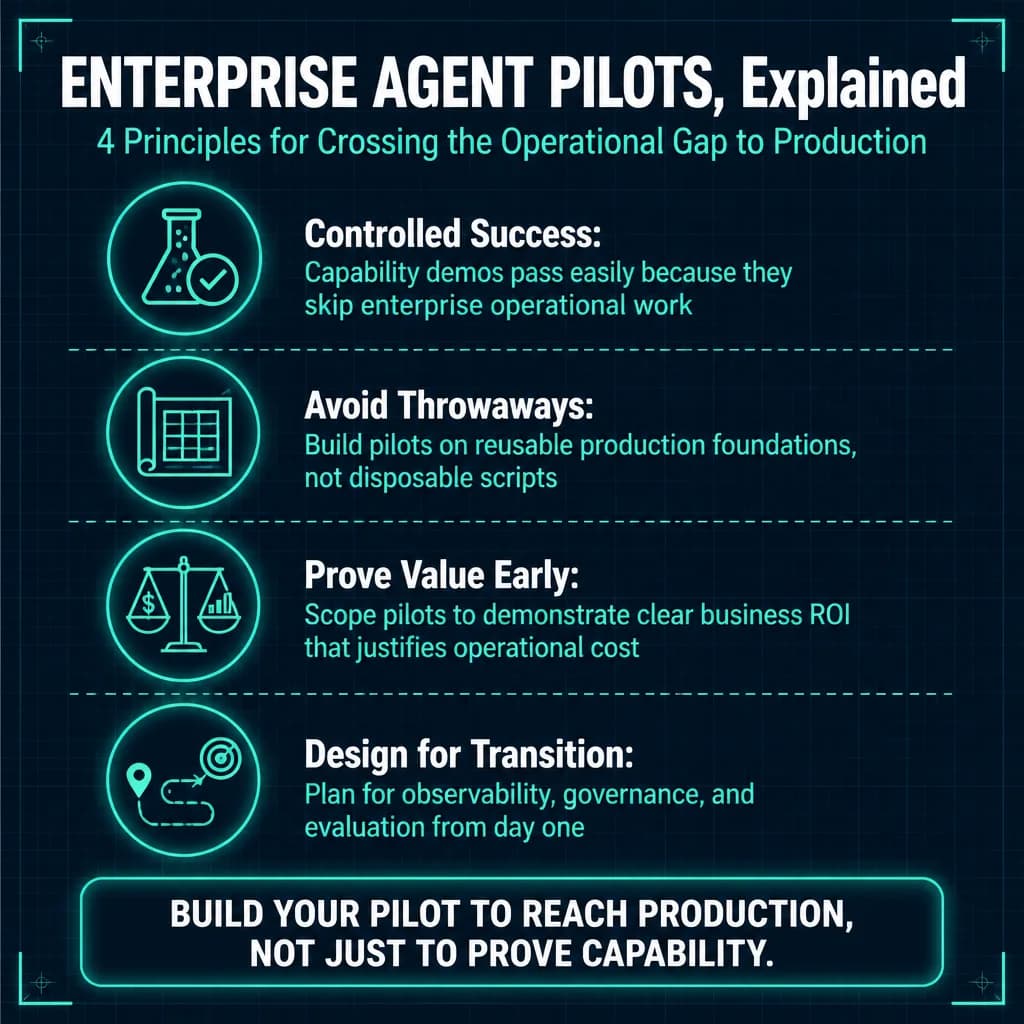
The gap is also often not crossed because the pilot was built in a way that does not support the transition, a throwaway demonstration rather than a foundation for production, so crossing the gap means substantial rebuilding rather than extending the pilot. A pilot built purely to demonstrate capability, without the operational foundations, is a pilot that has to be substantially rebuilt to reach production, and the cost of that rebuilding is part of why the transition stalls. And the gap is sometimes not crossed because the production performance or the ROI does not justify the operational investment, the pilot having demonstrated capability without demonstrating that the production deployment would be worth the operational work, so the organisation declines to cross the gap for an agent whose production value is unproven. The gap is not crossed because it is underestimated, because the pilot does not support the transition, and because the production value may not justify the operational investment, which are the reasons pilots stall at the operational gap that the capability demonstration did not address.
The trade-off, and building pilots that transition
Building pilots that can reach production requires more than building pilots that demonstrate capability, and naming that trade-off keeps the pilot approach realistic. A pilot built to transition to production, with the operational foundations that support the transition and a scope that proves production value, is more work than a pilot built purely to demonstrate capability, so building transition-ready pilots trades the additional pilot effort for the ability to reach production. This cost is justified when the goal is production, because the alternative, a pilot that demonstrates capability and stalls, has spent the pilot effort without reaching production, which is the wasted pilot the pattern produces.
The approach that gets pilots to production is designing them for the transition from the start, building the pilot on foundations that support production rather than as a throwaway demonstration, scoping the pilot to prove not just capability but the production value that justifies the operational investment, and planning for the operational work the transition requires rather than being surprised by it. This connects to the maturity progression, where the transition from pilot to production is the step from experimentation to operation that requires the operational work, and building the pilot to support that step is what lets it be taken. The deeper point is that the pilot’s purpose should be reaching production, not just demonstrating capability, which changes how the pilot is built, toward a foundation for production that proves the value and supports the operational work rather than a demonstration that stalls at the operational gap. Building pilots that transition, designed for production from the start and proving the value that justifies the operational investment, is what turns pilots from demonstrations that stall into steps toward production.
Where it almost broke
We saw an organisation with a pattern of agent pilots that succeeded and never reached production, pilot after pilot demonstrating capability and then stalling, never making the transition to production despite the agents working. Examining the pattern showed the cause: the pilots were built to demonstrate capability, skipping the operational work production required, so each successful pilot faced a large operational gap, observability, governance, reliability, evaluation, that the capability demonstration had not built, and the organisation, surprised by the size of the gap and unsure the production value justified the investment, let the pilots stall. The pilots were succeeding at the easy part and stalling at the operational work, which the pattern of demonstration-focused pilots reliably produced.
The correction changed how pilots were built. We designed the pilots for the transition to production from the start, building them on foundations that supported production rather than as throwaway demonstrations, scoping them to prove the production value that would justify the operational investment, and planning for the operational work the transition required. The pilots became steps toward production rather than demonstrations that stalled, because they were built to support the transition and proved the value that justified crossing the operational gap. The pattern of stalling pilots gave way to pilots that reached production, because the operational work was planned for and the pilots were built to support it. The lesson was that pilots stall at the operational gap the capability demonstration skips, and building pilots designed for the transition, proving the value and supporting the operational work, is what gets them to production.
Build the pilot to reach production
The reframe that gets agent pilots to production is building them for the transition from the start rather than as demonstrations that prove capability and stall. Why most enterprise agent pilots never reach production comes down to the pilots skipping the operational work production requires, so the gap between the working pilot and production is the observability, governance, reliability, and evaluation the capability demonstration did not build. The pilot succeeds at the easy part and stalls at the operational work that production actually requires.
The organisations that get agent pilots to production are the ones that built the pilots for the transition, on foundations that supported production, scoped to prove the value that justified the operational investment, and planned for the operational work rather than being surprised by it. A pilot built purely to demonstrate capability stalls at the operational gap the demonstration skipped, which is why the pattern of successful pilots that never reach production repeats. Building the pilot to reach production, designed for the transition and proving the value that justifies it, is what turns a pilot from a demonstration that stalls into a step that reaches production, which is the difference between proving an agent can work and operating it where it delivers value.
Related: Agentic AI
Tell us the number you need to move.
…outcomes that survive scrutiny.